Posted in 21st Century life, 21st Century parenting, data collecting, digital footprints, digital life, kids and privacy, online data collecting, parents and technology, privacy

How Photos & Data Collecting Take Away Our Privacy

Screen Shot 2016-05-22 at 6.54.28 PM
A bank of computers in a data center. Via Pixabay.

Finding good resources to help young people learn and understand more about data and photo collecting is key to building strong citizens in our 21st Century digital world. We adults can also learn a lot in the process.

Interestingly, no matter how we set privacy settings (stipulating who can see our images), the sites where we post and share continually accumulate information about us  — much, but not all, gleaned from the photos themselves.  Yes, it’s about digital footprints, but it’s much bigger than that.

One article we should read is Why Photos Are The Next Big Battleground in the Fight for Privacy, over at The Next Web news site. The report is chock full of interesting information about big data and how it zeros in on our photos. It also includes sobering statistics about the number of pictures that people share in sites like Facebook, Instagram, and Google. It’s good information to share with the digital kids in your family or school. Continue reading “How Photos & Data Collecting Take Away Our Privacy”

Posted in 21st Century Learning, 21st Century teaching, coding, digital learning, electronic toys, parents and technology, programming, robots, teaching

Teaching Kids to Code With Robots: Great New Yorker Article

Visit the Sphero website.

Check out the May 16, 2016 New Yorker for the article A Whole New Ball Game: The Rolling Robot That Teaches Kids to Code. Author D.T. Max, describes how Ian Bernstein and Adam Wilson invented the Sphero robot, and he explains how the ideas were conceived, how Sphero was designed, and the long process of promotion and sales. The article also includes explanations about how Sphero and other coding toys aim to help children develop 21st Century skills.

The comments from Sphero creators and from Paul Barberian, who became the first Sphero CEO, provide first-hand descriptions about working with and expanding ideas, connecting with a business incubator, and eventually starting a viable business. Max reminds readers about the Silicon Valley process — empathize, define, ideate, prototype, test — and how this process is crucial to the success of new inventions and in the schools where students use robot toys to solve problems. The article also includes thoughts from Barberian about how the business is considering expansion ideas, especially thinking about robots that develop personal attachments with their owners — what’s called adaptive personality.              Continue reading “Teaching Kids to Code With Robots: Great New Yorker Article”

Posted in 21st Century life, 21st Century parenting, cell phones, digital devices, digital kids, family conversations, parents and technology, screen time, teens and technology

Digital Devices & Parent-Teen Time Issues — New Research

Ne
Click here to visit the Common Sense Media research page and sign in for a larger and higher quality image.

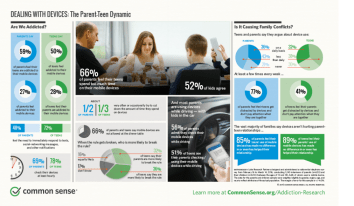
Check out the interesting new research just out from Common Sense Media about the issues and challenges when it comes to 21st Century digital kids and their mobile devices. The image depicts a range of statistics and device issues, collected via a poll of 1,200 parents and teens.

This infographic can be an excellent resource to use for family conversations about teens’ and children’s screen and digital device times (and adults’ times, too). It offers a range of information that can help parents discuss potential problems and concerns.

Continue reading “Digital Devices & Parent-Teen Time Issues — New Research”

Posted in 21st century job hunting, 21st Century life, anonymity, anonymous apps, apps, citizenship, conversations on commenting, cyber-bullying, digital citizenship, digital parenting, educating digital natives, family conversations, parents and technology

Teach Children About Anonymity Before They Make Mistakes

childing typingAnonymity presents digital kids with a complicated social obstacle — one they must confront and understand if they are to protect themselves from potential problems. Digital anonymity is not a friendly concept for growing children. I’d argue, in fact, that it’s downright dangerous, but app makers continue to offer the feature. For now these apps are a part of many digital kids’ daily lives, often negatively affecting their digital wellness.
No child with a connected device is immune from possible trouble caused by anonymity, because issues can arise in an instant, often as a part of routine online social interactions. Anonymous opportunities take advantage of kids’ developing brains, encouraging them to make public mistakes in judgment, and enabling young people, sometimes as young as third or fourth grade, to act and communicate with less and less restraint. A mistake made with an app’s anonymity feature can be hurtful or humiliating.

Continue reading “Teach Children About Anonymity Before They Make Mistakes”

Posted in 21st Century Learning, 21st Century parenting, 21st Century vocabulary words, cyber-bullying, digital citizenship, digital learning, digital life, digital parenting, kids and privacy, parents and technology

Building Habits of Privacy Into the Conversation & the Curriculum

21st Century Vocabulary Words — Privacy

Young people confuse privacy with safety.

While most kids carefully follow the rules that parents and teachers set out — no names, addresses, telephone numbers, or other personal information — when it comes to the big privacy picture, it turns out that many children understand very little about their personal data, how it accumulates, and how it affects privacy. (Check out my privacy links at the end of this post.)

Thus we need an alternate privacy teaching strategy that helps 21st Century kids — all ages really — understand how their digital-world data accumulates — even when users observe the all-important safety rules.

Bruce Schneier, a fellow at the Berkman Center for Internet and Society at Harvard Law School, writes about and consults on data and security, and his blog is Schneier on Security. In a 2010 post, A Revised Taxonomy of Social Networking Data, Schneier suggests how to classify data into six personal categories, the data generated as we use social media (and I’ll add other websites and games), and how all this data creates an individual’s digital profile. (Note: profile is another 21st Century vocabulary word).

Continue reading “Building Habits of Privacy Into the Conversation & the Curriculum”

Posted in 21st Century life, 21st Century parenting, citizenship, digital citizenship, digital health and wellness, digital parenting, parents and technology

Digital Kids & Parents Talk About Technology Rules

dig cit 2
Digital Citizenship Principle for Kids

A recent study, about parents, children and the technology rules that families adopt will be a terrific resource for schools and parent groups to share. Most parts of the research paper are fairly easy to read as are two articles, one from the University of Washington and the other from the University of Michigan. The research findings, with an extra focus on children’s expectations, are full of discoveries and observations that schools may want to share, almost word for word, with the parents of digital kids.

Alexis Hiniker and Julie A. Kientz at the University of Washington and Sarita Y. Schoenebeck at the University of Michigan conducted the study about digital life rules that parents make and enforce and the expectations that digital kids and their parents have of one another. A National Science Foundation research grant supported the academic work.

text drive dig cit 3 (1)
Digital Citizenship Principal for Kids

Interestingly, a few years ago I ask my students, after a year of working together, what messages they would give to their parents about the digital world and their parents’ roles. The answers these young people wrote down were so remarkable that I shared the children’s comments in a September 2013 blog post, and I’ve also included some of the posters that my students designed graphic depictions of the digital rules-of-the-road that parents and teachers expect them to uphold.                     Continue reading “Digital Kids & Parents Talk About Technology Rules”

Posted in 21st Century Learning, 21st Century life, 21st Century parenting, digital health and wellness, parents and technology

Building Habits of Moderation into the Conversation & the Curriculum

Screen Shot 2016-04-01 at 11.28.15 AM
21st Century Vocabulary Words — Moderation

When my brother and I were growing up in the Midwest, my dad had a big sign — about one foot by two feet — with the word MODERATION. The sign sat in the living room, just off the study, so that it was impossible to miss when we were watching television, reading, doing our homework, playing games, eating, and entering or leaving the house. Dad’s goal was for us to think as often as possible about self-regulating and managing what we did each day, even when we were even engaged in a favorite (or not so favorite) activity.

Understanding the importance of moderation is increasingly critical today as we live 21st Century lives that center on the media and on the digital devices that we — and our children — carry around all day long. Read an earlier post on moderation.

vocabulary 4
Check out other posts in this series.

You hear a lot these days about people eagerly pursuing their passions — which is great — but we don’t hear nearly as much about moderation. Understanding how to moderate and, yes, self-regulate daily activities is a digital world literacy skill for everyone at every age. For each child who cannot disconnect from Minecraft or other video games, there’s an adult, often a parent, who can’t put the phone down while taking a walk with kids or who uses the phone while driving. Everyone needs to learn how to moderate and disengage, and possessing these skills helps people develop digital strength and wellness.                                          Continue reading “Building Habits of Moderation into the Conversation & the Curriculum”