Posted in digital footprints, digital kids, family conversations, parent child conversations, parents and technology

How Many Digital Footprints Does Your Family Make?

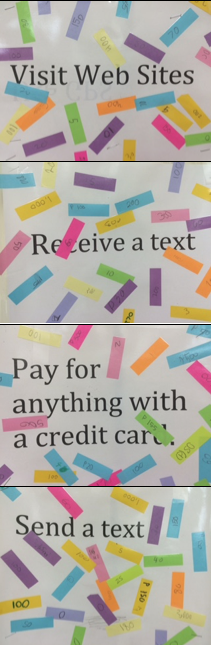
Screen Shot 2015-02-05 at 3.12.51 PMHave you ever thought long enough about digital footprints to imagine how many digital tracks family members or students make in a day or two?

Early in the school year fifth graders and their parents kept a short diary, estimating the footprints in a range of categories and then returned to school with the results. Footprints were estimated for sending texts, banking, receiving texts, purchasing groceries, cell phone calls, online banking, web sites, online purchases, and about a dozen more categories.

Continue reading “How Many Digital Footprints Does Your Family Make?”

Posted in parents and technology

Third Grade Good Things for 2015 Safer Internet Day

Created with Tagul!
Think of One Good Thing for Safer Internet Day 2015!

If you are a parent or an educator, it’s easy to think about some of the complications that the Internet brings into our lives.

Far more significant, however, are the many good changes such as access to information and easy communication. Celebrating the good things is what Safer Internet Day 2015 is all about. (Check out these K-8 lesson plans.)

Yesterday I spent time with a group of third graders, and we spoke about the difference between digital and non-digital activities in their lives. We made lists of the things that we do off-line, those that we can do online, and the activities that are possible to do both online and off — reading, for instance, and playing games.

Continue reading “Third Grade Good Things for 2015 Safer Internet Day”

Posted in 21st Century life, digital life, parents and technology, selfies

Collecting Information — Even From Selfies?

Screen Shot 2015-01-30 at 9.16.16 PMThere seems to be a way to collect information about — well — everything.

Nowadays that includes our images and more specifically the selfies that we informally snap and share. Parents of 21st Century digital kids need to know that data mining reaches ever farther into our lives, seeking information from our most spontaneous and casual digital image creating activities.

An October 10, 2014 article in AdWeek, How Marketers Are Mining Your Selfies for Data: Chances are, Without You Knowing, describes how data mining firms collect information on the millions of pictures that are casually uploaded and without privacy settings.                Continue reading “Collecting Information — Even From Selfies?”

Posted in 21st Century Learning, 21st Century teaching, coding, parents and technology, programming, teaching, teaching digital kids

Hour of Code Reflections: What a Difference a Few Words Make!

Image used with permission.

What if we encouraged young learners, when they encounter a difficult learning task, to replace the words “I don’t get it” with “I haven’t figured out the problem yet”? Can changing just a few small words make learners more comfortable when they work on unfamiliar or difficult activities?

I’ve spent the last month mulling over this word change idea after participating in Hour of Code activities with young 21st Century learners at my school in December. Watching the children in kindergarten and grades three, four and five solve puzzles and play the unfamiliar coding games was eye-opening because in each class the majority of students — and some of the teachers — were working on learning tasks that they had never encountered before (definitely terra incognita).                        Continue reading “Hour of Code Reflections: What a Difference a Few Words Make!”

Posted in 21st Century parenting, apps, digital kids, parents and technology, sexting, sharing media

Needed: Ongoing Social Media Conversations About Image Sharing

using smartponesIf your children are using or begging to use  InstagramSnapchat, Vineor the many other apps on their digital devices that share media, it’s time to get serious about conversations on social media and image sharing. Moreover, many other digital device apps exist or suddenly appear that also encourage sharing. (Check out my post that demonstrates just how apps multiply and catch on with kids.)

Sharing apps make users, especially young people, feel like they can have and keep secrets with their friends. Children, and adults, too, like the apps because they claim to offer a modicum privacy and because any media that they share will self-destruct within a few seconds. Voilà – it’s disappeared!

Continue reading “Needed: Ongoing Social Media Conversations About Image Sharing”

Posted in 21st Century parenting, mobile media devices, parents and technology, risky behavior, sexting

Sexting Information for Concerned Parents from FOSI

Screen Shot 2015-01-05 at 8.27.02 PM
Click here to get the FOSI brief.

If you worry about sexting, your child, and even the friends of your children, take a few minutes to read a Family Online Safety Institute (FOSI) digital parenting brief, Sexting: Felony or Flirting? This article fills in a lot of blanks for concerned parents who observe adolescents treating the sexting issues with almost casual regard.

The piece, by FOSI International Policy Manager, Emma Morris, offers broad information and excellent advice for the parents of digital kids, including overviews of recent news stories, research, and court cases.

Best Quote                         Continue reading “Sexting Information for Concerned Parents from FOSI”

Posted in 21st Century parenting, curating digital footprints, digital footprints, digital kids, parents and technology

Resolution 2015: Focus on Family Members’ Digital Footprints

Digital Footprint Venn Diagram Project
Student Digital Footprint Venn Diagram Project

Digital footprints — those small bits of digital information collected and compiled on each individual — can portray a person in all sorts of ways. Everything we do on the web or with when we interact with other connected sites is saved somewhere. We may think first of email, texts, social media, and web searches, but our information gets collected when we shop, travel, drive, make mobile phone calls, and even when we buy groceries.

Below are a few links that can help parents and educators think about managing and curating digital footprints. Everyone, child and adult, has a digital footprint profile.