It is a given in this age of connected life that our privacy is much diminished, and it does not matter whether we are children or adults. The trick seems to be for each us to make thoughtful decisions about what family members share and, as much as possible, be aware what is shared or collected about us.
For me, this has been an interesting week where privacy and kids’ privacy is concerned, because four distinct events occurred.
Did you know that, besides searching, Google can carry out a variety of simple tasks in daily life — making 21st Century connected life easier or at least a bit quicker? Amaze your children or students by trying out and sharing a few of these Google bells and whistles. A few of the tasks may also support learning activities.
Use Google as a timer by typing set time to 24 minutes.
Find a movie release by typing the name of the movie and the word release: e.g., Second Best Exotic Marigold Hotel release.
Check out the sunrise and sunset times by typing sunrise in [town or city].
Get the weather forecast by typing forecast [town or city].
Get a definition by typing define [word here].
Figure out a tip by typing tip calculator.
Get songs by groups you like by typing songs by the [group name].
Convert measurements by typing convert and the units that you want to convert to: e.g., convert 3 yards to meters.
Find books by a certain author by typing books by [author’s name].
With all the talk in today’s educational world about innovation, inventing, and making things, we sometimes forget that lots of good ideas still develop when an individual takes the time to organize a basic research project, sees it through to completion, and then clearly writes and reports about it. This process takes time.
Sometimes it seems that time is lacking when it comes to many of today’s digital products, an app for instance. Once it’s developed and deployed, it often feels like no one developing the product took enough time to think about and develop perspective about how many ways it might affect consumers.
Parents and educators will want to read I’m a 12-Year-Old Girl: Why Don’t the Characters in My Apps Look Like Me?,appearing in the March 4, 2015 Washington Post and written by Madeline Messer, a digitally native 12-year old. This young woman took the time to investigate the potential effects a product can have on individuals.
If you use Google, take a few minutes to check out the Google Dashboard and look over a detailed digital footprint snapshot of your Google activities. Learning about digital footprints is an important 21st Century connected-world skill.
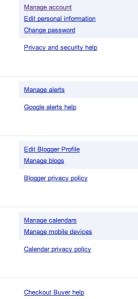
The Dashboard keeps track of everything — and I mean everything — that you do on Google. It’s a dynamic digital footprint collection. To sign in and examine your Gmail or Google Alertsis easy, and you can also check out the other features offered by Google such as Google Docs, Google Calendar, Blogger, or Google Reader (many more Google products are available and new ones become available on a regular basis).
Google Dashboard is an awesome connected-world teaching tool for 21st Century children at any age and for adults, because it makes a point — concretely — about the amount of information that Google accumulates on each of us. Many people are surprised, and a bit disconcerted, on a first visit, because the Dashboard depicts a good deal about each user.
Check out Nick Bilton’s New York Times article, Letting Your Kids Play in the Social Media Sandbox. The February 18, 2015 piece shares Bilton’s experience as he considers how much initial access his nephew should have to social media, after the boy asked about signing up for a YouTube account.
The best part of his decision-making process is the author’s metaphor describing the three doors that open to progressively more complicated social media and how each door leads to a more complicated social experience for a younger person. Bilton explains how each door opens to trickier types of social media that allow — or more likely promotes — certain types of negative behavior. He is not against social media access at all, but he has some specific recommendations about child supervision and parent responsibilities.
I am so energized by makerspaces, where people — children and adults — have access to all sorts of equipment to invent, try out ideas, and make things. I’ve spent some time in makerspaces at a number of conferences, and last summer I wrote about my experience at Gary Stager’s Constructing Modern Knowledge 2014 (CMK14) conference in Manchester, New Hampshire. (Read CMK post # 1. Read CMK post #2).
At my school our fifth graders have a small but lively makerspace where they can try ideas, often fail, and always have an opportunity to keep going and try again and the room is awash with small motors, LED devices, needles, fabrics, and even a few arduino boards. Parents and teachers should become aware of the trend for these innovative spaces and learn more about them. It will only benefit the learning of their 21st Century children and students. Continue reading “Makerspaces Are Amazing, Yet I Remember When…”→
For many people, even those of us who are digital immigrants, it feels like YouTube video sharing has always been around, but actually, YouTube is just celebrating its 10th birthday. The site, which makes it so easy to upload, view, and yes, use video resources, has changed 21st Century online culture.
Most interesting is the graph depicting large numbers of people of all ages who use YouTube and how the number of users has increased dramatically over the 10 years.

 It is a given in this age of connected life that our privacy is much diminished, and it does not matter whether we are children or adults. The trick seems to be for each us to make thoughtful decisions about what family members share and, as much as possible, be aware what is shared or collected about us.




You must be logged in to post a comment.