

Today everyone needs to get better at fact-checking –a critical digital world skill. Interestingly, as we parents and educators help young people learn to distinguish what is true from what is not, we quickly discover that many adults need as much or more practice than the kids.
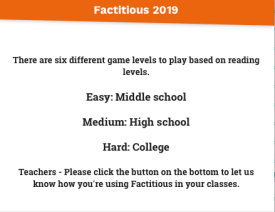
Online games and simulation activities can help people supercharge their fact-checking and evaluation abilities and even have a bit of fun doing it. Recently the weekly Poynter fact-checking newsletter, Factually, featured a list of seven of these games that can help people fine-tune their content evaluation skills. While each of the games is different from the others, all of them aim to help individuals gain the confidence and competence to determine what is true and what is misinformation or disinformation. All can be good teaching tools.
I recently wrote a blog post about Factitious, a game that is included in Poynter’s list, but the other six games look like they have enormous potential when it comes to helping kids and adults practice and understand a lot more about the need to fact-check and how to go about it.

 Tonight I looked
  If you are searching for an educational media literacy initiative that focuses on the mechanics of fact-checking, take a few minutes to learn about
  Ethan Lindenberger grew up in an anti-vaccine (anti-vax) family, surrounded by misinformation, but at age 18 he decided to get his vaccinations despite his parents’ protests.
  Watch this inside video tour (below) of the
  Media! Tech! Parenting!
You must be logged in to post a comment.