Posted in 21st Century life, digital life, family life, Gratitude, parents and technology

Digital Opportunities That Make Life Better — Thanksgiving 2015

Thanksgiving GratitudeIt’s Thanksgiving 2015 and time for my annual list celebrating what’s good about our digital world.

As a parent, teacher, and 21st Century learning advocate with a digital parenting focus, I spend lots of time suggesting ways that families, educators, and children, can strategize, enrich, and improve their digitally connected lives. And, of course, I am always encouraging people — kids and parents —  to learn and understand enough about digital life to avoid potential problems.

This year I am especially grateful for a young new family member and for the digital tools that allow me to continually stay in touch. The ability to see, chat, laugh, watch reactions, and almost touch family members who live at a distance enriches life in countless ways.

My 2015 Thanksgiving List 

I am thankful that digital life allows me to:       Continue reading “Digital Opportunities That Make Life Better — Thanksgiving 2015”

Posted in 21st Century Learning, 21st Century parenting, decision making, digital kids, digital life, ethical behavior, parents and technology

Building Ethical Thinking Skills – Thoughts on Disconnected: Youth, New Media & the Ethics Gap

In an always-connected world, how can we help our students and our children become better, more thoughtful problems solvers when they encounter challenging dilemmas? What can adults do to encourage young people to grow into citizens who understand how to examine issues and problems from a range of perspectives — theirs, of course, but also the possible ramifications of theirs in the context of a community where they live, with others, or even the world. Each parent and every teacher ask these reflective questions again and again as they observe young people navigating through their online lives.

The questions change a bit in the midst of a digital problem or public embarrassment, caused by misuse or misunderstandings on the Internet. In those situations it’s not uncommon to hear people, and young people especially, exclaim, “Why did I do that?” or “What was I thinking?”  Or even more often an adult asks a child, “What were you thinking?” These questions come up when there is little to reflect

In her book, Disconnected: Youth New Media and the Ethics Gap, Carrie James (read author’s bio) suggests some answers to these questions as she shares the results of her qualitative research with young people ages 10 – 25 and also with parents of digital natives. James examines the decisions that young people make and how they respond to digital life ethical problems. In her research the author documents how participants think about and solve privacy, participation, speech, and intellectual property dilemmas, finding that the most of the young people tended to examine issues and respond to problems with a self-focused perspective or a friend-focused moral perspective. Only rarely did the young subjects in her interviews engage in more complex ethical thinking by considering perspectives from the viewpoint of a larger community, a group, or even society as a whole.    Continue reading “Building Ethical Thinking Skills – Thoughts on Disconnected: Youth, New Media & the Ethics Gap”

Posted in 21st Century Learning, 21st Century parenting, digital footprints, digital life, family conversations, parents and technology

Parents: Discover Your Digital Footprints & Teach Your Children Well

Yes, once again it’s summer! To celebrate the season I’m writing specifically for the parents of digital kids — suggesting ways that parents can use this more relaxed time of year to learn more about their own digital footprints.

summer digital projects

While some of the activities are similar to those in a post from last year, this beginning-of-the-summer blog post aims to help parents gain a greater understanding of digital footprints for themselves — and then share this increased knowledge in conversations with their children. The longer-term goal, of course, is to ensure that each child returns to school in the fall with more knowledge about the family’s digital profile, their own digital footprints, and privacy.

Below are some suggestions to help parents get started learning.

  • Log in and visit your Google dashboard.
    Log in and visit your Google dashboard.

    Google yourself. See what digital footprints others see when they Google your name or your email address. Then go to the Dashboard, while you are logged in, and see how Google keeps track of your activities. Dashboard notes everything a person does on Google — from email to images to alerts to searches and much more. Once you finish up learning about your own digital trail, organize a family digital footprint party and help every member of the family go through the same steps.

Continue reading “Parents: Discover Your Digital Footprints & Teach Your Children Well”

Posted in 21st Century life, data collecting, digital life, gadgets and sleep, parents and technology

My Personal Fitness Device: Generating Data to Improve My Health

IMG_4639
My Jawbone bracelet — simple and basic black. I can wear it anywhere and any time.

If you wear a personal fitness device, or if you are considering one, check out Robin Raskin’s short Huffington Post article, What Happens to All Your Data When You Monitor Your Fitness. The author has also posted the piece on Linked In.

While we have many good reasons for wearing fitness trackers, Raskin’s piece explains how the device companies accumulate, post, and use our data. More importantly, she describes how the fitness data has inspired public health initiatives — just one more reason to wear a tracker. With all the concern about personal data in our 21st Century lives, it’s nice to know that sometimes the information can be put to good use.

Exactly one year ago, I began wearing my Jawbone UP 24 personal fitness bracelet. The first day I put it on, expecting to record 10,000 steps without thinking much about it. Boy, was I wrong. Despite the fact that I exercised four to five times a week, it turned out that many days I was barely getting over 5,000. For weeks I had to focus on accumulating the other 5,000. Over the first month, however, I discovered that I liked keeping track of my steps, and by the day things got easier and easier.

Continue reading “My Personal Fitness Device: Generating Data to Improve My Health”

Posted in 21st Century life, digital life, digital parenting, family conversations, parents and technology, social media, teaching digital kids

So What Happens to Social Media Data? Read the Terms of Service!

unnamedI am preparing to make a presentation to a group of well-informed teens at a school. In the process, I’ve reread the terms of service at a range of social media sites to remind myself about what can potentially happen to the pictures, comments, videos, and other content that we share on social media.

Social media is a part of life in today’s 21st Century world. Rather than wringing our hands about these apps, and the things that can go wrong, it’s a far better strategy for adults to proactively learn about social media, know what their digital children are using, and help them understand the power of social media apps. Moreover, every social media user — young and old — needs to develop strategies to use when things have the potential to go wrong.

Check out the terms of service for your favorite social media site. What do you think these policies mean for the pre-adolescents or teens in your life? The social media companies design these statements — albeit long documents — to make it clear what happens and what does not. What can you do to ensure that your child develops the necessary tools and strategies to think carefully about what content to post and share and what content to avoid sharing? Ongoing conversations about living in the digital world are a critical part of family life.

Each of the clips is from one of the social media websites, and I’ve added a link to each site’s complete terms of service document.  Most of the companies want us to understand these documents.

Continue reading “So What Happens to Social Media Data? Read the Terms of Service!”

Posted in 21st Century life, digital life, parents and technology, teens and finance

When It Comes to Check Writing “The Times Are A’ changin”

With thanks to the Deviant Art blog,  http://theinfamousj.deviantart.com
With thanks to the Deviant Art blog, http://theinfamousj.deviantart.com

People of a certain age write checks. People of a much younger certain age, mainly millennials don’t, instead using their mobile phones for most of their financial transactions.

It would be hard to find an elder who cannot write a check, and most aging children still write them, albeit far less frequently. Some parents have given a check to their millennial young adult, only to have their child carry it around in a wallet for weeks and weeks rather than cashing it.

Now according to Washington Post Wonkblog writer, Christopher Ingraham, how to write a check is a big search item on Google.            Continue reading “When It Comes to Check Writing “The Times Are A’ changin””

Posted in 21st Century life, digital kids, digital life, educating digital natives, parents and technology

Has Your Child Grown Up With Google? Check Out This Article

Ever so often adults are reminded that the world where we grew up is dramatically different from the world where our 21st Century children live, learn, and grow. What is new and different for parents and educators is merely routine to digital kids.

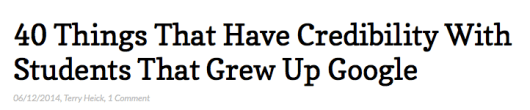
Over at the TeachThought blog I discovered an interesting article about the dramatic life changes that have occurred during the first 16 years of Google’s existence (dramatic to adults, that is). The author uses Google as a yardstick to measure the ways the world has changed during those 16 years, Click on the box below to read the whole article.

Screen Shot 2015-04-15 at 8.57.37 PM

Continue reading “Has Your Child Grown Up With Google? Check Out This Article”