Good for middle school as well as older students. Parts of this video can be shared with fifth graders, but the whole video may a bit too scary for that age.
Parents, on the other hand, may consider this as an excellent resource for family conversations about digital life.
Image made with WordFoto with a picture taken at the Library of Congress.
While people worry a lot about kids and their digital access, the most critical aspect to me — and the most likely to cause an eventual problem for a child — is the degree to which information can be tracked and collected while children work and play in the web.
Image made with Wordfoto with a picture taken at the Library of Congress.
Much of what a child or teen does online gets added to a digital profile. Even when information is not supposed to be collected, it accumulates – somewhere. Moreover, when a child or adolescent acts impulsively or thoughtlessly online, no way exists to erase or delete a digital mistake. Harvard’s Berkman Center for Internet and Society posts a great digital dossier videothat parents and educators may want to use as a conversation tool.
To learn a lot more about the state of privacy policy, especially as it concerns children and adolescents, read the article Congress Revisits Online Privacy Legislation over at Boston.com.
Our digital society hasn’t figured out what to do about privacy. More importantly, it hasn’t figured what to do about the privacy of our kids — we keep confusing privacy with transparency.
It’s problematic enough that adults are diving willy-nilly into the digital world, sharing everything about themselves, private and not so private, but it’s even worse to observe a world where everything a child does and almost every mistake he or she makes is now public. These days we are giving children and adolescents no cover and no protection as they blithely explore the digital world while making what in any other era would be common and developmentally appropriate errors.
Lest I sound like a digital Luddite, I’m not. I love participating in the activities of my digital world, actively but moderately, and I have an arsenal of digital gadgets in my purse, book bag, and lying around my house. As an educator, however, I am keenly aware of how much we are forgetting to nurture and honor kids’ developmental stages as they grow up in this digitally dense world. Part of solving that problem involves ensuring that children have a guaranteed amount of privacy.
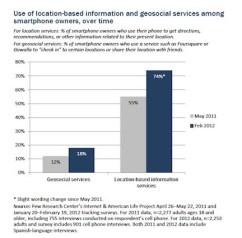
The Pew Internet & American Life Project has just published new survey results finding that 74% of smartphone owners — that’s three-quarters — appear to be using location services on their phones.
This statistic is double what it was when Pew conducted a similar survey in May 2011. The increase in location services occurs despite privacy concerns about tracking and data collection. Check out the report to look at the data by age, gender, and ethnic group, depicted in a range of charts and graphs.
I am still minimizing or turning off the number of location services that I use on my phone. While some of us use more location services than others on our smartphones, it’s critical for parents to know how location services work and how to limit access on the phones that their children around each day. Many apps ask to turn on location services during the installation process.
Do you know about Foursquare ? If it’s on an adolescent’s cell phone a parent needs to learn about it. Find out more about location services by reading a post that I wrote about location services, Location, Location, Location – Services that Is.
Each adult needs to figure out how much privacy is necessary or desired in his or her digital life and also in the digital lives of children. People seeking one right answer won’t find it, however, it’s best to take the time to understand the devices that family members carry and apps that they use.
NPR’s All Tech Considered blog has posted a thought-provoking piece on privacy (February 29, 2012).
In New Ways to Think About Online Privacy, Nina Gregory shares what she heard at TED Long Beach where some major technology thinkers and innovators (some speakers, some attenders) shared their thoughts about what Gregory calls “privacy hygiene” (and about what they might be teaching their kids about the subject).
You may not have heard of some of the companies represented, but the thoughts about privacy are worth reading.



 Media! Tech! Parenting!
You must be logged in to post a comment.