Posted in cultural changes, digital citizenship, digital parenting, media literacy, parents and technology, research on the web

Virtual World Questions and Thoughtful Surmises

Check out Is the Virtual World Good For the “Real” One? in the February 23, 2011 Huffington Post.  The article, by Joseph Kahane, describes a longitudinal study focused on the amount of time that young people (age 18 – 29) spend online. Researchers wondered whether time in the virtual world may be keeping young people from paying enough attention to the tangible needs of the real world.

Kahane, who currently chairs the MacArthur Foundation Research Network on Youth and Participatory Politics, describes some interesting findings and concludes, ” In short, the virtual world can be good for the “real” one. There are forms of online activity that can give youth civic and political engagement a much-needed boost. We need to fully tap this potential.”

Read the entire article.

Posted in digital parenting, great sites for students, Library of Congress, parents and technology, web research

Our Library of Congress: Knowledge Moves into the Digital World

The LOC Reading Room - Picture taken from the entrance.

If you ever visit Washington, DC, save an afternoon or even a day to visit the Library of Congress (LOC). Filled with resources — primary and secondary, hands-on and digital — the Library is a delight for anyone who loves to learn. In my post , The Library of Congress: Go Exploring for Digital Resources, I wrote about a few LOC digital learning opportunities, and library website features many more. The digital learning resources are available no matter where a person lives, however there is much to see at the library itself, and a LOC library visit is fun for adults and children.

Last Monday, on the February holiday that honors Abraham Lincoln and George Washington, the Library of Congress, which was started with the book collection of another president, Thomas Jefferson, opened its main reading room to the public.

Continue reading “Our Library of Congress: Knowledge Moves into the Digital World”

Posted in acceptable use, cyber-bullying, digital citizenship, digital parenting, family conversations, parents and technology

Trend Micro’s Family Internet Safety and Citizenship Site

Trend Micro, a web security firm, devotes a part of the company’s website to Internet Safety for Families and Kids. The section is well-organized and topical so a visitor can quickly scan a list of subjects to find tips, links to organizations that support digital citizenship, and an internet safety and citizenship resources library that includes a wide range of documents available downloading and sharing. Topics include Safety Tips for Social Networking, three short videos on social networking, and A Safety Guide for Web Threats. These and other documents can be used as handouts for parent organizations and discussion groups, or  just shared during those parent-child conversations that are so necessary in today’s digital world.

Continue reading “Trend Micro’s Family Internet Safety and Citizenship Site”

Posted in acceptable use, digital citizenship, digital photography, parent child conversations, parents and technology, writing for the web

Conversations About Commenting

If you have ever written a comment at the end of an article or blog posting, you have surely read more than a few inappropriate and sometimes distasteful remarks. Sometimes people leave these comments anonymously. Posted by folks who do not understand why websites invite visitors to share thoughts and ideas, many unfiltered remarks are permanently attached to websites — indiscretions waiting for the whole world to discover.

Read a short post and watch a video on newspaper comments, uploaded by the Nieman Journalism Lab at Harvard. Some newspapers sites, such as the Boston Globe, post a short and succinct comment policy.

Helping your child avoid public website blunders is one reason to discuss commenting etiquette. Often children don’t know or forget that their comments leave a digital footprint trail that will last much longer than their per-adolescent and even teenage years.  Often confusion arises because many children first encounter commenting opportunities in places where adult supervision is scarce. As a result an impulsive idea can beat out good common sense even when a child knows better. Bottom line — response and commenting areas are not places to leave nasty, rude, and hateful conversation.

Continue reading “Conversations About Commenting”

Posted in digital parenting, parents and technology, when kids make mistakes

My Kid’s Digital Blunders? How to React?

updated 9-26-2011

At one time or another, most of us experience the protective parent surge, a not-my-child reaction, when someone lets us know that a son or daughter could be involved in some sort of digital misbehavior. Often a child’s digital blunder is public for many people, but not public enough for a  parent to casually discover the problem, so the first alert may indeed come from another parent.

Especially if this information comes from someone who is not well-known, the protective parent energy surge can complicate an issue even further. I know because I’ve felt this powerful surge.

Ages ago I heard a presentation that described how to react when one parent tells another parent that a child may be involved in a problem. I don’t remember when or where, but here are the seven rules I subsequently made for myself. Continue reading “My Kid’s Digital Blunders? How to React?”

Posted in digital parenting, Evaluating Web Resources, parents and technology, research on the web

Kids and Web Credibility

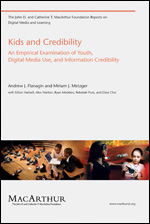
Click for PDF of the book.

If you worry about the digital research activities of children, especially older students who complete significant amounts of their research using the unlimited resources available on the World Wide Web, you are not alone. Over the past 10 years I have wondered — more than once and sometimes with great angst — if my child and the many children I’ve known over the years really understand the need to evaluate the resources that they find on the web.

Recently I discovered a small book, published by the MacArthur Foundation, describing research that explored how children perceive the quality and reliability of digital media. It’s a book that concerned parents may want to read. In Kids and Credibility: An Empirical Examination of Youth, Digital Media Use, and Information Credibility, authors Andrew J. Flanagin and Miriam J. Metzger, summarize their study as a “…comprehensive investigation into youth’s Internet use and their assessment of the credibility of online information.” The authors wondered whether young digital media users, while sophisticated and fearless about using technology, could evaluate information and determine its quality. Continue reading “Kids and Web Credibility”

Posted in digital parenting, family conversations, parent child conversations, parents and technology, social networking

Mrs. Obama Said No Facebook???

Preteens are savvy media consumers, and among the kids I know there is significant buzz about Michelle Obama’s views on Facebook. “Pre-teenagerdom” is such a difficult and challenging time for parents and for the kids themselves. Many children want to hurry up and become teens and joining into social networking activities is one way to make them feel older and even wiser. Feeling and sometimes believing that your parents simply don’t understand technology is another way. So it’s a bit of a blow when the First Lady and First Mom — a person many of them admire — tells their parents to slow things down.

A Few Other Reports