Posted in 21st Century Learning, 21st Century parenting, digital change, digital life, digital parenting, education not fear, Facebook, parents and technology, risky behavior, social media, supervising digital kids, values in digital life

On Digital Parenting Fear, Part #2 – We Must Know More About Kids’ Digital Lives

fear-riskIn our connected world unfamiliar activities make adults worry about kids, and violent and exploitative events, some connected to the digital world, make us fear for our children’s safety. This past week two events, a 13-year-old’s ruthless murder that was associated with online app interactions and a Wall Street Journal article, Cyberthieves Have a New Target: Children, made many of us wonder, once again, whether the digital world is degrading the quality of our lives.

Cybertheives PM

For me the week reinforced the importance of parents understanding what their children are up to on digital devices. It’s a serious responsibility, it requires enormous time and energy, and we cannot hire outside experts to do it for us. The work requires every parenting skill that we’ve ever developed and more, and if you are not up to it you need to consult a parent education organization, such as the Parenting Encouragement Program (PEP) in my area, that offers training to parents. Continue reading “On Digital Parenting Fear, Part #2 – We Must Know More About Kids’ Digital Lives”

Posted in 21st Century parenting, connected learning, digital citizenship, digital kids, parents and technology, research on the web, risky behavior, social media friends

On Digital Parenting Fear, Part #1 – What Risks Should We Worry About the Most?

When we teach and interact with digital kids about their hyper-connected lives, I wish we could de-emphasize the fear factor and re-emphasize education and understanding, helping young users become stronger digital world problem-solvers. While monitoring, learning, and guiding, we also need to be sure to help kids, develop the antennae to identify and avoid a range of online problems — not just the big ones.

fear risk
Image made at Festisite.

A day doesn’t go by without hearing an adult comment about children’s digital world risks, and invariably these conversations focus on predators, strangers, pornography, cyber-bullying and even the death of a child. In the area where I live, a grievous and tragic event is unfolding as I edit this post.

My concern as an educator is that my students, without fail, noted how important it was to be aware of the frightening situations. Their deep concern about potentially horrible Internet encounters — events that do not occur nearly as often as the mainstream media imply — obscured for many of them, the importance of many other interactive problems that happen on a daily basis to digital kids — misjudgments, miscommunications, and daily social events gone awry. It’s these problems, often the result of minor online misjudgments or typically adolescent missteps that regularly cause public humiliation and embarrassment, and such events wreak havoc on a child’s and a family’s daily life.       Continue reading “On Digital Parenting Fear, Part #1 – What Risks Should We Worry About the Most?”

Posted in 21st Century Learning, electronics, innovation, maker movement, makerspaces, parents and technology

Electronics Tutorial Helps Parents & Teachers Gain Deeper Understanding

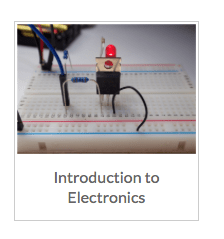
Click on this icon at the top left of the webpage to access the tutorial.
Click on this icon at the top left of Paul Mirel’s webpage to access the tutorial.

As exciting makerspaces spring up all over the place, I wonder how much attention is given to leveling the makerspace playing field in order to ensure that everyone in a 21st Century group, class, or school community has the basic knowledge for exploring and innovating.

Take understanding basic electricity, for instance. At a conference that I attended last year — an amazing event filled with countless maker opportunities —  some people seemed to understood electricity’s basics and lots of others did not. The people without the knowledge, the “have-nots,” frequently appeared to lurk on the periphery of projects.

A friend and former colleague, physics teacher Paul Mirel, recently developed an introductory electronics tutorial for his art students at the Maryland Institute College of Art (MICA) in Baltimore, MD. It’s written in a way that is easy to understand and also easy to follow. He thinks that his students need an elementary understanding of basic electronics if they are to fine tune their maker skills. Check it out!               Continue reading “Electronics Tutorial Helps Parents & Teachers Gain Deeper Understanding”

Posted in 21st Century life, digital change, early childhood, electronic toys, language development, parents and technology

Traditional Toys, Electronic Toys, and Language Development

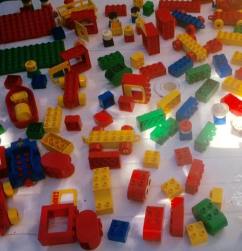
Lego blocks for early childhood playing, conversing, and learning.
Lego blocks for early childhood playing and learning.

In December I read an article about a study published in the journal JAMA Pediatrics describing how different types and amounts of parent/child speech interactions during infant play may increase or decrease, depending on the type of toys that the child uses.

The new research, though conducted on a small sample of participants, finds an association between talking electronic toys and and reduced parent/child interaction during playtime, and the results add to an existing body of literature that observes how electronic toys affect a child’s language development.

In her article, Association of the Type of Toy Used During Play With the Quantity and Quality of Parent-Infant Communication, (abstract) researcher Anna V. Sosa, PhD. discusses her research, carried out with 26 parent and older infant pairs (dyads). The article is not too difficult to read, but it is available only at a library with access to the journal. Continue reading “Traditional Toys, Electronic Toys, and Language Development”

Posted in 21st Century Learning, Bookmark It!, digital learning resources, online learning, parents and technology

National Library of Medicine Learning Resources for Young Learners

Amazing resources for young learners at The National Library of Medicine!
Amazing resources for young K-12 learners at The National Library of Medicine!

Check out The National Library of Medicine (NLM) resources for K-12 education, including a number of games. The library is a part of the National Institutes of Health (NIH), and also has an excellent weekly podcast on a wide range of topics.

Posted in 21st Century life, digital learning, digital life, digital parenting, parents and technology

5 New Year’s Resolutions to Improve Parents’ & Kids’ Digital Literacy Skills

The New York Times recently published For the New Year, Let’s Resolve to Improve Our Tech Literacy, about the need for leaders, law enforcement officials and policymakers to increase their digital world literacy. The December 23, 2015 article, written by Farhad Manjoo, points out that many the big problems that occur in our world become even more complicated because the leaders and law enforcement personnel do not have a big-picture understanding of the vast changes technology brings to today’s world. Greater understanding might strengthen our leaders’ problem-solving skills.

This article looks at the importance of digital literacy on a large-scale.

Tech Literacy

As I finished reading, I began thinking about resolutions on a smaller scale — those steps that adults and children can take in 2016 to improve a family’s tech literacy and perhaps prevent at least some of the potential connected-world problems. It’s a fast-paced, always-changing 21st Century world and everyone has a lot to learn. Many of the issues that do occur are made worse because kids and parents do not have enough knowledge to anticipate what might go wrong and take steps to steer clear of problems.

Below are five digital literacy resolutions that parents can make, and all of them can help people — both adults and children — become more sensible and savvy connected world citizens.                                                                  Continue reading “5 New Year’s Resolutions to Improve Parents’ & Kids’ Digital Literacy Skills”

Posted in 21st Century life, 21st Century parenting, digital devices and gadgets, digital life, digital parenting, kids' advice for parents, media and family life, parents and technology, screen time

What to Do About Screen Time – A Diane Rehm Show Discussion

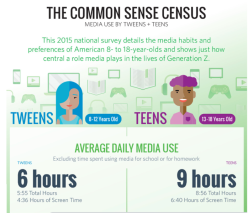
Click to check out the report’s infographic..
Click to check out the Common Sense Media research report’s infographic.

This past week I listened to New Research On Teens, Toddlers and Mobile Devices, an engaging radio program about digital parenting on The Diane Rehm Show (NPR). In early November 2015 Rehm featured four expert guests who thoughtfully examined the digital parenting issues that adults should consider when it comes to digital media and children. It was rebroadcast in  December 2015.

The program appeared to be timed to highlight a recently released report, The Common Sense Census: Media Use by Tweens and Teens (2015). Educators and parents will learn a lot by listening to this broadcast or reading the transcript and by checking out the program’s resource links.

A new year—with new devices and new considerations about rules and limitation—is a good time to listen to experts who can help adults think more carefully about how to define screen time and discuss the research (and the need for much more). This program can help adults guide children whose 21st Century lives are increasingly defined by digital activities.                         Continue reading “What to Do About Screen Time – A Diane Rehm Show Discussion”