Posted in American Academy of Pediatrics, answers to media questions, digital devices and gadgets, media literacy, parents and technology

Discouraging News on the Media Lit Frontier

Zero to Eight: Children’s Media Use in America, p 11

The New York Times has reported on a Common Sense Media (CSM) sponsored study, Zero to Eight, Children’s Media Use in America (PDF). The Times article, Screen Time Higher Than Ever for Children, describes the study and points out that kids are in front of a screen more than ever despite the recommendations of their doctors.

After reading this I am feeling a bit more pessimistic than usual. Adults are used to tossing health caution to the wind for themselves, but we were vigilant about protecting the health of our children. Now we seem to disregard the recommendations of pediatricians — the very people who can help us do the most possible to ensure that our kids grow into strong and productive adults. Are we as a society less and less concerned about the development of strong minds? Times reporter Tamar Lewin writes:

Despite the American Academy of Pediatrics’ longstanding recommendations to the contrary, children under 8 are spending more time than ever in front of screens…

Continue reading “Discouraging News on the Media Lit Frontier”

Posted in digital devices and gadgets, digital parenting, family conversations, parent child conversations, parents and technology

Is It Spying or Is It Parenting?

A look at the browsing history in Safari

Recently I read Tracy Grant’s article, The Case for Spying on Your Kids, in the October 5, 2011 Washington Post, and it’s well worth reading. Grant believes that parents should keep close track of their children’s online activities. After I finished the article I decided it’s unfortunate that so many people equate keeping an eye on a child’s digital activities with spying. It’s not spying.

From my perspective, it’s just fine for parents to closely supervise the digital activities of kids, just like parents supervise non-digital endeavors. Understanding what’s going on, setting limits, teaching children to follow website rules, and defining expectations — as children encounter more and smaller personal computers and digital gadgets — are important responsibilities. Knowing what’s going on is a part of parenting.

Yet learning about what’s going on takes time, a scarce resource for many adults, and the situation gets even more complicated because the digital skills of many children outpace their parents.

Grant describes her conversation with Steven Balkam of the Family Online Safety Institute (FOSI) (this organization has a website that parents may want to explore), and she also mentions a new monitoring service, SafetyWeb

In Grant’s article Balkam points out, “The history button on a computer is a very important tool for parents.”

The digital world offers many opportunities to help children learn, collaborate, and grow as digital citizens, and we want our children to become literate and savvy consumers of online resources. Strong digital parenting — even when a parent is in awe of a child’s online prowess — is one of the ways to ensure that children grow into confident, respectful, and competent learners.

I recommend reading the book Born Digital, by John Palfrey and Urs Gasser. The authors, from the Berkman Center for Internet and Society at Harvard, focus on the changing nature of growing up in the digital world.

Posted in cyber-bullying, digital devices and gadgets, digital downloading, Evaluating Web Resources

Terms of Use, Readability, and Digital Kids

Check the terms of use readability level at your favorite sites.

Just about every time I head over to iTunes to purchase something, I’m all set to finish up when the site diverts me to a change in the terms of use. It happens at lots of sites.  And each time I click to look at a site’s terms of use, it’s a longer document — 40 pages, 41, 42… Now I don’t object to changes or even insisting that users check things out, but terms of use are abstract and arcane and not especially easy to read or even understand.

I’ve always thought it would be an interesting conversation topic for parents and kids — taking a few minutes to look at those terms of use statements that most people accept and go right by, and helping children discover a bit about the fine print.

About eight months ago, I read a posting about terms of use documents, C’mon! Match Terms of Use Text to Users’ Comprehension Level, written by Linda Criddle over at the I look Both Ways blog.

Criddle described her experience examining terms of use documents posted on well-known and popular websites. She looked over the terms of use documents for the sites such as the New York Times, Amazon, iPhone, Club Penguin. Then she ran each document through a readability index – a tool that examines a passage and estimates how easy or hard it will be for a person to read the words, as well as what level of education the reader might need to comprehend the information. Continue reading “Terms of Use, Readability, and Digital Kids”

Posted in cell phones, digital devices and gadgets, digital parenting, distracted driving, gadget ownership, parents and technology

BMW PSA: Cell Phones, Texting, and Distracted Driving

Click here to watch the video on YouTube or watch below.

In my years as a teacher and parent (now with a with a young adult child), I’ve seen lots of public service announcements that focus on improved parenting, better health, preventing substance abuse, and the like.

However, I’ve never watched one with the impact and shock quality of this distracted driving video PSA, produced by BMW (see below) and released in June. Read a short report about the video at Auto News. BMW also put out a press release in, BMW Launches National Campaign Against Distracted Driving in Time for the Summer Driving Season.

Bravo BMW!

Continue reading “BMW PSA: Cell Phones, Texting, and Distracted Driving”

Posted in cell phones, digital devices and gadgets, electronic communication, iPhones and iPads, parents and technology

Keeping Gadgets Working When the Power Goes Off

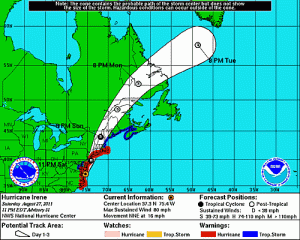
Visit the National Oceanic and Atmospheric Administration (NOAA)

How does one keep mobile devices working during some type of emergency?

It’s been an eventful week here in Northern Virginia. On Tuesday we had an earthquake, 5.8 on the Richter magnitude scale, shaking lots of things at home and work to the floor. Almost immediately, on Wednesday, we began making preparations for Hurricane Irene, the largest of its kind to move up the east coast of the United States in more than 50 years. In both cases, it’s been harder than usual to count on gadgets like mobile phones, iPads, tablets, and laptops.

For more than an hour after the earthquake, making mobile phone calls was difficult, though I found I was able to text easily. Now, during hurricane Irene (I am sitting by a window watching the rain fall in sheets), I worry about maintaining the battery charge of each gadget as long as possible, since the power is sure to go out at some point. Of greater concern is that, with millions of people losing power, it may take some time to get the power restored. Preservation becomes even more of a concern.

Continue reading “Keeping Gadgets Working When the Power Goes Off”

Posted in digital devices and gadgets, digital parenting, electronic communication, parents and technology

Summer Camps and Technology

Have fun reading this Chicago Tribune article, Welcome to Camp Tur-Ni-Toff, describing the lengths that sleep-away camps are going to preserve “their bucolic bubbles.” It sounds like the luckiest camps are those that do not have cell reception in the area. NOTE: The reporter points out that parents have more difficulty with the gadget prohibitions than do the campers.

My favorite quote:

The essence of camp is to rise and fall on your own … not to call your parents because you’re homesick or having a bad day,

My second favorite quote:

Even letters home are done with actual stamps and paper … a first for many of our campers.

Read the entire article.

Posted in acceptable use, digital devices and gadgets, digital parenting, family conversations, home computer security, online security, parents and technology

4 Basic Rules to Secure the Computers in Your Household

FBI Bunny helps me teach my students about digital citizenship and security.

Brian Krebs, over at the blog Krebs on Security, has posted 3 Basic Rules for Online Security.  From his perspective, and I agree, just about everything can be distilled into these three guidelines. To read the more detailed explanations, head on over to his post. Keep these three rules in mind, day in and day out, as you work on your computer and your kids work on their devices.

  1. If you didn’t go looking for it, don’t install it
  2. If you installed it, update it.
  3. If you no longer need it, remove it.

For those of us who wish we possessed a bit more of the “geekiness” factor (a term I use affectionately), these three rules, especially numbers one and two, should be household digital policy. While Krebs’ three precepts are broad, they will, if followed, prevent lots of computer trouble.

I will add a fourth rule for families. Digital parents, not their digital children, should administer the computers in a household, at least until a child has demonstrated a fair understanding about potential security problems. In my household, this included the ability to explain the basics of avoiding virus, spyware, malware, digital citizenship and digital footprint issues (also see rules one and two) and the ability to appreciate potential consequences. A child can learn a lot while administering a computer, however, before taking on the task, he or she needs to possess a strong sense of responsibility and the knowledge of what can go wrong.

Krebs is a journalist, formerly of the Washington Post, who writes on security issues.