Posted in Facebook, fraud, parents and technology, risky behavior, scams and fraud

Facebook Scammers Continue to Lure Users – Successfully

danger fB scamsI sometimes observe a Facebook friend sharing or unknowingly posting a scam as often as once a day.

According to a post on Techlicious, scammers continue to find victims on Facebook. While Facebook continues to work against these scams, the sheer number of users on Facebook (one billion) encourages unscrupulous people to continue to seek victims.

The December 4, 2012 post by Techlicious writer, Christina DesMarais, lists six of the most prevalent scams — which often masquerade as apps — that Facebook users may encounter, all offering services that may catch a users’ fancy (or conscience).

I’ve listed the six types below, but check the post, The 6 Biggest Facebook Scams, for lots more information.

  1. Changing the color of profiles.
  2. Offering free things — cards, vouchers, prizes, etc.
  3. Begging for cards to send to wounded soldiers or warriors.
  4. Offering pictures of things or videos — often alerting a person via e-mail or message.
  5. Encouraging users to find out who is viewing your Facebook profile.
  6. Making the case for privacy options that are really hoaxes.

The post also explains how Facebook users can disconnect themselves from Facebook hoaxes or questionable apps.          Continue reading “Facebook Scammers Continue to Lure Users – Successfully”

Posted in 21st Century Learning, American Academy of Pediatrics, digital learning, digital parenting, parents and technology, teaching digital kids, wireless gadgets

8 Tips to Help Parents Raise Stronger 21st Century Learners

As we approach the end of 2012 and the holiday season that will surely introduce new gadgets and devices into many of our households, it’s a good time to reassess family digital expectations.

Learning in the 21st Century requires that children competently use digital resources much of the time. To do this each student needs plenty of experience making choices, understanding limits, and mastering the art of filtering out what is immaterial at any given point. Children who get this guidance at home and at school are the most prepared to become effective learners.

These eight tips aim to help parents of digital kids to get started. If you teach, consider sharing them with your students’ parents.

1. Place computers and tablet devices in central, well-traveled locations — away from bedrooms and private spaces.

2. Make adults, not children, the administrators on all computers, including laptops until you are certain of each child’s decision-making. Know what is installed on your child’s mobile devices.

3. Print and post rules and expectations. Specify the times when you do not want your children using computers. Emphasize that your family rules are in effect when your child goes to a friend’s house.

4. Help your children to come up with a strategy that helps them to distance themselves whenever and wherever inappropriate digital activities occur.

5. If your children have mobile phones, have you discussed appropriate use, texting, and limits on a phone’s digital camera? Download a PDF of my cell phone contract.  Check out my contracts and agreement page.                     Continue reading “8 Tips to Help Parents Raise Stronger 21st Century Learners”

Posted in 21st century job hunting, digital change, digital parenting, family conversations, generating content, parents and technology, social media, social networking

Just How Much Social Media Is There?

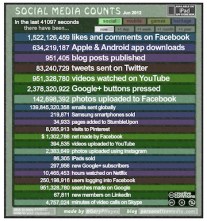
Click on the image to visit Gary’s Social Media Counter.

Have you ever wondered about how much social media interaction occurs in the digital world at any given point in time? Recently I discovered an excellent social media teaching and learning tool that helps people gaze into the always-changing world of social media content.

Over at PersonalizedMedia.com, blogger Gary P. Hayes offer a living widget with algorithms that track the approximate number of interactions in a range of social media categories — all in real time. He’s also turned his counter into an iPad app.

Visit Social Media Counts — a living statistical chart originally published in 2009 but upgraded in 2011 and 2012 — and start counting the moment you open the page. The site offers a progressive snapshot of what’s occurring in the social media universe as time moves along. It continues counting until a visitor closes the web page, and it starts counting again if the page is reloaded or if a user clicks the “now button.”

Leave the page up on your browser, come back a while later, and gaze in wonder at the growing statistics. Users can also click on the day, week, or month buttons to see different, and more massive social media statistics.

Continue reading “Just How Much Social Media Is There?”

Posted in cultural changes, digital change, digital parenting, future of the Internet, online communication, parents and technology, social media, social media friends, social networking

Looking into Our Kids’ Futures: Will Social Media Be There?

If you missed this set of essays, Is Facebook a Fad? Will Our Children Tweet?, published in the June 19, 2012, New York Times, take some time to read these short pieces on social media and contemporary life.

As a part of a regular Times’ feature, Room for Debate opinion, readers can learn what six knowledgeable media commentators think about the always evolving digital world.

For instance, MIT Professor Sherry Turkle describes the tendency of social media users to “hide” from one another, substituting quick text nuggets for what used to be face-to-face interaction. Morra Aarons Mele, a digital manager and founder of Women Online, acknowledges the communication downsides, but says that social media and the digital professional work it has created make the world more egalitarian.           Continue reading “Looking into Our Kids’ Futures: Will Social Media Be There?”

Posted in 21st Century Learning, cultural changes, digital learning, digital parenting, parent education, parents and technology, teaching digital kids

Beloit College 2016 Mindset List: How Fast Life Changes

The new Beloit College 2016 Mindset List — a great start-of-the-school-year conversation piece for adults — is out.

Watch a video about the list.

At the beginning of each academic year, several faculty members at Beloit compile a list to demonstrate how students in the entering freshman college class experience life, learning, and culture differently from many of the adults they know. Some items are silly, others compare digital kids with their parents’ generation; some I don’t understand; and others I can fit into a bit of context, but they are mostly unfamiliar to me.

The list’s mission is to remind educators and parents that it takes energy and openness to new literacies to understand how dramatically the “growing-up” and learning processes change over time (and many of these have nothing to do with digital life). 

Every fall I look forward to the release of this list, which Beloit releases just before the start of the school year. I’ve included a few of my favorites from this year.          Continue reading “Beloit College 2016 Mindset List: How Fast Life Changes”

Posted in digital parenting, parent child conversations, parents and technology, social media, social networking

Summer, Social Media, and Digital-Age Parenting

Read the research here.

Summer is a good time for parents to learn more about the social media activities of their children, developing additional skill and more understanding about what’s happening in the digital whirl that is a huge part of kids’ social lives.

A 2011 Pew Internet and American Life Project report, Teens, Kindness, and Cruelty on Social Networking Sites, noted that 95% of children ages 12 – 17 are online, many on social networking sites. Since that Pew report was published, media sources report that children several years younger than 12 are also using social media. Read the NPR piece, Social Networks: Thinking of the Children. Children continue to need guidance and limits-setting from their parents.

The goal is not to prevent children from exploring — that’s not realistic. Instead, parents need to gather enough information to be able to keep an eye on activities, facilitate discussions when required, and intervene when it’s necessary to insulate their kids from impulsive digital behavior on computers, smartphones, and tablets.        Continue reading “Summer, Social Media, and Digital-Age Parenting”

Posted in digital change, parents and technology

Phone Books: Are They Useful Anymore?

My newest phone book.

Yesterday in my town the new phone books arrived on our porches. I brought mine in and put it in the cabinet where I keep them, pulling out the oldest one and depositing it in the recycling bin.

My neighbor used a different strategy. She took the new phone book off of her porch and put it immediately into the recycling bin.

I began thinking about the last time I used the phone book. I haven’t opened that cabinet for at least six months, perhaps longer — definitely a long time ago.

Are phone books at all useful anymore?

On the other hand, Northern Virginia, where I live, just experienced an epic storm, and many people were without power for four or five days. Even streetlights were dark. Landlines worked, but the Internet did not. Cell phones ran out of power. I wonder if anyone used the phone book?