Posted in 21st Century Learning, 21st Century life, 21st Century parenting, 21st Century teaching, online communication, online security, parents and technology, privacy, public vs private comments, teachers, teaching digital kids

Digital Communication Disrupts the Rules of Civility, Privacy, & Integrity

Click to read the article.
Click to read the Washington Post article.

After spending years teaching digital citizenship and civility in the K-12 world, I’ve now come to the conclusion that we parents and teachers should, in the midst of teaching children, stress that there is never privacy online. Yes, I know that we already teach this — or try to — in most schools and homes, but election 2016, accompanied by the theft and sharing of emails and other connected world materials, is scary. It has proven that everyone can be hurt by what they say online — even when what is said is not intended to generate hurtfulness.

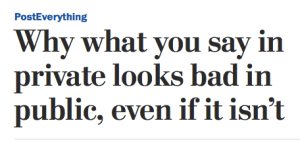
To learn much more about the lack of privacy in private communication read Deborah Tannen’s October 28, 2016 Washington Post column, Why What You Say In Private Looks Bad in Public, Even if It Isn’t. Tannen is a professor at Georgetown University and the author of the bestseller, You Just Don’t Understand.

Our confidential comments may differ from what we say in public. When our candid thoughts become widely available — yes, through hacking, but with kids, it’s through intentional sharing, gossip, or the unintentional mistakes that kids make — words can often be interpreted negatively. Moreover, at least for the time being, we live in a world where stealing a public figure’s private communications and making them public appears to be OK.

Good Quotes from Deborah Tannen’s Article  (Read the entire article for much more)           Continue reading “Digital Communication Disrupts the Rules of Civility, Privacy, & Integrity”

Posted in acceptable use, digital citizenship, family life, mobile media devices, parents and technology, parents as mentors

Let’s Also Think About Grown-up’s Screen Time

Mid-morning coffee with an iPad.

With so much conversation about screen time for kids of all ages, it’s also useful to think and talk about adults’ screen time. Adults model, but not always well, screen time habits for the young people in their families. When asked, most 21st Century children can share all sorts of stories about how much time their parents spend on their devices, even at inappropriate or inopportune times.

In his New York Magazine article, I Used to Be a Human Being, writer and contemporary thinker Andrew Sullivan contemplates the overwhelming “full immersion” that he and many adults experience with the online world.

Continue reading “Let’s Also Think About Grown-up’s Screen Time”

Posted in 21st Century life, digital kids, family media plan, media and family life, media diet, parents and technology

Pediatricians Recast Screen Time Recommendations & Give Parents Online Planning Tools

Thanks to the American Academy of Pediatrics (AAP), parents and teachers now have two simple and easy-to-use tools that can assist with developing a family’s media plan and estimating how family members can organize their time so that screen time is balanced with physical activity, reading, face-to-face connections, and homework.

screen-shot-2016-10-21-at-8-47-49-pm
A screenshot of the two new media tools.

Every school administrator and every PTA group will want to share the information about these digital planning devices in as many ways as possible. The new tools are available at the AAP’s HealthyChildren.org website.

The Academy has also refreshed its screen time recommendations for children of all ages, making needed updates to reflect the changing digital landscape as well as the many media activities in the lives of family members. Whether you agreed or vehemently disagreed with previous AAP screen and media guidelines, the professional society of children’s physicians deserves high praise for its ongoing efforts to address a media and digital landscape that dramatically affects the health and wellness of young people.

Continue reading “Pediatricians Recast Screen Time Recommendations & Give Parents Online Planning Tools”

Posted in 21st Century life, hateful comments, offensive speech, parents and technology

Teaching Children (and Adults) to Extricate Themselves from Offensive Situations

Expressing hate is so easy with just a few taps on the keyboard.
Expressing hate is so easy with just a few comments or taps on the keyboard. Develop strategies to contain it.

Can a person learn how to respond to an offensive or hateful situation? Can adults help 21st Century young people master the skills? Earlier this fall I wrote a post, Is Hate Speech Here to Stay?, wondering if up-front, in-your-face hate and offensive speech will be a continuing problem in our connected world.

Recently a New York Times article, Lessons in the Delicate Art of Confronting Offensive Speech, described the challenges and awkwardness that individuals experience when they happen to hear or see a person engaging in offensive activity. The piece highlighted research about what occurs when people challenge offensive speech, and it suggests concrete steps that a person can take when confronted by offensive behavior or speech. The authors, Benedict Carey and Jan Hoffman, point out that researchers have consistently found that a person who makes the awful comments will often curb behavior when another expresses reservations or reacts in a more indirect way.

Continue reading “Teaching Children (and Adults) to Extricate Themselves from Offensive Situations”

Posted in parents and technology

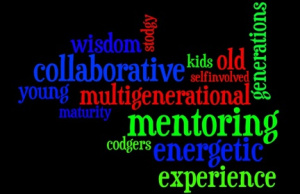
Multi-Generational Teams Work Best: Surprise!?

I keep hearing about really knowledgeable and skilled people in their 50s and 60s who are searching for jobs and not getting them. As I chat with them at different times and in different places, each has a sense that age plays a role in not getting at least some of the jobs they seek.

I am reblogging a popular post from a few years ago about multi-age work teams.

Ageism in hiring practices is a terrible mistake, not just because it’s wrong but because it weakens the workplace. Multi-age teams produce better products, services, technology innovations, and while research keeps confirming the importance of intergenerational groups at work, employers are slow to catch on.

Marti Weston's avatarAs Our Parents Age So Do We

Have you been ever in a work situation where you feel especially old because younger colleagues occasionally roll their eyes or flaunt their up-to-the-minute technology skills? Does this situation make you speak defensively, sometimes making jokes about senior moments or aging? We’ve all been there!

Read, Why Multi-Generational Teams Are Bestover at bNet, the CBS Interactive Business Network, and feel much better about your age and the contributions that you make at work.

Two broad reasons that a variety of age groups work together well and produce better results are:

View original post 63 more words

Posted in 21st Century life, anonymity, anonymous apps, commenting, digital world reading habits, ethical behavior, hate groups on the web, online hate, parents and technology, raising digital kids

Is Hate Speech in the Connected World Here to Stay?

Expressing hate is so easy with just a few taps on the keyboard.
Expressing hate is takes just a few taps on a keyboard.

Hate speech has been around for a long time, but the connected world has amplified it. Sometimes hateful and threatening comments on social media and in comment sections feel like they are run-of-the-mill daily events. Sadly, Twitter, an awesome social media communications platform — one that I and many educators use and adore — has offered one of the easiest pathways for hate speech amplification. Twitter makes it easy to be “sort-of” anonymous.

For a good overview of Twitter’s online hate problems, take a few minutes to read Jim Rutenberg’s New York Times article, On Twitter, Hate Speech Bounded Only by a Character Limit. Rutenburg shares some of the hateful accusations he’s received and talks about the challenges that Twitter faces with so much hateful, accusatory, and threatening speech. He notes that Twitter, which is no longer growing its subscriber base, is now for sale. Gutenberg speculates on who might purchase it. “You have to wonder,” he writes, “whether the cap on Twitter’s growth is tied more to that basic — and base — of human emotions: hatred.”                                                    Continue reading “Is Hate Speech in the Connected World Here to Stay?”

Posted in 21st Century life, 21st Century parenting, citizenship, digital citizenship, digital world conversations, parents and technology, raising digital kids

6 Digital Life Conversation Starters to Use in School Meetings, Discussions & Presentations

How much should parents know about the settings on children’s digital devices?

Now that back-to-school nights are about over, schools will be scheduling parent potlucks, curriculum nights, and educational seminars throughout the academic year. These activities offer lots of opportunity for educational communities to start conversations about the challenges — for parents and kids — of growing up in the connected world.

At all of these events administrators, teachers, and parents should plan to incorporate a few introductory comments that encourage parents to think about helping their digital children become stronger learners, savvier digital citizens, better consumers of content on their digital devices, and overall, more knowledgeable citizens.

Below are a few questions that can be shared at school events and classroom presentations, questions that encourage parents to talk about managing life with 21st Century digital kids. While there are no right answers to these questions, the conversations provide adults an opportunity to talk about what works — and what does not —  in the context of young people’s school and social lives.

Choose one or at most two inquiries to use at each activity. Continue reading “6 Digital Life Conversation Starters to Use in School Meetings, Discussions & Presentations”