Posted in 21st Century Learning, 21st Century parenting, 21st Century vocabulary words, cyber-bullying, digital citizenship, digital learning, digital life, digital parenting, kids and privacy, parents and technology

Building Habits of Privacy Into the Conversation & the Curriculum

21st Century Vocabulary Words — Privacy

Young people confuse privacy with safety.

While most kids carefully follow the rules that parents and teachers set out — no names, addresses, telephone numbers, or other personal information — when it comes to the big privacy picture, it turns out that many children understand very little about their personal data, how it accumulates, and how it affects privacy. (Check out my privacy links at the end of this post.)

Thus we need an alternate privacy teaching strategy that helps 21st Century kids — all ages really — understand how their digital-world data accumulates — even when users observe the all-important safety rules.

Bruce Schneier, a fellow at the Berkman Center for Internet and Society at Harvard Law School, writes about and consults on data and security, and his blog is Schneier on Security. In a 2010 post, A Revised Taxonomy of Social Networking Data, Schneier suggests how to classify data into six personal categories, the data generated as we use social media (and I’ll add other websites and games), and how all this data creates an individual’s digital profile. (Note: profile is another 21st Century vocabulary word).

Continue reading “Building Habits of Privacy Into the Conversation & the Curriculum”

Posted in 21st Century life, 21st Century parenting, digital devices, digital kids, digital life, mentoring digital kids, parents and technology

Another Digital Parenting Book That’s Scary – Sigh…

fear riskSo many digital parenting books and articles generate fear and anxiety, and American Girls: Social Media and the Secret Lives of Teenagers is no exception. The big question is whether or not this book, or any of the others, can inspire parents to get serious, learn about the relationships and issues their children encounter with poorly supervised mobile devices, and then figure out how to guide and, yes, supervise their children.

Journalist Nancy Jo Sales offered us a preview of her book in a 2013 Vanity Fair article, Friends Without Benefits, and now that I’ve read both the book and the article, I’d recommend going for the article. The book definitely offers many more interviews with girls, providing an intensive gaze through the prism of 21st Century adolescent digital life.

Continue reading “Another Digital Parenting Book That’s Scary – Sigh…”

Posted in 21st Century life, 21st Century parenting, digital devices, digital life, media diet, parents and technology

Screen Time: Myths & Facts (and More)

Screen Shot 2016-03-03 at 7.44.51 PMCheck out a cool infographic over at Tuned in Parents that addresses many screen time questions. The image was created using information from a broad array of evidence-based research conducted by organizations such as Common Sense Media, The American Academy of Pediatrics, Zero to Three, PBS, and a number of research sources, and the infographic addresses many of the questions that parents continuously mull over.

Screen time is for many of us is a conundrum. Most parents and teachers (and grandparents, too) wonder just how to balance the time children spend with screens. Our goal, after all, is to create digital wellness for our children and ourselves — a sometimes lofty goal.

We have many questions including: Continue reading “Screen Time: Myths & Facts (and More)”

Posted in 21st Century Learning, 21st Century parenting, digital change, digital life, digital parenting, education not fear, Facebook, parents and technology, risky behavior, social media, supervising digital kids, values in digital life

On Digital Parenting Fear, Part #2 – We Must Know More About Kids’ Digital Lives

fear-riskIn our connected world unfamiliar activities make adults worry about kids, and violent and exploitative events, some connected to the digital world, make us fear for our children’s safety. This past week two events, a 13-year-old’s ruthless murder that was associated with online app interactions and a Wall Street Journal article, Cyberthieves Have a New Target: Children, made many of us wonder, once again, whether the digital world is degrading the quality of our lives.

Cybertheives PM

For me the week reinforced the importance of parents understanding what their children are up to on digital devices. It’s a serious responsibility, it requires enormous time and energy, and we cannot hire outside experts to do it for us. The work requires every parenting skill that we’ve ever developed and more, and if you are not up to it you need to consult a parent education organization, such as the Parenting Encouragement Program (PEP) in my area, that offers training to parents. Continue reading “On Digital Parenting Fear, Part #2 – We Must Know More About Kids’ Digital Lives”

Posted in 21st Century life, 21st Century parenting, 21st Century teaching, data collecting, digital footprints, digital life

Talking about Privacy & Digital Footprints In Grades 7-12

footpathOver the past couple of years, I’ve heard middle and high school kids say that they are sick-and-tired of hearing about their digital footprints — with many exclaiming that they already know what they need to know. My thought? They understand how they make digital footprints, but they don’t always make good decisions when it comes to avoiding the not-so-good digital trails.

What older students — those in late middle and high school — need is a reframed conversation, one that does not focus exclusively on what they do, focusing instead on the broad and complex issue of 21st Century privacy. Continue reading “Talking about Privacy & Digital Footprints In Grades 7-12”

Posted in 21st Century life, digital learning, digital life, digital parenting, parents and technology

5 New Year’s Resolutions to Improve Parents’ & Kids’ Digital Literacy Skills

The New York Times recently published For the New Year, Let’s Resolve to Improve Our Tech Literacy, about the need for leaders, law enforcement officials and policymakers to increase their digital world literacy. The December 23, 2015 article, written by Farhad Manjoo, points out that many the big problems that occur in our world become even more complicated because the leaders and law enforcement personnel do not have a big-picture understanding of the vast changes technology brings to today’s world. Greater understanding might strengthen our leaders’ problem-solving skills.

This article looks at the importance of digital literacy on a large-scale.

Tech Literacy

As I finished reading, I began thinking about resolutions on a smaller scale — those steps that adults and children can take in 2016 to improve a family’s tech literacy and perhaps prevent at least some of the potential connected-world problems. It’s a fast-paced, always-changing 21st Century world and everyone has a lot to learn. Many of the issues that do occur are made worse because kids and parents do not have enough knowledge to anticipate what might go wrong and take steps to steer clear of problems.

Below are five digital literacy resolutions that parents can make, and all of them can help people — both adults and children — become more sensible and savvy connected world citizens.                                                                  Continue reading “5 New Year’s Resolutions to Improve Parents’ & Kids’ Digital Literacy Skills”

Posted in 21st Century life, 21st Century parenting, digital devices and gadgets, digital life, digital parenting, kids' advice for parents, media and family life, parents and technology, screen time

What to Do About Screen Time – A Diane Rehm Show Discussion

Click to check out the report’s infographic..
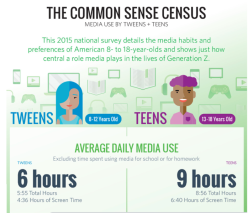
Click to check out the Common Sense Media research report’s infographic.

This past week I listened to New Research On Teens, Toddlers and Mobile Devices, an engaging radio program about digital parenting on The Diane Rehm Show (NPR). In early November 2015 Rehm featured four expert guests who thoughtfully examined the digital parenting issues that adults should consider when it comes to digital media and children. It was rebroadcast in  December 2015.

The program appeared to be timed to highlight a recently released report, The Common Sense Census: Media Use by Tweens and Teens (2015). Educators and parents will learn a lot by listening to this broadcast or reading the transcript and by checking out the program’s resource links.

A new year—with new devices and new considerations about rules and limitation—is a good time to listen to experts who can help adults think more carefully about how to define screen time and discuss the research (and the need for much more). This program can help adults guide children whose 21st Century lives are increasingly defined by digital activities.                         Continue reading “What to Do About Screen Time – A Diane Rehm Show Discussion”