Posted in 21st Century life, data collecting, digital life, gadgets and sleep, parents and technology

My Personal Fitness Device: Generating Data to Improve My Health

IMG_4639
My Jawbone bracelet — simple and basic black. I can wear it anywhere and any time.

If you wear a personal fitness device, or if you are considering one, check out Robin Raskin’s short Huffington Post article, What Happens to All Your Data When You Monitor Your Fitness. The author has also posted the piece on Linked In.

While we have many good reasons for wearing fitness trackers, Raskin’s piece explains how the device companies accumulate, post, and use our data. More importantly, she describes how the fitness data has inspired public health initiatives — just one more reason to wear a tracker. With all the concern about personal data in our 21st Century lives, it’s nice to know that sometimes the information can be put to good use.

Exactly one year ago, I began wearing my Jawbone UP 24 personal fitness bracelet. The first day I put it on, expecting to record 10,000 steps without thinking much about it. Boy, was I wrong. Despite the fact that I exercised four to five times a week, it turned out that many days I was barely getting over 5,000. For weeks I had to focus on accumulating the other 5,000. Over the first month, however, I discovered that I liked keeping track of my steps, and by the day things got easier and easier.

Continue reading “My Personal Fitness Device: Generating Data to Improve My Health”

Posted in 21st Century life, apps, digital devices, parents and technology

Top Mobile Apps? Interesting Data from ComScore

top-25-mobile-apps-by-unique-visitor_reference
Click for a larger image.

Parents and educators often wonder aloud just who produces the most popular mobile apps and how many people, especially preadolescents and adolescents, actively use them on mobile devices.

Check out this ComScore image that depicts the most popular apps. Click on the image to visit a larger one at the company’s website that is much easier to read. The numbers represent unique visitors, though we cannot figure out ages. Still, it is interesting to wonder how many of these apps are on your digital devices? Your children’s digital devices?

ComScore is a company that statistically measures the activities of people on the web. It collects information from all over the world and the website is available in a range of languages. If you visit ComScore you can discover all sorts of interesting digital-world info-snapshots depicted with charts and graphs.

I am not at all surprised by this list of most popular apps in our 2014 21st Century lives. Are you?

Posted in 21st Century Learning, 21st Century parenting, 21st Century teaching, apps, Back-to-school digital reading, digital devices, digital kids, digital parenting, mobile phones, parents and technology

How Quickly Do New Apps Gain Kids’ Attention?

See the larger charts below.

As we get ready to return to school for the 2014-15 academic year, my thoughts turn toward the digital life changes that I’ll observe in the lives of my 21st Century students when we come together in September.

After three months of summer activities such as volunteering or part-time jobs and the less structured time at camps and on vacations, most kids arrive at school with new digital experiences, devices, and apps — and they want to share everything. I’ve especially thought about the number of apps that seem to come out of nowhere — suddenly appearing in kids lives and on their mobile devices — and I know popular new ones will appear this fall.

Below I am sharing three slides from digital parenting presentations that I made over six months, from October to May during the 2013-14 school year.

Continue reading “How Quickly Do New Apps Gain Kids’ Attention?”

Posted in 21st Century life, online tracking, parents and technology, privacy

Retailers Track Adults by Monitoring Device Wifi

We most often worry about advertisers tracking our children online but sometimes forget to think about how much we adults are followed around digitally.

FTC Privacy Series
FTC Privacy Seminar on Mobile Device Tracking

Check out the Washington Post article, Privacy Advocates Push Back on Stores’ Tracking, describing how retailers keep track their customers by monitoring smartphone wifi signals. No guidelines currently regulate this type of information collecting so no privacy parameters exist. Essentially this mobile device tracking is a way to get more information about shoppers, track what they do, and target advertising and target advertising more effectively.

The article, by Amerita Jayakuma, describes how a Maryland legislator has proposed a bill to require retailers to inform people if the store is watching them while they shop.  The Federal Trade Commission recently held a seminar on mobile device tracking.

I’ve been wondering for some time if I was tracked a few months ago when I visited a huge regional outlet mall with my husband.

Continue reading “Retailers Track Adults by Monitoring Device Wifi”

Posted in 21st Century parenting, digital devices, gadget ownership, mobile media devices, parents and technology, too much media?

Children’s Media Use in America – 2013 Report

Common Sense Media 2013 report finding
Check out the other survey findings.

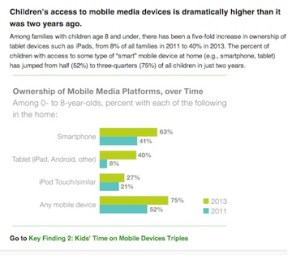
Common Sense Media has published a 2013 report on young children and their access and use of mobile media devices, Zero to Eight, Children’s Media Use in America 2013. The new research study aims to get a reading on how media use has changed since the organization completed and published its 2011 media and children study. Common Sense Media plans to redo this research biennially and publish the collected data.

The 2013 results are based on a nationally representative survey of parents with children under eight years of age. Researchers surveyed 1,463 parents utilizing the same methodology that was used in the 2011 survey and making sure that African-American and Latino representation was large enough to ensure statistically valid conclusions. To further ensure the reliability of the data, investigators provided devices and Internet access to survey participants when necessary.

Several of the Most Interesting 2013 Findings

  • The survey data indicate that almost twice as many children, eight years and younger now use mobile media when compared to the 2011 Common Sense Media results.
  • Television, DVD, and video game use on traditional screens is decreasing, but television still dominates.
  • Although access to mobile media for poor and underserved children has increased since the 2011 survey, a digital divide still exists.

Continue reading “Children’s Media Use in America – 2013 Report”

Posted in cell phones, digital parenting, electronic communication, gadget ownership, mobile phones, parents and technology, social media friends

Are Teens Moving Away from Facebook?

Take a few minutes to read Some Teens Aren’t Liking Facebook as Much as Older Users, a May 30, 2012 business article in the Los Angeles Times. Facebook’s growth is slowing, and many teens, after absorbing lessons about privacy and the need to share less personal information, now seek to socialize online in smaller community groups with people they know.

Reporters Jessica Guynn and Ryan Faughnder point out that students are also far more eager to use mobile services designed for their smartphones. Interestingly, parents are still avid Facebook users.

Best Quotes from the Article

  • Teens… can also be more selective about what they share and with whom, and feel less social pressure to “friend” everyone in their school or friends or friends.
  • Teens who belong to the first truly mobile generation — their most common form of communication is text messaging — are increasingly gravitating to services made for their smartphones and tablets.