Posted in 21st Century life, digital change, early childhood, electronic toys, language development, parents and technology

Traditional Toys, Electronic Toys, and Language Development

Lego blocks for early childhood playing, conversing, and learning.
Lego blocks for early childhood playing and learning.

In December I read an article about a study published in the journal JAMA Pediatrics describing how different types and amounts of parent/child speech interactions during infant play may increase or decrease, depending on the type of toys that the child uses.

The new research, though conducted on a small sample of participants, finds an association between talking electronic toys and and reduced parent/child interaction during playtime, and the results add to an existing body of literature that observes how electronic toys affect a child’s language development.

In her article, Association of the Type of Toy Used During Play With the Quantity and Quality of Parent-Infant Communication, (abstract) researcher Anna V. Sosa, PhD. discusses her research, carried out with 26 parent and older infant pairs (dyads). The article is not too difficult to read, but it is available only at a library with access to the journal. Continue reading “Traditional Toys, Electronic Toys, and Language Development”

Posted in 21st Century life, digital learning, digital life, digital parenting, parents and technology

5 New Year’s Resolutions to Improve Parents’ & Kids’ Digital Literacy Skills

The New York Times recently published For the New Year, Let’s Resolve to Improve Our Tech Literacy, about the need for leaders, law enforcement officials and policymakers to increase their digital world literacy. The December 23, 2015 article, written by Farhad Manjoo, points out that many the big problems that occur in our world become even more complicated because the leaders and law enforcement personnel do not have a big-picture understanding of the vast changes technology brings to today’s world. Greater understanding might strengthen our leaders’ problem-solving skills.

This article looks at the importance of digital literacy on a large-scale.

Tech Literacy

As I finished reading, I began thinking about resolutions on a smaller scale — those steps that adults and children can take in 2016 to improve a family’s tech literacy and perhaps prevent at least some of the potential connected-world problems. It’s a fast-paced, always-changing 21st Century world and everyone has a lot to learn. Many of the issues that do occur are made worse because kids and parents do not have enough knowledge to anticipate what might go wrong and take steps to steer clear of problems.

Below are five digital literacy resolutions that parents can make, and all of them can help people — both adults and children — become more sensible and savvy connected world citizens.                                                                  Continue reading “5 New Year’s Resolutions to Improve Parents’ & Kids’ Digital Literacy Skills”

Posted in 21st Century Learning, digital citizenship, digital devices, family conversations, family life, mentoring digital kids, parents and technology

A Positive Story for Younger Digital Kids: Meet the Von Awesome Family

THUMBNAIL_IMAGEAs parents and educators, we quickly come to understand how stories help young people learn.

Unfortunately, when it comes to digital parenting and digital citizenship, we do not have many positive children’s stories — the kind you can sit down and read with a child. We know what we want children to learn as they grow up and use more and more digital devices in a connected world. We are also gradually coming to understand that citizenship and digital citizenship are one and the same.

We need lots more stories that illustrate the way digital life should be lived — stories that we can share with 21st Century children when they are young.

Continue reading “A Positive Story for Younger Digital Kids: Meet the Von Awesome Family”

Posted in 21st Century Learning, 21st Century life, digital citizenship, digital devices and gadgets, family conversations, kids changing lives, parents and technology

Digital Literacy 101 for Kids, PreK -Grade 6: A Checklist

Screen Shot 2015-10-21 at 1.09.16 PM

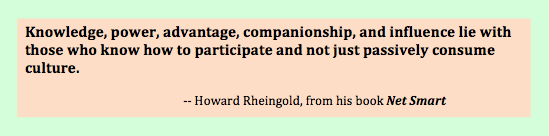
In his book Net Smart, Howard Rheingold writes that for any of us to become knowledgeable connected world users and citizens, each of us needs to develop and continually strengthen five areas of digital literacy. People who use the web wisely and with good results develop fundamental skill in five literacy areas — attention, participation, collaboration, network awareness, and critical consumption of content.

New Smart
New Smart – Read Rheingold’s Educause book excerpt.

As the lives of children, online and off, grow more complex by the day, we adults spend a good deal of our time helping them learn more about the lives they will live in a 21st Century world. We are accomplished at mentoring children in the parts of their lives that are offline, but often teachers and parents simply react to digital life problems rather than build fundamental digital literacy skills that will help children avoid problems. For kids to really be prepared to develop the five literacies that Rheingold describes, they need to build up a foundation of knowledge about the connected world environment.

How is it that children, pre-adolescents, and teens can understand how to use digital devices, consume digital culture at an early age, and even figure out digital device problems for their parents, but have only the barest knowledge about how to relate thoughtfully to people online, take complete advantage of digital resources, and solve problems rather than create them? The reason? We adults have so often put the cart before the horse. We give children their own personal devices or let them borrow ours — gadgets connect in various ways to the entire world,  albeit different ones at different ages — and only gradually go about teaching the fundamental literacy aspects later on and especially when something goes wrong.                          Continue reading “Digital Literacy 101 for Kids, PreK -Grade 6: A Checklist”

Posted in 21st Century life, Conversation skills, parents and technology

Why We Need Baby Talk in the Digitally Connected World

9780525954873_p0_v3_s192x300I just finished reading an engaging National Public Radio (NPR) report about Dana Suskind, MD, a University of Chicago surgeon, learning about her new book, 30 Million Words, Building a Child’s Brain. Dr. Suskind, who notes that we should speak to babies all the time that they are awake — when we play, when we help them with things, when out on walks and whenever else, because it ensures that the best neural development takes place. Baby talk has a huge purpose.

After writing my previous post, Does Digital Life Distort our Conversation Skills? about Sherry Turkle’s new book, I was reminded about the people we see talking on mobile phones while pushing wide awake babies in strollers. But I also pictured myself grabbing a glance at my phone when my baby grandson gets especially engaged with a toy — a time when I should continue to, well, babbling  away with him.

30 Million Words is another must read book.

Continue reading “Why We Need Baby Talk in the Digitally Connected World”

Posted in 21st Century Learning, 21st Century life, 21st Century parenting, Conversation skills, digital devices, digital health and wellness, parents and technology

Does Digital Life Distort Our Conversation Skills?

Jacket-for-Reclaiming-Conversation
Learn more about the book.

Do our conversation skills weaken as we continually connect — virtually and physically — with our digital devices? How does this always-connected environment affect our children and youth? Are conversational and empathy skills developing as they should?

Sherry Turkle describes these problems in Reclaiming Conversation, a book that relates how the individuals in many of her interviews note — uncomfortably so — that they are less and less able to carry on a conversation confidently. More worrisome, children, in general, appear to be less able to converse, put themselves in another individual’s shoes, and empathize with that person. Turkle backs up her assertions with evidence.

Continue reading “Does Digital Life Distort Our Conversation Skills?”

Posted in 21st Century Learning, 21st Century parenting, digital kids, digital parenting, parents and technology

A Few Back-to-School Posts from the Past

backtoschool postsEach year I write a back-to-school post, that challenges parents and educators to think about the ever-changing lives we live as parents and teachers in our increasingly digital world. This year my  2015 post, A Back-to-School Digital Parenting Checklist, received quite a few hits.

So today I am re-sharing several of my back-to-school pieces from the start of previous academic years. Despite how fast change occurs in our lives, these posts are still timely.                              Continue reading “A Few Back-to-School Posts from the Past”