Posted in 21st Century life, data collecting, digital life, kids and privacy, online data collecting, online tracking

How Much Privacy Do I Have? DuckDuckGo Gives More

book-dg3-150wAlthough I believed that I had taken significant steps to maintain a modicum of privacy in my 21st Century digital life, I was wrong.

I am less than halfway through Bruce Schneier’s book, Data and Goliath, all about the hidden methods of collecting our personal data, and already I am discovering that my personal privacy plan has many holes. I’m not that different from most adults. Privacy, however, is going away, and we collaborate in the process by not making any specific decisions and by going along with the ways the Internet tracks us. We do have choices, and we educators and parents need to learn a lot more about maintaining privacy and then share what we’ve learned with young people.

Screen Shot 2016-06-09 at 10.19.26 PM
Vanity Fair has 11 trackers and widgets.

In the book’s first chapters Schneier addresses data collection, how trackers get added to my computers and digital devices as little files called cookies. With a quick search, I found over 1,000 cookies and cache files on my laptop, despite the fact that I only allow cookies from places that I visit (about 650 were cookies). Some of these are useful and don’t bother me — like the cookies for the several catalogs where I  regularly make purchases, the newspapers which I read, and the educational and musical organizations which I like. Read more about cache. Continue reading “How Much Privacy Do I Have? DuckDuckGo Gives More”

Posted in parents and technology

Privacy: I’ve Got Nothing to Hide So I’m Not Worried …

Just the other day, in a conversation about personal privacy, I overheard one adults say to another person, “I’ve got another to hide… “ I wanted to jump into the conversation, but instead I am republishing this 2013 blog post.

Marti Weston's avatarMedia! Tech! Parenting!

imageI often hear people of all ages, including children, say, “It doesn’t matter that my digital information is collected, because I have nothing to hide.” What bothers me most about this comment is the limited understanding that it demonstrates — a lack of knowledge about how fast the traditional walls of privacy are tumbling down and how little of it has to do with the bad things that people do.

People who make the comment usually know little about what happens to collected digital data, most of it documenting everything we do in our daily digital lives and almost none of it destined to identify wrongdoings or help to find “bad guys.” So much data is now collected about each of us in so many different ways, that almost nothing about us cannot be found out.

Our phones document where we go, our cars move through intersections with mounted cameras…

View original post 384 more words

Posted in 21st Century life, 21st Century parenting, coding, collaborating with kids, Conversation skills, digital kids, family conversations, gadgets of convenience, modeling for kids, parents and technology

Digital Kids’ Summer – Collaborative Projects & a Printable

** Please feel free to share this post with parents at your school
or parent group using this PDF. **

IMG_4257Summertime, summertime, sum, sum, summertime!

Summer 2016 is almost here. It’s a great time for family fun, outdoor activities, visiting museums and historical sites, and choosing from all sorts of camps and special programs. Problem is, many kids spend a lot of their summer vacation in front of screens, and it’s one of the hardest time of the year to focus on digital moderation.

With less frenetic schedules and no school, the summer months are a good time for parents to learn more about the digital whirl that’s such a huge part of kids’ 21st Century lives. So when school is out, plan to do some connected world exploring and learning together, concentrating on projects that can help family members — children and their parents — connect with interesting and meaningful work together. Everyone will figure out more about digital life and add some variety to the types of digital activities that they typically do.

Below are 10 family digital project summer suggestions — all activities require collaboration —  to consider for the upcoming summer vacation.

Ten Summer Digital Projects for Families                        Continue reading “Digital Kids’ Summer – Collaborative Projects & a Printable”

Posted in 21st Century life, 21st Century parenting, data collecting, digital footprints, digital life, kids and privacy, online data collecting, parents and technology, privacy

How Photos & Data Collecting Take Away Our Privacy

Screen Shot 2016-05-22 at 6.54.28 PM
A bank of computers in a data center. Via Pixabay.

Finding good resources to help young people learn and understand more about data and photo collecting is key to building strong citizens in our 21st Century digital world. We adults can also learn a lot in the process.

Interestingly, no matter how we set privacy settings (stipulating who can see our images), the sites where we post and share continually accumulate information about us  — much, but not all, gleaned from the photos themselves.  Yes, it’s about digital footprints, but it’s much bigger than that.

One article we should read is Why Photos Are The Next Big Battleground in the Fight for Privacy, over at The Next Web news site. The report is chock full of interesting information about big data and how it zeros in on our photos. It also includes sobering statistics about the number of pictures that people share in sites like Facebook, Instagram, and Google. It’s good information to share with the digital kids in your family or school. Continue reading “How Photos & Data Collecting Take Away Our Privacy”

Posted in 21st Century life, 21st Century parenting, personal data, social media, social media content, understanding data

U.S. Government to Search Social Media Accounts for Security Clearances

Who’s data is it?
Who’s data is it?

Are there specific situations when others — people we do not know — check out and examine our social media data?

An article in the Washington Post, U.S. to Scan Social Media Accounts Before Issuing Security Clearances, describes a directive issued by James Clapper, the Director of National Intelligence, about searching social media files.

According to officials responsible for formulating policy and implementing the directive, future government employment security clearance investigations will include a search of social media content. Applicants will not be asked for passwords and investigators will not log into (or break into) accounts. Investigators will seek to identify the range of an individual’s public content, looking for information that might raise red flags and adversely affect a decision to give a person a security clearance.

Continue reading “U.S. Government to Search Social Media Accounts for Security Clearances”

Posted in 21st Century Learning, 21st Century teaching, coding, digital learning, electronic toys, parents and technology, programming, robots, teaching

Teaching Kids to Code With Robots: Great New Yorker Article

Visit the Sphero website.

Check out the May 16, 2016 New Yorker for the article A Whole New Ball Game: The Rolling Robot That Teaches Kids to Code. Author D.T. Max, describes how Ian Bernstein and Adam Wilson invented the Sphero robot, and he explains how the ideas were conceived, how Sphero was designed, and the long process of promotion and sales. The article also includes explanations about how Sphero and other coding toys aim to help children develop 21st Century skills.

The comments from Sphero creators and from Paul Barberian, who became the first Sphero CEO, provide first-hand descriptions about working with and expanding ideas, connecting with a business incubator, and eventually starting a viable business. Max reminds readers about the Silicon Valley process — empathize, define, ideate, prototype, test — and how this process is crucial to the success of new inventions and in the schools where students use robot toys to solve problems. The article also includes thoughts from Barberian about how the business is considering expansion ideas, especially thinking about robots that develop personal attachments with their owners — what’s called adaptive personality.              Continue reading “Teaching Kids to Code With Robots: Great New Yorker Article”

Posted in 21st Century life, 21st Century parenting, cell phones, digital devices, digital kids, family conversations, parents and technology, screen time, teens and technology

Digital Devices & Parent-Teen Time Issues — New Research

Ne
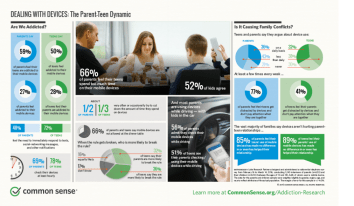
Click here to visit the Common Sense Media research page and sign in for a larger and higher quality image.

Check out the interesting new research just out from Common Sense Media about the issues and challenges when it comes to 21st Century digital kids and their mobile devices. The image depicts a range of statistics and device issues, collected via a poll of 1,200 parents and teens.

This infographic can be an excellent resource to use for family conversations about teens’ and children’s screen and digital device times (and adults’ times, too). It offers a range of information that can help parents discuss potential problems and concerns.

Continue reading “Digital Devices & Parent-Teen Time Issues — New Research”