Posted in 21st Century life, 21st Century parenting, citizenship, digital citizenship, digital world conversations, parents and technology, raising digital kids

6 Digital Life Conversation Starters to Use in School Meetings, Discussions & Presentations

How much should parents know about the settings on children’s digital devices?

Now that back-to-school nights are about over, schools will be scheduling parent potlucks, curriculum nights, and educational seminars throughout the academic year. These activities offer lots of opportunity for educational communities to start conversations about the challenges — for parents and kids — of growing up in the connected world.

At all of these events administrators, teachers, and parents should plan to incorporate a few introductory comments that encourage parents to think about helping their digital children become stronger learners, savvier digital citizens, better consumers of content on their digital devices, and overall, more knowledgeable citizens.

Below are a few questions that can be shared at school events and classroom presentations, questions that encourage parents to talk about managing life with 21st Century digital kids. While there are no right answers to these questions, the conversations provide adults an opportunity to talk about what works — and what does not —  in the context of young people’s school and social lives.

Choose one or at most two inquiries to use at each activity. Continue reading “6 Digital Life Conversation Starters to Use in School Meetings, Discussions & Presentations”

Posted in parents and technology

Digital Parenting Booster Shot? A Healthy Child Metaphor

If you are getting ready for Back-to-School or Curriculum Nights at your school, here’s a post from September 2015 the illustrates the importance of including digital wellness information in all-school and classroom presentations.

Marti Weston's avatarMedia! Tech! Parenting!

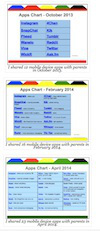
mini-apps-charts-sm2If you are an educator or parent searching for just the right comments about digital parenting to use at a school, organization, or parent meeting, take a look at the blog post A Booster Shot on Parents’ Night by Ann Klotz over at the National Association of Independent Schools (NAIS). Klotz, the head of the Laurel School outside of Cleveland, hits the nail on the head, using a healthy child metaphor to describe the important responsibilities — digital and otherwise — for the parents of digital kids. Adults, she points out, must take on these responsibilities no matter how they feel about technology (or even how much more a parent thinks a child knows about technology). Below is one paragraph from Klotz’s post, but I suggest that you read the entire post.

Ann Klotz wrote:                                   

View original post 488 more words

Posted in 21st Century parenting, acceptable use, digital parenting, modeling for kids, parents and technology

Sharenting? A Child’s Digital Future Requires Careful Consideration Today

It was so much easier when we shared in photo albums!

I’ve often written about sharenting — defined as digital age parents sharing their 21st Century kids’ photos, stories, and information via Facebook, blogs, and other public online social media.

If you are mulling over the sharenting topic and want more guidance and perspective, take a few minutes to read a just-published article over at Sonya Livingstone’s Parenting for a Digital Future blog. The article, written by Alicia Blum-Ross, Where and When Does a Parent’s Right to Share End Online?, discusses the ways that bloggers who are also parents think about sharing information online and the “digital dilemma” that they experience. Blum-Ross also explores how these parents consider the future that their children will experience while growing up and examining the digital information about themselves.

Continue reading “Sharenting? A Child’s Digital Future Requires Careful Consideration Today”

Posted in parents and technology

Quizzes? Fun, but Each Quiz Wants Your Information

If like me you get a kick out of taking Facebook quizzes and sharing your results with friends, it’s time to think a bit more about caution and privacy. Have you ever wondered why these quizzes pop up on your account? Parents, teachers, and students all need to understand that these quizzes have little to do with entertainment and lots to do with getting people to part with personal information.

What is an IP Address?

If you do not know much about online quizzes, and you take them or are tempted by many of them, spend a few minutes reading What You Need to Know About Online Quizzes and Surveys over at the Webroot website and Facebook Quizzes: What Happens to Your Data at the BBC. Essentially, when you take a quiz you freely give out your personal information — and it’s not just the answers you provide, but also the data you allow the quiz creator to access. You also give up a bit more of your personal privacy and may have a small app installed on your Facebook page.

Continue reading “Quizzes? Fun, but Each Quiz Wants Your Information”

Posted in 21st Century life, collaborating with kids, digital health and wellness, digital life, family conversations, parents and technology, screen time, starting the school year

The Screen Time Equation – Crafting Thoughtful Solutions to a Digital Life Dilemma

screen time
What is screen media?

Crafting screen time guidelines for all family members is a great back-to-school undertaking, but coming up with guidance that is fair and equitable requires family members to consider and answer a range of questions.

Devoting beginning-of-the-year time — at home and at school — to examine solutions to the screen time equation will help 21st Century  children find and understand answers to the most challenging question that so many of us ask, “What exactly is screen time?” To help get started the whole family can listen to a radio program about screen time, a 2015 broadcast on NPR’s The Diane Rehm Show.

Schools can support and collaborate with families by helping students understand the usefulness of non-screen activities, specifying clearly to parents and students the academic expectations for school digital devices at home, and explaining in detail what students are expected to do and use when they complete work online. Refocusing on multitasking (It’s not possible.) is also a good idea as well as stating the school’s commitment to student privacy.         Continue reading “The Screen Time Equation – Crafting Thoughtful Solutions to a Digital Life Dilemma”

Posted in 21st Century Learning, 21st Century parenting, back-to-school, digital footprints, digital parenting, digital parenting checklist, parents and technology

9 Digital Parenting Back-to-School Tips – 2016-17 (With Printable PDF)

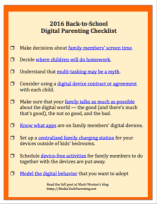
Screen Shot 2016-08-21 at 9.44.02 PM
Click to download a PDF document.

You can also read a 2019-20 back-to-school update of this post.

What can parents and teachers do to ensure that digital kids, with their hand-held devices, connected school activities, homework, and other online activities, get off to a good start at the beginning of the school year?

Back-to-school preparation is more than school supplies, lunch boxes, and carpool arrangements. It also involves reviewing and articulating connected-life expectations with family members.

To help you consider the issues in your 21st Century child’s digital life, and your own, use this nine-item back-to-school digital parenting checklist to get started. Continue reading “9 Digital Parenting Back-to-School Tips – 2016-17 (With Printable PDF)”

Posted in 21st Century Learning, 21st Century teaching, connected learning, constructing modern knowledge, digital change, digital devices, educational technology, maker movement

Farewell Dr. Papert: May Your Technology & Learning Vision Live Forever!

Massachusetts Institute of Technology’s Professor Seymour Papert passed away recently.

A picture I took onside the MIT Media Lab.
A picture I took inside the MIT Media Lab.

While he had been fragile for some time following an accident, his extraordinary influence on teaching and learning, including how he really created the maker movement more than 25 years ago, will continue for many years to come.

Without his wisdom and vision, many educators in the school technology fields, where I spent most of my career,  would not have been fortunate enough to pursue exciting and deeply meaningful vocations. Every school, every teacher, every educational technology specialist, and every K-12 technology director can trace their professional activities back to Dr. Papert’s deep understanding of the power of learning with computers and digital devices. The Media Lab remembrance page notes that:

Papert’s career traversed a trio of influential movements: child development, artificial intelligence, and educational technologies. Based on his insights into children’s thinking and learning, Papert recognized that computers could be used not just to deliver information and instruction, but also to empower children to experiment, explore, and express themselves.

Continue reading “Farewell Dr. Papert: May Your Technology & Learning Vision Live Forever!”