
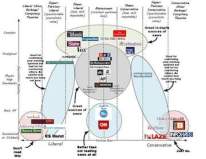
How to scrutinize, classify, organize, and evaluate today’s media — as much as possible, online and off? That’s the question.
As we search for ideas that can help young people explore news sources, evaluate their preferences, examine how the media outlets identify and share facts, we mustn’t forget incorporating the opportunity to talk with one another about the perspective that each source brings to its news-sharing. Recently I found Vanessa Otero’s interesting diagram that demonstrates how we can focus on media sources as well as consider their viewpoints and biases.
Evaluating 21st Century news is more complex than it’s ever was in the 20th Century. Reading the news is de-emphasized and watching the news is more prevalent, so we don’t interact much with information sources. The Internet and cable television channels allow opinions or made-up stories to masquerade as news sources — even when those opinions have no credible or factual source. Social media amplifies everything. Truth and expertise are incidental. Continue reading “Classifying News Sources With a Venn-Diagram Mapping Strategy”
 Fake is a generic term. It means one thing to one person and another thing to someone else. Anyone can say that something is fake or made up.
 Fake is a generic term. We don’t use it much when we teach — in any subject — because it’s judgmental and doesn’t tell us much about whatever it’s supposed to be characterizing. Besides, anyone can say that something — anything — is fake or made up.
 If you think a lot about fake news these days, and if you aim to help your students or family members develop the ability to effectively evaluate and decide what’s real and what’s not, National Public Radio (NPR) just published an excellent article,
  Media! Tech! Parenting!
You must be logged in to post a comment.