Posted in 21st Century Learning, 21st Century parenting, digital change, digital devices, digital wellness, digital-device-free times, mentoring digital kids, modeling for kids, parents and technology

After Buying a Device & Before Giving It to Kids — 2016 Update

iphone-6s
My new iPhone, purchased in early 2016.

Every 21st Century parent needs a holiday digital parenting checklist that describes the tasks to accomplish between purchasing a new digital device and watching a child gleefully unwrap it. This list gives parents a head start, identifying challenges, offering explanations, anticipating problems, and most importantly, setting the stage for responsible and respectful use of exciting but extraordinarily powerful devices.

The time adults spend preparing for new devices that enter a family’s life is well spent and spending that time up front may well prevent a huge time drain later on after a your child experiences a connected world problem. Parents are simultaneously guides, limits setters, and lifeguards, whether or not they know as much about digital life as their children.
The MediaTechParenting 2016
         Digital Parents’ Holiday and Beyond Checklist        

Continue reading “After Buying a Device & Before Giving It to Kids — 2016 Update”

Posted in 21st Century Learning, 21st Century life, 21st Century parenting, 21st Century teaching, online communication, online security, parents and technology, privacy, public vs private comments, teachers, teaching digital kids

Digital Communication Disrupts the Rules of Civility, Privacy, & Integrity

Click to read the article.
Click to read the Washington Post article.

After spending years teaching digital citizenship and civility in the K-12 world, I’ve now come to the conclusion that we parents and teachers should, in the midst of teaching children, stress that there is never privacy online. Yes, I know that we already teach this — or try to — in most schools and homes, but election 2016, accompanied by the theft and sharing of emails and other connected world materials, is scary. It has proven that everyone can be hurt by what they say online — even when what is said is not intended to generate hurtfulness.

To learn much more about the lack of privacy in private communication read Deborah Tannen’s October 28, 2016 Washington Post column, Why What You Say In Private Looks Bad in Public, Even if It Isn’t. Tannen is a professor at Georgetown University and the author of the bestseller, You Just Don’t Understand.

Our confidential comments may differ from what we say in public. When our candid thoughts become widely available — yes, through hacking, but with kids, it’s through intentional sharing, gossip, or the unintentional mistakes that kids make — words can often be interpreted negatively. Moreover, at least for the time being, we live in a world where stealing a public figure’s private communications and making them public appears to be OK.

Good Quotes from Deborah Tannen’s Article  (Read the entire article for much more)           Continue reading “Digital Communication Disrupts the Rules of Civility, Privacy, & Integrity”

Posted in 21st Century life, hateful comments, offensive speech, parents and technology

Teaching Children (and Adults) to Extricate Themselves from Offensive Situations

Expressing hate is so easy with just a few taps on the keyboard.
Expressing hate is so easy with just a few comments or taps on the keyboard. Develop strategies to contain it.

Can a person learn how to respond to an offensive or hateful situation? Can adults help 21st Century young people master the skills? Earlier this fall I wrote a post, Is Hate Speech Here to Stay?, wondering if up-front, in-your-face hate and offensive speech will be a continuing problem in our connected world.

Recently a New York Times article, Lessons in the Delicate Art of Confronting Offensive Speech, described the challenges and awkwardness that individuals experience when they happen to hear or see a person engaging in offensive activity. The piece highlighted research about what occurs when people challenge offensive speech, and it suggests concrete steps that a person can take when confronted by offensive behavior or speech. The authors, Benedict Carey and Jan Hoffman, point out that researchers have consistently found that a person who makes the awful comments will often curb behavior when another expresses reservations or reacts in a more indirect way.

Continue reading “Teaching Children (and Adults) to Extricate Themselves from Offensive Situations”

Posted in 21st Century life, 21st Century parenting, citizenship, digital citizenship, digital world conversations, parents and technology, raising digital kids

6 Digital Life Conversation Starters to Use in School Meetings, Discussions & Presentations

How much should parents know about the settings on children’s digital devices?

Now that back-to-school nights are about over, schools will be scheduling parent potlucks, curriculum nights, and educational seminars throughout the academic year. These activities offer lots of opportunity for educational communities to start conversations about the challenges — for parents and kids — of growing up in the connected world.

At all of these events administrators, teachers, and parents should plan to incorporate a few introductory comments that encourage parents to think about helping their digital children become stronger learners, savvier digital citizens, better consumers of content on their digital devices, and overall, more knowledgeable citizens.

Below are a few questions that can be shared at school events and classroom presentations, questions that encourage parents to talk about managing life with 21st Century digital kids. While there are no right answers to these questions, the conversations provide adults an opportunity to talk about what works — and what does not —  in the context of young people’s school and social lives.

Choose one or at most two inquiries to use at each activity. Continue reading “6 Digital Life Conversation Starters to Use in School Meetings, Discussions & Presentations”

Posted in 21st Century life, collaborating with kids, digital health and wellness, digital life, family conversations, parents and technology, screen time, starting the school year

The Screen Time Equation – Crafting Thoughtful Solutions to a Digital Life Dilemma

screen time
What is screen media?

Crafting screen time guidelines for all family members is a great back-to-school undertaking, but coming up with guidance that is fair and equitable requires family members to consider and answer a range of questions.

Devoting beginning-of-the-year time — at home and at school — to examine solutions to the screen time equation will help 21st Century  children find and understand answers to the most challenging question that so many of us ask, “What exactly is screen time?” To help get started the whole family can listen to a radio program about screen time, a 2015 broadcast on NPR’s The Diane Rehm Show.

Schools can support and collaborate with families by helping students understand the usefulness of non-screen activities, specifying clearly to parents and students the academic expectations for school digital devices at home, and explaining in detail what students are expected to do and use when they complete work online. Refocusing on multitasking (It’s not possible.) is also a good idea as well as stating the school’s commitment to student privacy.         Continue reading “The Screen Time Equation – Crafting Thoughtful Solutions to a Digital Life Dilemma”

Posted in 21st Century Learning, 21st Century parenting, back-to-school, digital footprints, digital parenting, digital parenting checklist, parents and technology

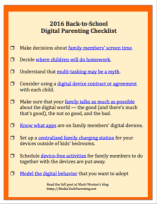
9 Digital Parenting Back-to-School Tips – 2016-17 (With Printable PDF)

Screen Shot 2016-08-21 at 9.44.02 PM
Click to download a PDF document.

You can also read a 2019-20 back-to-school update of this post.

What can parents and teachers do to ensure that digital kids, with their hand-held devices, connected school activities, homework, and other online activities, get off to a good start at the beginning of the school year?

Back-to-school preparation is more than school supplies, lunch boxes, and carpool arrangements. It also involves reviewing and articulating connected-life expectations with family members.

To help you consider the issues in your 21st Century child’s digital life, and your own, use this nine-item back-to-school digital parenting checklist to get started. Continue reading “9 Digital Parenting Back-to-School Tips – 2016-17 (With Printable PDF)”

Posted in 21st Century life, 21st Century parenting, cell phones, digital devices, digital kids, family conversations, parents and technology, screen time, teens and technology

Digital Devices & Parent-Teen Time Issues — New Research

Ne
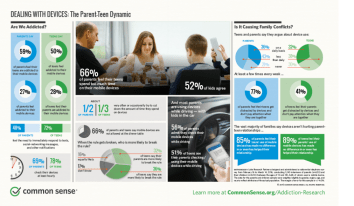
Click here to visit the Common Sense Media research page and sign in for a larger and higher quality image.

Check out the interesting new research just out from Common Sense Media about the issues and challenges when it comes to 21st Century digital kids and their mobile devices. The image depicts a range of statistics and device issues, collected via a poll of 1,200 parents and teens.

This infographic can be an excellent resource to use for family conversations about teens’ and children’s screen and digital device times (and adults’ times, too). It offers a range of information that can help parents discuss potential problems and concerns.

Continue reading “Digital Devices & Parent-Teen Time Issues — New Research”