Posted in 21st Century Learning, digital learning resources, parents and technology, workshops and conferences

Constructing Modern Knowledge: Sometimes Out of My Comfort Zone

CMK 2014
Click to visit the CMK14 site.

Occasionally we educators (and parents, too) participate in a learning experience that requires us to struggle for understanding and work hard to figure out what’s happening. Young learners go through this situation day after day in their school lives, even in the most wonderful classrooms. Adults not so much.

I’m in the middle of a challenging learning experience right now. This week the Constructing Modern Knowledge summer institute (CMK14) requires me to stretch. I’m expected to learn new things, figure out problems, and use all sorts of materials to invent, explore, and, yes, construct new ideas and information. Sometimes the work is heavy with digital materials and sometimes we use resources that have little to do with technology. It’s all about ideas and self-directed learning. No one tells me what to do or what to choose, but plenty of people are around to help me once I’m engaged with a task.                           Continue reading “Constructing Modern Knowledge: Sometimes Out of My Comfort Zone”

Posted in 21st Century Learning, collaborating with kids, digital kids, digital learning, parents and technology

10 Digital Summer Projects for Parents and Kids: Collaborate!

Summertime, summertime, sum, sum, summertime.  

Yup, it’s almost summer 2014! summer digital projects

With less frenetic schedules the summer months are a good time to learn more about the digital whirl that’s such a huge part of kids’ 21st Century lives. So when school is out, plan to do some connected world exploring and learning together, concentrating on projects that can help family members — children and their parents — figure out even more about digital life.

Below are 10 family digital project summer suggestions — all activities require collaboration —  to consider for the upcoming vacation. Note: Be sure to collaborate on these projects so that adults and children make meaningful contributions.

Ten Summer Digital Projects for Families                        Continue reading “10 Digital Summer Projects for Parents and Kids: Collaborate!”

Posted in 21st Century Learning, digital citizenship, digital learning, digital learning resources, educating digital natives, online learning

Action Words that Describe Digital World Learning

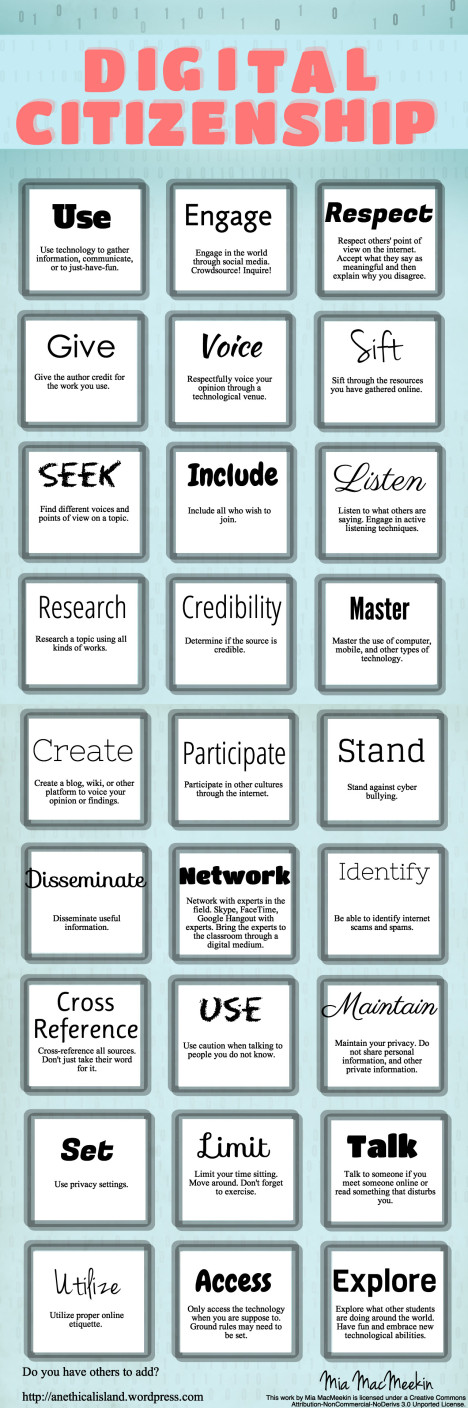
digital-citizenship Can we teach pre-adolescents and teens to reflect on what’s happening as they use digital world tools and interact with online content? Can we help them understand more about what they are doing when they work and play online?

Educators often provide a checklist or rubric for students to use as they work on assignments or projects. A rubric usually contains editing specifications, project requirements, resource documentation, and expectations — all for students to consider while completing the work.

Now I’ve discovered that Mia MacMeekin over at the An Ethical Island blog offers what I think of as a digital learning graphical rubric. The easy-to-understand graphic features World Wide Web nouns and action verbs that describe the ways people encounter, process, and use online information. MacMeekin thinks of her infographic as a digital citizenship tool, but it’s much more than that. The chart offers educators with opportunities to ask questions as they teach, and more importantly, expect students to answer them.          Continue reading “Action Words that Describe Digital World Learning”

Posted in 21st Century parenting, 21st Century teaching, digital citizenship, digital kids, digital parenting, digital world conversations, workshops and conferences

Soundbites From Day Two of FOSI 2013 – Conference Post #3

fosi2013While I could not spend the entire day at the FOSI2013 conference, I joined the event around 1:00 P.M. after a morning at school and just in time for a terrific panel, Child Psychology and the Effects of Technology. Later I attended a session, Creating Trust on Social Networks, with panel members from the social media industry who described in some detail how vendors and social media sites strive to commit themselves to user support, troubleshooting, problem-solving, and integrity — in theory, above profit concerns.

As usual, each of the break-out periods featured two sessions — topics that I really wanted to attend but scheduled at the same time — so I had the difficult task of making choices. Because FOSI2013 provided a detailed schedule before the conference began, I arrived with a pretty good idea about which session related more to the issues that I am currently thinking about and coping with at my school. Still, making this type of choice at a conference is always challenging. I’ve tentatively arranged to get together, face-to-face, with local colleagues who also attended the conference and swap notes about the sessions that we missed.

I might mention here that during a break my edtech colleague, David, and I struck up a conversation with Patricia, a conference attendee and government official from Kenya. She had arrived just before the conference and was leaving almost immediately afterward. He asked her if she would be attending the FOSI2014 conference next year and invited her to plan a few extra days and visit his school. I  chimed in and offered an invite to mine. Then we told Patricia that our independent school technology community is close-knit, and would welcome her at their schools, too.

To round out the afternoon, conference attendees all came back together to hear a group of experts discuss and distill some of the issues — privacy, digital citizenship, parenting, social media, connected life — that FOSI featured during the two-day conference. This was one of the most engaging conference activities, I think, because of the way the panelists — a journalist, an academician, a therapist, and a legal scholar — ranged back and forth over the topics connecting events and adding their own information.

Continue reading “Soundbites From Day Two of FOSI 2013 – Conference Post #3”

Posted in 21st Century Learning, assessing learning, digital learning resources, e-portfolios, electronic portfolios, NAIS Conference Reports, parents and technology, teaching digital kids

Getting Started With Electronic Portfolios: My NAIS Conference #2

You do not always expect the first workshop, on the first day of a conference to be a slam-dunk, but my 8:00 A.M. Thursday morning session was awesome.

Check out the online presenters' resources.
Check out the online presenters’ resources.

Every bit of information that I collected at the Garrison Forest School workshop on electronic portfolios, presented at the National Association of Independent Schools (NAIS) annual conference in Philadelphia, will help me start an e-portfolio project at my school. As the four presenters shared their many resources and described their electronic portfolio research, my mind zoomed ahead to my return to school — all this before the end of the first hour of the conference.

I’ve been thinking about helping teachers and students create e-portfolios for some time, but with so many factors to consider and so much to figure out, I’m always a bit stumped when I think about the extensive collaboration that needs to take place. The benefits for teachers, students, and parents are clear, but the process takes an enormous amount of time to plan and carry out, and time is always at a premium. Yet we all know that twenty-first Century learners need to be able to think about, examine, evaluate, and extend their work if they are to be, well — better 21st Century learners. E-portfolios support this learning process.

Interestingly, about two weeks before this conference, two teaching teams that I support indicated – out of the blue — their interest in developing some sort of electronic portfolio project, so I am fortunate to have a small group of educators who want to get started. This workshop has essentially handed me the knowledge as well as a map to lead me.

Continue reading “Getting Started With Electronic Portfolios: My NAIS Conference #2”

Posted in 21st Century Learning, Bookmark It!, digital learning resources, educating digital natives, parents and technology

Grammar Girl Podcasts – Listen and Learn!

Just about every day I have a grammar question, despite that in junior high school I was an ace at diagramming sentences. Most commonly I need to figure out how to punctuate something I have written. I search for an answer, and I want to remember the information — if possible — so that I can use it the next time the same question arises. Yes, I could consult The Elements of StyleOn Writing WellThe Chicago Manual of Style, or countless other good grammar books.

grammargirl
Visit Grammar Girl!

These days, however, when I am puzzling over a comma or a particular word, I almost always go online to find a podcast at Grammar Girl’s Quick and Dirty TipsI listen to the explanation, usually accompanied by music and amusing examples, and even days later I still remember the rule or the spelling or usage — even if the topic has not reappeared in my writing.

If you have not checked out the Grammar Girl podcasts, take some time to do so. They are great fun — two words that I never associated with sentence diagrams.

Continue reading “Grammar Girl Podcasts – Listen and Learn!”

Posted in 21st Century Learning, collaboration, digital learning, online research, parents and technology

Now This Is What You Want Connected Kids to Do!

geography-44729_640
Pixabay Public Domain Images

Sometimes when I sit quietly in a computer lab at school and observe my students, I overhear the most wonderful conversations about learning. Today, as I sat in a corner working quietly, several fifth-grade students came in and sat down to work on essays. Focused on work, they took little note of me.

A delightful conversation ensued when one student asked the other student for help with the name of a country. As soon as I realized that an interesting 21st Century learning conversation was happening, I started typing their dialogue rather than my parent letter.

The two children went online together, searched, made all sorts of comments and decisions about what they saw, discovered a few things that they were not looking for, and finally located the information that they needed. But their searching led to additional questions.

The entire conversation lasted less than two minutes, but they learned a great deal.

Student #1: I am trying to write about the country that broke off from India when India became independent. Do you know its name?

Student #2: I’m not sure. I know it’s right next door.

Student #1: Hummm. Maybe it’s Pakistan?  But I’m not sure.

Student #2: Maybe. Let’s go online and find a world map.

Student #1: OK. Are you going to Google it?

Student #2: Yes and look. If we go into Images there are lots of maps.

At this point the two students are both looking at dozens of world maps on Google Images and pointing at some of them. They talk about which map to look at. They choose one, but when the enlarge it, it doesn’t work.                  Continue reading “Now This Is What You Want Connected Kids to Do!”