Posted in 21st Century life, connected learning, digital citizenship, digital learning, digital parenting, digital wellness, educating digital natives, parents and technology

10 Digital Wellness Thoughts to Consider

Digital WellnessThese days everyone talks about personal wellness — those steps that people need to take to remain physically and mentally healthy and strong. But what about digital wellness? Poor digital health affects not only our connected lives but also our physical and mental well-being.

Digital wellness is about fine-tuning the 21st Century skills that we use to work and play in a connected world, and it also involves understanding a number of common myths about the nature of online life. Helping family members take steps to develop digital wellness habits can challenge parents, mainly because many children, pre-adolescents, and teens appear to be far more advanced online consumers than their parents. Underneath the veneer of digital native expertise, however, are a fair number of information gaps.              Continue reading “10 Digital Wellness Thoughts to Consider”

Posted in coding history, computer history, early computing, women and computing

ENIAC: The First U.S. Computer and How Women Made It Work

ENIAC 6People — young and old — enjoy learning about the first computer in the United States, ENIAC, booted up in 1946. Every 21st Century learner needs to know about this amazing machine and the story of the first programmers.

A few weeks ago I visited Philadelphia and had a special opportunity to visit ENIAC. This huge, old-fashioned computer is owned by the Smithsonian Institution  (read this article), but parts of it are still housed in a building at the University of Pennsylvania, almost exactly where it was originally set up. ENIAC could be  programmed to do extensive calculations much faster than humans could calculate.

The letters in ENIAC stand for Electronic Numerical Integrator And Computer.                             Continue reading “ENIAC: The First U.S. Computer and How Women Made It Work”

Posted in 21st Century Learning, 21st Century teaching, coding, professional development, programming, teaching digital kids

Learning How to Code: Demonstrating How to Learn – Report #2

scratch_logoWe educators offer great gifts to our 21st Century students when we demonstrate that we, too, can learn new things. By letting children see us mastering unfamiliar information, figuring out problems, overcoming challenges, and yes, even making mistakes, we help them develop more comfort and confidence when they make errors and feel like they are not making progress. We adults teach all the time, but we probably don’t model learning new material nearly enough, and the kids notice it.

UnknownAs Ted Sizer wrote in his book, The Children Are Watching, they notice what we do and what we do not do. (A good book, by the way, for teachers and parents to read).

So this year I’m demonstrating how much I have to learn for students in grades one through five who attend my MIT Scratch coding activity. Literally, they are watching me learn how to code Scratch scripts.

Continue reading “Learning How to Code: Demonstrating How to Learn – Report #2”

Posted in digital footprints, digital kids, family conversations, parent child conversations, parents and technology

How Many Digital Footprints Does Your Family Make?

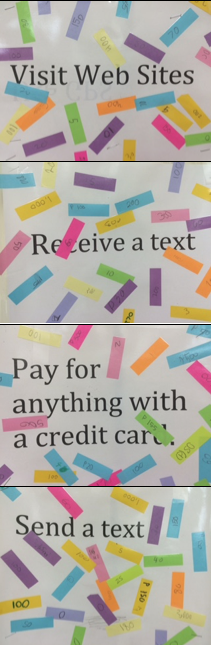
Screen Shot 2015-02-05 at 3.12.51 PMHave you ever thought long enough about digital footprints to imagine how many digital tracks family members or students make in a day or two?

Early in the school year fifth graders and their parents kept a short diary, estimating the footprints in a range of categories and then returned to school with the results. Footprints were estimated for sending texts, banking, receiving texts, purchasing groceries, cell phone calls, online banking, web sites, online purchases, and about a dozen more categories.

Continue reading “How Many Digital Footprints Does Your Family Make?”

Posted in 21st Century Learning, 21st Century teaching, coding, parents and technology, programming, teaching, teaching digital kids

Hour of Code Reflections: What a Difference a Few Words Make!

Image used with permission.

What if we encouraged young learners, when they encounter a difficult learning task, to replace the words “I don’t get it” with “I haven’t figured out the problem yet”? Can changing just a few small words make learners more comfortable when they work on unfamiliar or difficult activities?

I’ve spent the last month mulling over this word change idea after participating in Hour of Code activities with young 21st Century learners at my school in December. Watching the children in kindergarten and grades three, four and five solve puzzles and play the unfamiliar coding games was eye-opening because in each class the majority of students — and some of the teachers — were working on learning tasks that they had never encountered before (definitely terra incognita).                        Continue reading “Hour of Code Reflections: What a Difference a Few Words Make!”

Posted in 21st Century parenting, apps, digital kids, parents and technology, sexting, sharing media

Needed: Ongoing Social Media Conversations About Image Sharing

using smartponesIf your children are using or begging to use  InstagramSnapchat, Vineor the many other apps on their digital devices that share media, it’s time to get serious about conversations on social media and image sharing. Moreover, many other digital device apps exist or suddenly appear that also encourage sharing. (Check out my post that demonstrates just how apps multiply and catch on with kids.)

Sharing apps make users, especially young people, feel like they can have and keep secrets with their friends. Children, and adults, too, like the apps because they claim to offer a modicum privacy and because any media that they share will self-destruct within a few seconds. Voilà – it’s disappeared!

Continue reading “Needed: Ongoing Social Media Conversations About Image Sharing”

Posted in 21st Century Learning, 21st Century parenting, digital citizenship, digital kids, educating digital natives, parents and technology

Family Online Safety Institute Conference 2014: Lots to Learn

A  year has passed and once again I’ve attended the Family Online Safety Institute (FOSI) annual conference — this time the 2014 edition. I was especially excited to be learning,  connecting, and enjoying the events with a bevy of edtech and teaching colleagues — 15 at last count — educators who are committed to supporting 21st Century learning and to guiding our students’ parents, grown-ups who must continually fine-tune their 21st Century parenting skills.

Screen Shot 2014-11-14 at 10.49.52 AMRead my FOSI 2013 posts.

Right at the beginning we learned about FOSI’s latest research, this time focused on parenting in the digital age. A presentation by researchers at Hart Associates gave us more insight into the excitement, the concerns, and the hope that parents have about their children’s connected world lives. The good news is that parents’ knowledge is increasing and so is the confidence that they bring to parenting digital natives. I’ll share lots more about that in a future post, but you can read the full report before I get to my review of the research.      Continue reading “Family Online Safety Institute Conference 2014: Lots to Learn”