Posted in digital parenting, media literacy, parents and technology, social media

The Children are Watching and Seeing, Listening and and Hearing

They watch us all the time. The students, that is. They listen to us sometimes. They learn from all that watching and listening.

                            –Theodore and Nancy Faust Sizer, The Students are Watching, 1999, Beacon Press

The Sizers wrote about classrooms and schools, explaining that students learn from what their teachers do and say and also from the things their teachers do not do or say. The authors illustrated their points in many ways, demonstrating how much our students learn from the things we do not do.

I read the Sizer’s book in the later 1990s with my growing child at home, so it was easy to see how the lessons applied not just to teachers but also to everyday family life. The message — that children learn from what we don’t do and don’t say as much as from the things we intentionally teach — applies well at home and at school.

This week, with so many media-rich events, I thought about the Sizers’ book. Adults spent a huge amount of time-consuming news about superstorm Sandy, the election, and for a few minutes, many of us gazed at a viral short video of a little girl crying out “No more Bronco Bama and Mitt Romney.” We encountered non-stop negative television commercials, disaster pictures and videos, television news programs, robo telephone calls, radios tuned into programs all day long (yes, I am guilty of keeping NPR on most of the day when I am home), and plain old-fashioned magazines and newspapers. Lot’s of us may have felt like crying. But my question is, “Why did Abby hear or see so much that she started to cry?”

Muppet Lydia Whatnot summed things up in her YouTube response

Continue reading “The Children are Watching and Seeing, Listening and and Hearing”

Posted in 21st Century Learning, choosing reliable resources, digital photography, evaluating web site resources, healthy media images, parents and technology, social media

7 Questions to Ask Before Sharing Hurricane Sandy Media With Kids

The Pier Before the Storm
Photo by Marti Weston, 2008

Parents and teachers of digital kids should make it a habit to evaluate media for authenticity and reliability rather than automatically sharing dramatic images with children. Evaluating media is a critical 21st Century skill — for adults and children

The other day a friend sent me a link to a storm picture. The image featured a familiar ocean pier with huge waves about to crash onto its farthest end. (The photo at left is the pier long before the storm). While the drama of the image intrigued me, on reflection I was bothered because I could not learn anything about the website that hosted the image. Other than labeling the town and the storm, the photograph offered no other identifying narrative.

With its ethereal quality, the image looked as if the pier was superimposed over a dramatic ocean scene — the waves and spray crashing at one end while the rest of the structure was clear without any water or spray obstructions. Moreover, since I was familiar with the location, I could not figure out where the photographer stood to take the picture. Perhaps I was wrong, but since I could not discover anything more about the picture, I decided not to send it to anyone else, and I am not even posting it here.

When a huge emergency like Hurricane Sandy occurs, digital pictures and videos circulate all over the web and via social media. A fair amount of these digital materials misrepresent the situation. To avoid focusing too much on the misrepresentations we need to apply some 21st Century common sense. Continue reading “7 Questions to Ask Before Sharing Hurricane Sandy Media With Kids”

Posted in 21st century job hunting, digital change, digital parenting, family conversations, generating content, parents and technology, social media, social networking

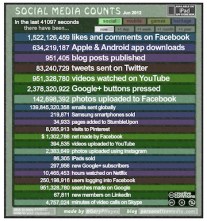
Just How Much Social Media Is There?

Click on the image to visit Gary’s Social Media Counter.

Have you ever wondered about how much social media interaction occurs in the digital world at any given point in time? Recently I discovered an excellent social media teaching and learning tool that helps people gaze into the always-changing world of social media content.

Over at PersonalizedMedia.com, blogger Gary P. Hayes offer a living widget with algorithms that track the approximate number of interactions in a range of social media categories — all in real time. He’s also turned his counter into an iPad app.

Visit Social Media Counts — a living statistical chart originally published in 2009 but upgraded in 2011 and 2012 — and start counting the moment you open the page. The site offers a progressive snapshot of what’s occurring in the social media universe as time moves along. It continues counting until a visitor closes the web page, and it starts counting again if the page is reloaded or if a user clicks the “now button.”

Leave the page up on your browser, come back a while later, and gaze in wonder at the growing statistics. Users can also click on the day, week, or month buttons to see different, and more massive social media statistics.

Continue reading “Just How Much Social Media Is There?”

Posted in cultural changes, digital change, digital parenting, future of the Internet, online communication, parents and technology, social media, social media friends, social networking

Looking into Our Kids’ Futures: Will Social Media Be There?

If you missed this set of essays, Is Facebook a Fad? Will Our Children Tweet?, published in the June 19, 2012, New York Times, take some time to read these short pieces on social media and contemporary life.

As a part of a regular Times’ feature, Room for Debate opinion, readers can learn what six knowledgeable media commentators think about the always evolving digital world.

For instance, MIT Professor Sherry Turkle describes the tendency of social media users to “hide” from one another, substituting quick text nuggets for what used to be face-to-face interaction. Morra Aarons Mele, a digital manager and founder of Women Online, acknowledges the communication downsides, but says that social media and the digital professional work it has created make the world more egalitarian.           Continue reading “Looking into Our Kids’ Futures: Will Social Media Be There?”

Posted in apps, cell phones, digital devices and gadgets, digital parenting, mobile phones, parents and technology, social media, social networking, tweens and technology

Getting to Know Instagram – Links to Bring Adults Up to Speed

In a matter of weeks last spring quite a few older elementary and middle school children whom I know jumped on the Instagram bandwagon, and they continue to have fun with it. The social networking photography app, now owned by Facebook, lives on their wireless devices, making it easy to use without getting encumbered with computers.

The minimum age for the Instagram app is 13, but that hasn’t stopped the site from attracting many children younger than that. While I tend to be someone who takes age requirements seriously, many parents, after checking out various sites, are more comfortable than I am with letting their children use sites when they are a bit younger than 13 years of age.

The biggest challenge for adults is keeping an eye on the content and quality of the photos that their children are uploading to Instagram. Problems can occur when children err in judgment as they make decisions about what to share (and what not to share).

In any event, all of us — parents, teachers, and any other adults in children’s lives — need to learn more about Instagram. I’ve added the app to my phone and plan to get acquainted with it. The list of articles below offers parents and teachers lots of information  — how Instagram works and how children socialize when they use the social networking app with their friends.         Continue reading “Getting to Know Instagram – Links to Bring Adults Up to Speed”

Posted in digital parenting, parent child conversations, parents and technology, social media, social networking

Summer, Social Media, and Digital-Age Parenting

Read the research here.

Summer is a good time for parents to learn more about the social media activities of their children, developing additional skill and more understanding about what’s happening in the digital whirl that is a huge part of kids’ social lives.

A 2011 Pew Internet and American Life Project report, Teens, Kindness, and Cruelty on Social Networking Sites, noted that 95% of children ages 12 – 17 are online, many on social networking sites. Since that Pew report was published, media sources report that children several years younger than 12 are also using social media. Read the NPR piece, Social Networks: Thinking of the Children. Children continue to need guidance and limits-setting from their parents.

The goal is not to prevent children from exploring — that’s not realistic. Instead, parents need to gather enough information to be able to keep an eye on activities, facilitate discussions when required, and intervene when it’s necessary to insulate their kids from impulsive digital behavior on computers, smartphones, and tablets.        Continue reading “Summer, Social Media, and Digital-Age Parenting”

Posted in digital parenting, parents and technology, social media, social media friends

Facebook and Younger Kids: Will They or Won’t They?

Earlier this month a spate of articles (see links below) reported that Facebook is testing features to help it decide whether to expand its social networking access to children under the age of 13.

Now a group of child advocacy organizations sent a June 18, 2012, letter to Facebook’s CEO, Mark Zuckerberg, strongly urging the company to avoid advertising for kids as well as to offer a guarantee of no tracking of children’s online activity. Read the entire letter at the bottom of this Consumer’s Union page.

The following organizations signed the letter:

Consumers Union, Center for Digital Democracy, Academy of Child and Adolescent Psychiatry, Center for Media Justice, Center for Science in the Public Interest, ChangeLab Solutions/Public Health Law & Policy, Children Now, Consumer Action, Consumer Federation of America, Consumer Watchdog, Privacy Rights Clearinghouse, Privacy Times, Public Citizen, and World Privacy Forum.

Articles to Read                         Continue reading “Facebook and Younger Kids: Will They or Won’t They?”