I’ve been following a well-written blog by a young man named Josh, in his teens, who describes his experiences during the discovery of a brain tumor, the surgery to remove it, and his subsequent chemotherapy treatments (still going on). Believe me, these posts, on his blog calledJosh’s Journey, are compelling and riveting to read, largely because he is a careful observer and a good writer.
Visit Josh’s blog.
Josh assumes the role of a journalist, focusing on details, experiences, and his reactions as his medical team goes about providing his care. Readers learn what it’s actually like to proceed, step-by-step first with surgery and then with subsequent medical treatments at the Children’s Hospital of Philadelphia (CHOP).
Writing must be helpful, perhaps even therapeutic, as Josh confronts uncomfortable medical procedures, but it’s extraordinary that he sustains his writer’s voice, objectively sharing observations and perspectives about the challenging process of fighting a tumor.
Data were gathered through a survey of 2,326 parents whose children were eight years old and younger. The surveys were conducted in English and Spanish. Check out page nine of the report for more information on the methodology of the research project.
Most Interesting Report Findings (more are available in the report)
A large number of the parents in the survey do not believe that increased use of media has made parenting easier.
Most parents in the survey did not report many or significant family conflicts around media use.
There continues to be a big gap between those who can afford new digital devices and those who cannot afford them.
The study identified three types of parenting styles when it comes to family media use.
Media-centric family life centers around various types of screens, and parents as well as children enjoy using media a lot of the time.
Media moderate family life includes less media access, and the television is turned off a lot more of the time. Video games are not as important to daily life as in a media-centric family.
Media lite family life includes screen time but less than the other two parenting styles. They tend to do to less television watching as a family, and they do not use television to distract children so that parents can accomplish other tasks.
…and lots of families will soon purchase a new mobile phone for a fifth, sixth, or seventh grade child.
Remember, however, you are not just handing over a telephone. A child is getting a mini-computer — a digital device that takes pictures, shares locations, communicates via text, e-mail, and phone calls, and easily installs apps that connect in all sorts of other ways. A new cell phone networks your child in nearly unlimited ways to the entire world, and most of what he or she sends on the web via cell phone will never be deleted.
Before handing over the new mobile device, 21st Century parents need to think about how they want digital kids to use their new prized possessions and also about what they don’t want children to do.
Adults can be specific and clear about what is acceptable by setting up a cell phone user contract. Use an agreement word-for-word from the list of links on this blog. Or copy one of the contracts as a template and write a more personalized version that is appropriate for your family. Today’s kids are 21st Century learners, eager to use and explore the digital world — a great way to be — but parents need to set clear expectations that help to ensure that a child explores and experiments as much as possible without humiliation and embarrassment. Continue reading “Getting Your Child a Cell Phone This Summer? Read This First!”→
iPhones seem to have unlimited features to tweak. Since I have owned iPhones for more than four years, I tend to believe I am pretty expert about using them.
Then I read this Christian Science Monitor article, 40 iPhone Tips and Tricks Everyone Should Know, and discovered that I still have quite a few cool new things to learn. The February 2012 report, by Megan Riesz, Eoin O’Carroll, and Chris Gaylord, includes a few far-fetched suggestions that I will never do — in my case some the ideas for tweaking Siri — but it also includes several iPhone tweaks that I’ve already added as I was making my way through the 40 tips.
Data from a joint Pew Internet and Harvard Berkman Center research report, Teens, Social Media and Privacy, identify a discrepancy between the ways teens and adolescents preserve their privacy and their lack of concern about the invasive collection of personal information by third parties.
The May 21, 2013 report also points out that while teens are increasing the amount of sharing they do on social media, many adolescents are tiring of Facebook because so many adults use the site and because of the excessive sharing that Facebook seems to prod people to do. The researchers gathered much their Facebook data through focus groups. Continue reading “Teens, Social Media and Privacy — From Pew Internet”→
Listen to a Los Angles CBS video about the controversy and read the story.
In light of the extraordinary negative media messages about body image in children’s lives, ensuring the strength and confidence of preadolescents and teens is a continuing challenge for parents and teachers. So much of the advertising markets thinness, popularity, sexuality, and one type of attractiveness, so it can be difficult for adults to counteract the effect of the of this pressure on a child.
Sometimes the entire ethos of a company emphasizes values that we do not want children in our care to adopt.
A distressing article over at the Huffington Post, A Message to Abercrombie’s CEO from a Former Fat Girlby Sara Taney Humphreys, highlights how one company has made exclusion, intentionally or otherwise, a part of its mission. Humphreys’ article isn’t about something that happened recently, but rather a quote from a 2006 Salon article about the CEO of Abercrombie and Fitch. While the article is more than six years old, the comments are disturbing, especially given the number of children who like to shop at Abercrombie and the many others who struggle with body image. Below is a quote from the Salon article.
As far as Jeffries is concerned, America’s unattractive, overweight or otherwise undesirable teens can shop elsewhere. “In every school there are the cool and popular kids, and then there are the not-so-cool kids,” he says. “Candidly, we go after the cool kids. We go after the attractive all-American kid with a great attitude and a lot of friends. A lot of people don’t belong [in our clothes], and they can’t belong. Are we exclusionary? Absolutely. Those companies that are in trouble are trying to target everybody: young, old, fat, skinny. But then you become totally vanilla. You don’t alienate anybody, but you don’t excite anybody, either.”
You can also listen to thisABC Chicago television story (after an airlines advertisement), including interviews with teenagers — many of whom can fit into the Abercrombie clothes but choose not to buy them. The teens are demonstrating at one of the stores in Chicago.
Libraries continue to play a significant role in the development of young readers, even as digital resources increase and children engage in more digital activities.
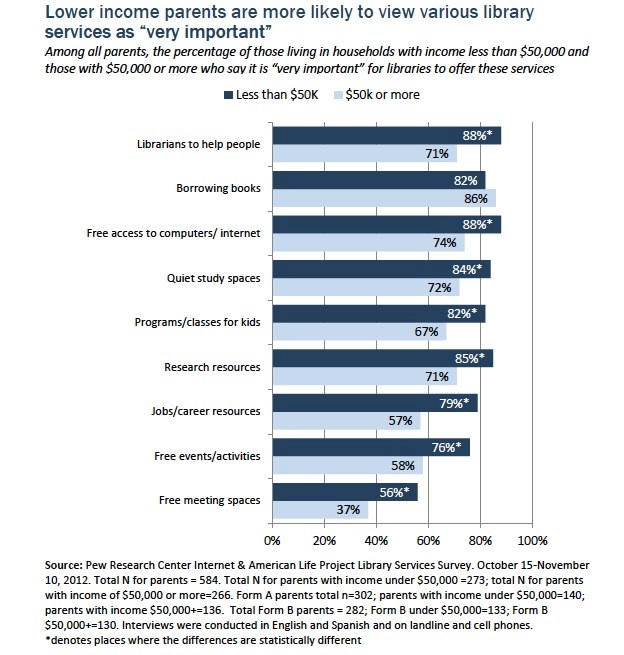
Recent research by the Pew Internet and American Life Organization finds that families with incomes under $50,000 consider libraries to be an important resource in the lives of their children.
Whether they are considering digital or non-digital opportunities, these families are more likely to rate library services as important than parents in families with higher incomes.
Some interesting research findings, quoted from the report:
94% of parents say libraries are important for their children and 79% describe libraries as “very important.” That is especially true of parents of young children (those under 6), some 84% of whom describe libraries as very important.
84% of these parents who say libraries are important and a major reason they want their children to have access to libraries is that libraries help inculcate their children’s love of reading and books.
81% say a major reason libraries are important is that libraries provide their children with information and resources not available at home.







You must be logged in to post a comment.