If I had any doubt about the efficiency of the global economy, it was put to rest these past three days as I watched my new iPhone 4s traverse the world via Fed Ex, from Shenzhen, China to my front porch in northern Virginia, USA.
The iPhone began its journey on November 2nd, though allowing for time zones and the international date line, it was probably still November 1st where I live. Nevertheless, after it left China the package made intermediate stops in Hong Kong, Anchorage, Alaska, Memphis, Tennessee, and Dulles, VA, before being loaded onto the Fed Ex delivery truck in Alexandria, VA and arriving on my front porch in the early afternoon of November 4th. The package spent the most time standing still at the Fed Ex hub in Memphis, where packages accumulate all day and then fly out at night to destinations around the United States. Continue reading “The Global Economy, My New iPhone 4s, and Grandpa’s Voyage to America”→
Recently I read Tracy Grant’s article, The Case for Spying on Your Kids, in the October 5, 2011Washington Post, and it’s well worth reading. Grant believes that parents should keep close track of their children’s online activities. After I finished the article I decided it’s unfortunate that so many people equate keeping an eye on a child’s digital activities with spying. It’s not spying.
From my perspective, it’s just fine for parents to closely supervise the digital activities of kids, just like parents supervise non-digital endeavors. Understanding what’s going on, setting limits, teaching children to follow website rules, and defining expectations — as children encounter more and smaller personal computers and digital gadgets — are important responsibilities. Knowing what’s going on is a part of parenting.
Yet learning about what’s going on takes time, a scarce resource for many adults, and the situation gets even more complicated because the digital skills of many children outpace their parents.
Grant describes her conversation with Steven Balkam of the Family Online Safety Institute (FOSI)(this organization has a website that parents may want to explore), and she also mentions a new monitoring service, SafetyWeb.
In Grant’s article Balkam points out, “The history button on a computer is a very important tool for parents.”
The digital world offers many opportunities to help children learn, collaborate, and grow as digital citizens, and we want our children to become literate and savvy consumers of online resources. Strong digital parenting — even when a parent is in awe of a child’s online prowess — is one of the ways to ensure that children grow into confident, respectful, and competent learners.
I recommend reading the book Born Digital, by John Palfrey and Urs Gasser. The authors, from the Berkman Center for Internet and Society at Harvard, focus on the changing nature of growing up in the digital world.
With more than 30 years as a teacher including over 20 in the educational technology field, I’ve heard many kids reflect thoughtfully, and not so thoughtfully, on their parents’ digital skills.
Here are the seven most common “I Wish” statements that I’ve heard expressed by children over the last 16 or 17 years. Two of them my daughter told me.
Old card catalog drawers at the Library of Congress
When I was in what we used to call junior high, working on my first bona-fide school research projects, mired down with things to read, and wishing to be finished, my father reminded me over and over again, “… you cannot attribute too much, only too little.” Even now, years later, with only a few words written on a page, I start thinking about Dad’s attribution credo.
Every parent of digital kids needs to share Dad’s strategy whenever children are working on school projects and papers. It is way too easy, in this age of Google, Wikipedia, and easy instant access to digitized scholarly articles, to write about another person’s ideas without giving credit.
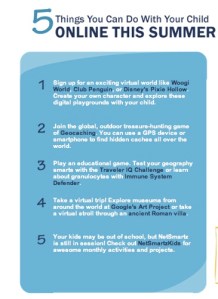
This set of summer digital activities, 5 Things You Can Do Online With Your Child This Summer, arrived in my e-mail a week or so ago. The list includes simple, but open-ended activities, each one enjoyable by itself, but with the potential to lead parents and children in many additional and enjoyable digital directions during the summer vacation. The ideas come from NetSmartz.
NetSmartz is an interactive and educational program for parents and kids, connected with the National Center for Missing & Exploited Children® (NCMEC). NetSmartz uses its considerable resources and clout to educate, engage, and empower children and their families about digital care and safety.
NetSmartz also features a wide range of digital safety educational resources for educators and law enforcement professionals.
No blog, though, at least not one that I can find. Puzzling since they provide some excellent information on blogging. Why not an example of what good blogging looks like — maybe one for parents and one for adolescents?
School’s out and many children fill at least part of their summer days with World Wide Web activities on fast internet connections. Camps and day camps feature computer labs and lots of specialized digital programs. On the go, we increasingly carry more gadgets — mobile phones, smartphones, iTouches, Blackberries, and iPads. In fact, even on vacations and at hotels, cottages, and many of those rustic country cabins we all hope to escape to, we stay connected. After years of teaching, I’ve found that my students’ digital skills usually expand during the three-month summer hiatus from school.
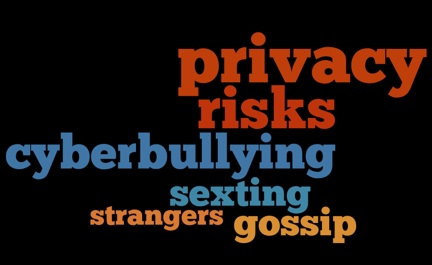
Day after day frightening stories bombard us with warnings about what might happen to children and teens when they use the Internet and World Wide Web, so it’s useful to remind ourselves that these digital resources can provide our children with unparalleled opportunities to learn, socialize, and become active citizens. An article, Our Overblown Paranoia About the Internet and Teens, recently published in the online publication,Salon, provides just such a reminder.
Pediatrician Rahul Parikh, who practices in the San Francisco Bay area, points out that, despite all of our anxiety about teens and Internet risks, no statistics really exist to offer a full picture of the incidence of exposure to risk. Those few that do are often biased because of a common problem for research, posing questions to get the desired answer. Situations that do occur are often covered by a hysterical media, making us feel like a problem happens over and over, just around the corner. Continue reading “Teens, Parent Anxiety, and the Internet”→

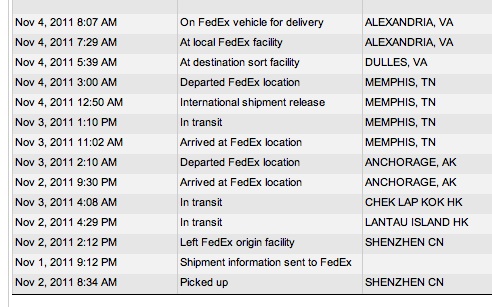 If I had any doubt about the efficiency of the global economy, it was put to rest these past three days as I watched my new iPhone 4s traverse the world via Fed Ex, from Shenzhen, China to my front porch in northern Virginia, USA.



 Media! Tech! Parenting!
You must be logged in to post a comment.