
Tomorrow I’ll write a bit about QR Codes. Here’s the graph from the ComScore Data Mine site.

Tomorrow I’ll write a bit about QR Codes. Here’s the graph from the ComScore Data Mine site.

Check out the article, Why Online Learning Should Not Mean Replacing Teachers With Computers, at the MacArthur Foundation website. The post describes an article in the Nation Magazine that examines how online learning companies are manipulating the futures of our children.
I am peripherally involved with a new middle school Khan Academy project. As I’ve watched the program get started and observed the teacher combining her experienced teaching skills with the online opportunities that Khan presents, I am impressed. This dynamic classroom environment combines the best of face-to-face interaction with online learning tools, but the teacher-student connection continues, just as it always has. It’s a joy to watch children work in this setting.
What makes my colleague’s classroom so amazing is how she blends learning resources together — the activities that have always been in her classroom are now expanded with the online Khan materials. And with these additional digital materials she can more easily analyze the needs of her students, reinforce skills, and expand assignments. It’s this blend of rich teaching together with a unique online educational resource, that creates a strong educational environment in her classroom
How sad it will be if some children only have an opportunity to learn online, because the human interaction — and by this I mean the face-to-face moment-by-moment connections and not the digital communications between teacher and student — will never be completely replaced. As one of my colleagues commented recently, blended instruction (a combination of online and connections to real people) will always the easiest way to learn.
We are all living in a time of transformative cultural change. These days teaching — and learning for that matter — seem to be under fire everywhere we look — even in districts with the highest achievement levels in their states. Good digital resources present us with lots of opportunity and the potential to expand and improve the traditional classroom in infinite and exciting directions. Run-of-the-mill digital resources do very little and may, in fact, create more problems.
The bottom line? Continue reading “Good Ed for Kids? Then Don’t Expect Online to Replace Teachers!”
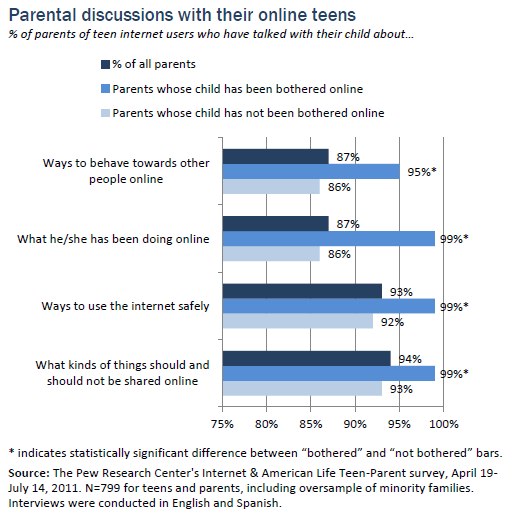
Take a few minutes to read at least the main points of the November 2011 report on teens and social networking, published in November 2011 by the Pew Internet and American Life Project. The executive summary is a fairly quick read.
During the spring and summer of 2011 researchers made calls to 799 teens between the ages of 12 and 17, and they also spoke with a parent or guardian of each adolescent. Interestingly, a large number of the teens surveyed reported that their parents and teachers provided them with the best and most helpful advice on digital citizenship issues and other virtual concerns. The media were the third most significant influence.
Browse all of the infographics from this Pew Internet report.
A Few Other Interesting Points
Continue reading “Pew Report on Teen Behavior and Social Media Sites”

My mother sent me an electronic Advent calendar from Jacquie Lawson E-cards and Greetings. It’s amazing. No, this calendar is not just amazing — it cute, whimsical, and downright fun. Also, it’s a simple and easy gift to give to a grandchild, a grandparent, or anyone in-between — and it’s easy to use. It may be necessary to join the e-card site, but it’s cheap relative to what we spend on cards and greetings.
Each morning, just like when I was a child, I dash to my computer or iPad, open the digital door, and start the day’s Advent/Christmas animation. My calendar depicts Victorian London, and so far I’ve decorated a tree, watched a London market stock up for Christmas, and explored a room inside Big Ben’s clock tower.
A couple of weeks ago the calendar arrived via an e-mail message with a download link and instructions. It works on my PC and my Mac (in fact, the day after installing it, I upgraded to a new Mac operating system, and the calendar continued to play without a hitch), and an advent calendar app is available on iTunes.
Continue reading “Celebrate Christmas? Check out this Digital Advent Calendar”
 Even in today’s fast-paced virtual world, these tips never seem to age. Help kids learn to make good choices.
1. Who made the site? Is it from a university or other institution? Is it for-profit or non-profit. Corporate? Look for an “about” link that describes the site.
2. When was the site made and how often is the site updated? Somewhere, usually at top or bottom it should tell. Is this site updated recently? If not this may be a reason to check out another website on your topic.
3. Is it possible to contact the webmaster or the sponsor of the site? Is there a “contact us” link somewhere on the page?
4. How much advertising is on the page, and how aggressive is it? Good sites that use advertising are careful to keep it from being “in your face.”
5. Does the site state its mission? Why was it set up?
Continue reading “10 Tips to Ensure that You Use Accurate Digital Information”
 I’ve just read a November 28, 2011 Bloomberg article, iPad Crazed Toddlers Spur Holiday Sales. OK, the title is a bit overly dramatic, but it’s an interesting read, describing the demand for tablets of all kinds and kids’ motivation to use them.
Seriously, though, the tone of the article makes me worry a bit. As a confirmed techie, gadget lover, educational technology specialist, teacher, and parent, I know that children also need lots of outside play time and plenty of experiences working/playing with others. We don’t know what the jobs will be in 15 years when these kids are looking for employment, but we do know that their superior technology skills will matter little if they don’t have great people skills — understanding how to share, take turns, and work collaboratively.
The article reminds parents about the American Academy of Pediatrics recommendations about no screen time (or very little of it) for children under two years of age. And please — this is a plea from me — avoid, as much as possible, using these digital devices as electronic pacifiers, the term used in the article by Victoria Nash of the Oxford Internet Institute (England).
Continue reading “iPad Crazed Kids? OK, but Are They Also Learning How to Play With Others?”

Read You Make the Call on Kids’ Phones in the Sunday, November 27, 2011 Washington Post. Written by columnist Michelle Singletary and aimed at the parents of digital kids, the article examines the practice of giving children cell phones at younger and younger ages. The author believes that, in reality, cell phones are simply playful gadgets that easily confuse children about the difference between needing things and wanting things.
Most Compelling Thoughts from the Article
 Media! Tech! Parenting!
You must be logged in to post a comment.