With so much conversation about screen time for kids of all ages, it’s also useful to think and talk about adults’ screen time. Adults model, but not always well, screen time habits for the young people in their families. When asked, most 21st Century children can share all sorts of stories about how much time their parents spend on their devices, even at inappropriate or inopportune times.
In his New York Magazine article, I Used to Be a Human Being, writer and contemporary thinker Andrew Sullivan contemplates the overwhelming “full immersion” that he and many adults experience with the online world.
How much should parents know about the settings on children’s digital devices?
Now that back-to-school nights are about over, schools will be scheduling parent potlucks, curriculum nights, and educational seminars throughout the academic year. These activities offer lots of opportunity for educational communities to start conversations about the challenges — for parents and kids — of growing up in the connected world.
At all of these events administrators, teachers, and parents should plan to incorporate a few introductory comments that encourage parents to think about helping their digital children become stronger learners, savvier digital citizens, better consumers of content on their digital devices, and overall, more knowledgeable citizens.
Below are a few questions that can be shared at school events and classroom presentations, questions that encourage parents to talk about managing life with 21st Century digital kids. While there are no right answers to these questions, the conversations provide adults an opportunity to talk about what works — and what does not — in the context of young people’s school and social lives.
Anonymity presents digital kids with a complicated social obstacle — one they must confront and understand if they are to protect themselves from potential problems. Digital anonymity is not a friendly concept for growing children. I’d argue, in fact, that it’s downright dangerous, but app makers continue to offer the feature. For now these apps are a part of many digital kids’ daily lives, often negatively affecting their digital wellness.
No child with a connected device is immune from possible trouble caused by anonymity, because issues can arise in an instant, often as a part of routine online social interactions. Anonymous opportunities take advantage of kids’ developing brains, encouraging them to make public mistakes in judgment, and enabling young people, sometimes as young as third or fourth grade, to act and communicate with less and less restraint. A mistake made with an app’s anonymity feature can be hurtful or humiliating.
While most kids carefully follow the rules that parents and teachers set out — no names, addresses, telephone numbers, or other personal information — when it comes to the big privacy picture, it turns out that many children understand very little about their personal data, how it accumulates, and how it affects privacy. (Check out my privacy links at the end of this post.)
Thus we need an alternate privacy teaching strategy that helps 21st Century kids — all ages really — understand how their digital-world data accumulates — even when users observe the all-important safety rules.
Bruce Schneier, a fellow at the Berkman Center for Internet and Societyat Harvard Law School, writes about and consults on data and security, and his blog is Schneier on Security. In a 2010 post, A Revised Taxonomy of Social Networking Data, Schneier suggests how to classify data into six personal categories, the data generated as we use social media (and I’ll add other websites and games), and how all this data creates an individual’s digital profile. (Note: profile is another 21st Century vocabulary word).
A recent study, about parents, children and the technology rules that families adopt will be a terrific resource for schools and parent groups to share. Most parts of the research paper are fairly easy to read as are two articles, one from the University of Washington and the other from the University of Michigan. The research findings, with an extra focus on children’s expectations, are full of discoveries and observations that schools may want to share, almost word for word, with the parents of digital kids.
Alexis Hiniker and Julie A. Kientz at the University of Washington and Sarita Y. Schoenebeck at the University of Michigan conducted the study about digital life rules that parents make and enforce and the expectations that digital kids and their parents have of one another. A National Science Foundation research grant supported the academic work.
Digital Citizenship Principal for Kids
Interestingly, a few years ago I ask my students, after a year of working together, what messages they would give to their parents about the digital world and their parents’ roles. The answers these young people wrote down were so remarkable that I shared the children’s comments in a September 2013 blog post, and I’ve also included some of the posters that my students designed graphic depictions of the digital rules-of-the-roadthat parents and teachers expect them to uphold. Continue reading “Digital Kids & Parents Talk About Technology Rules”→
When we teach and interact with digital kids about their hyper-connected lives, I wish we could de-emphasize the fear factor and re-emphasize education and understanding, helping young users become stronger digital world problem-solvers. While monitoring, learning, and guiding, we also need to be sure to help kids, develop the antennae to identify and avoid a range of online problems — not just the big ones.
Image made at Festisite.
A day doesn’t go by without hearing an adult comment about children’s digital world risks, and invariably these conversations focus on predators, strangers, pornography, cyber-bullying and even the death of a child. In the area where I live, a grievous and tragic event is unfolding as I edit this post.
My concern as an educator is that my students, without fail, noted how important it was to be aware of the frightening situations. Their deep concern about potentially horrible Internet encounters — events that do not occur nearly as often as the mainstream media imply — obscured for many of them, the importance of many other interactive problems that happen on a daily basis to digital kids — misjudgments, miscommunications, and daily social events gone awry. It’s these problems, often the result of minor online misjudgments or typically adolescent missteps that regularly cause public humiliation and embarrassment, and such events wreak havoc on a child’s and a family’s daily life. Continue reading “On Digital Parenting Fear, Part #1 – What Risks Should We Worry About the Most?”→
As parents and educators, we quickly come to understand how stories help young people learn.
Unfortunately, when it comes to digital parenting and digital citizenship, we do not have many positive children’s stories — the kind you can sit down and read with a child. We know what we want children to learn as they grow up and use more and more digital devices in a connected world. We are also gradually coming to understand that citizenship and digital citizenship are one and the same.
We need lots more stories that illustrate the way digital life should be lived — stories that we can share with 21st Century children when they are young.



 Anonymity presents digital kids with a complicated social obstacle — one they must confront and understand if they are to protect themselves from potential problems. Digital anonymity is not a friendly concept for growing children. I’d argue, in fact, that it’s downright dangerous, but app makers continue to offer the feature. For now these apps are a part of many digital kids’ daily lives, often negatively affecting their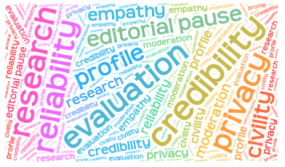




 Media! Tech! Parenting!
You must be logged in to post a comment.