Posted in 21st Century Learning, 21st Century life, 21st Century parenting, 21st Century teaching, online communication, online security, parents and technology, privacy, public vs private comments, teachers, teaching digital kids

Digital Communication Disrupts the Rules of Civility, Privacy, & Integrity

Click to read the article.
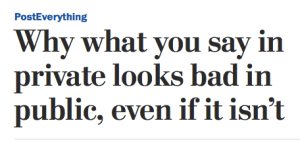
Click to read the Washington Post article.

After spending years teaching digital citizenship and civility in the K-12 world, I’ve now come to the conclusion that we parents and teachers should, in the midst of teaching children, stress that there is never privacy online. Yes, I know that we already teach this — or try to — in most schools and homes, but election 2016, accompanied by the theft and sharing of emails and other connected world materials, is scary. It has proven that everyone can be hurt by what they say online — even when what is said is not intended to generate hurtfulness.

To learn much more about the lack of privacy in private communication read Deborah Tannen’s October 28, 2016 Washington Post column, Why What You Say In Private Looks Bad in Public, Even if It Isn’t. Tannen is a professor at Georgetown University and the author of the bestseller, You Just Don’t Understand.

Our confidential comments may differ from what we say in public. When our candid thoughts become widely available — yes, through hacking, but with kids, it’s through intentional sharing, gossip, or the unintentional mistakes that kids make — words can often be interpreted negatively. Moreover, at least for the time being, we live in a world where stealing a public figure’s private communications and making them public appears to be OK.

Good Quotes from Deborah Tannen’s Article  (Read the entire article for much more)           Continue reading “Digital Communication Disrupts the Rules of Civility, Privacy, & Integrity”

Posted in 21st Century Learning, 21st Century teaching, connected learning, constructing modern knowledge, digital change, digital devices, educational technology, maker movement

Farewell Dr. Papert: May Your Technology & Learning Vision Live Forever!

Massachusetts Institute of Technology’s Professor Seymour Papert passed away recently.

A picture I took onside the MIT Media Lab.
A picture I took inside the MIT Media Lab.

While he had been fragile for some time following an accident, his extraordinary influence on teaching and learning, including how he really created the maker movement more than 25 years ago, will continue for many years to come.

Without his wisdom and vision, many educators in the school technology fields, where I spent most of my career,  would not have been fortunate enough to pursue exciting and deeply meaningful vocations. Every school, every teacher, every educational technology specialist, and every K-12 technology director can trace their professional activities back to Dr. Papert’s deep understanding of the power of learning with computers and digital devices. The Media Lab remembrance page notes that:

Papert’s career traversed a trio of influential movements: child development, artificial intelligence, and educational technologies. Based on his insights into children’s thinking and learning, Papert recognized that computers could be used not just to deliver information and instruction, but also to empower children to experiment, explore, and express themselves.

Continue reading “Farewell Dr. Papert: May Your Technology & Learning Vision Live Forever!”

Posted in 21st Century life, 21st Century teaching, advertising, civics, civility, credibility, digital devices, digital health and wellness, digital kids, digital life, ethical behavior, information credibility, media and family life, parents and technology, social media, teaching digital kids

Civility Is Now Devalued — So What Will Adults Do About It?

dry-cracked-earth-texture-408x544
Image from http://www.public-domain-image.com.

If there is ever a time to emphasize ideas on civility, commenting, fact-checking, and media literacy, it’s during an election. Children, preadolescents, and teens will learn much during the 2016 presidential campaign just from all the watching. (Read my post The Children are Watching and Seeing, Listening and Hearing.)

Our traditional expectations for civility and ethical behavior are cracking apart right before our eyes.

On the basis of what’s happened at recent political conventions and the beginning of the election season, young people will be witnessing name-calling, stereotyping, hateful comments, online hate, and in some cases veiled bodily threats. Kids will hear things on TV at home and on the televisions that are broadcasting in lounges, waiting rooms, doctor’s offices, and everywhere else. They will hear radios broadcasting the news at home and in other peoples’ homes. And, of course, there’s social media.

Continue reading “Civility Is Now Devalued — So What Will Adults Do About It?”

Posted in 21st Century Learning, 21st Century teaching, coding, digital learning, electronic toys, parents and technology, programming, robots, teaching

Teaching Kids to Code With Robots: Great New Yorker Article

Visit the Sphero website.

Check out the May 16, 2016 New Yorker for the article A Whole New Ball Game: The Rolling Robot That Teaches Kids to Code. Author D.T. Max, describes how Ian Bernstein and Adam Wilson invented the Sphero robot, and he explains how the ideas were conceived, how Sphero was designed, and the long process of promotion and sales. The article also includes explanations about how Sphero and other coding toys aim to help children develop 21st Century skills.

The comments from Sphero creators and from Paul Barberian, who became the first Sphero CEO, provide first-hand descriptions about working with and expanding ideas, connecting with a business incubator, and eventually starting a viable business. Max reminds readers about the Silicon Valley process — empathize, define, ideate, prototype, test — and how this process is crucial to the success of new inventions and in the schools where students use robot toys to solve problems. The article also includes thoughts from Barberian about how the business is considering expansion ideas, especially thinking about robots that develop personal attachments with their owners — what’s called adaptive personality.              Continue reading “Teaching Kids to Code With Robots: Great New Yorker Article”

Posted in 21st Century Learning, 21st Century parenting, 21st Century teaching, digital wellness, parents and technology

Incorporating 21st Century Vocabulary Words Into the Conversation & the Curriculum

vocabulary 4
Check out all the posts in this series and watch for new ones.

To become successful, intelligent, and mindful 21st Century learners, young people need to understand and apply a small group of vocabulary words that now have expanded digital world meanings.

Parents may want to use and talk about these words in conversation as often as possible. Teachers should consciously incorporate them into the curriculum, because the vocabulary knowledge provides young learners with tools that help them consume information more effectively.

Screen Shot 2016-04-01 at 11.28.15 AM
21 Century Vocabulary Words

As young preadolescents and teens become more comfortable with these words and increasingly able at applying the conceptual meanings they may also gain skill at discerning and then avoiding many of the digital world problems and pitfalls that children encounter.

Continue reading “Incorporating 21st Century Vocabulary Words Into the Conversation & the Curriculum”

Posted in 21st Century life, 21st Century parenting, 21st Century teaching, data collecting, digital footprints, digital life

Talking about Privacy & Digital Footprints In Grades 7-12

footpathOver the past couple of years, I’ve heard middle and high school kids say that they are sick-and-tired of hearing about their digital footprints — with many exclaiming that they already know what they need to know. My thought? They understand how they make digital footprints, but they don’t always make good decisions when it comes to avoiding the not-so-good digital trails.

What older students — those in late middle and high school — need is a reframed conversation, one that does not focus exclusively on what they do, focusing instead on the broad and complex issue of 21st Century privacy. Continue reading “Talking about Privacy & Digital Footprints In Grades 7-12”

Posted in 21st Century Learning, 21st Century teaching, coding, parents and technology

A Great Code Chat for Girls

Watch this amazing  and inspirational video about girls and coding. It’s worth sharing with kids and keeping it at hand when your child or a student in your class gets discouraged by a challenge in a math or coding activity.

The video comes out of the Made With Code project where there are lots of other videos to watch.