Posted in 21st Century Learning, 21st Century parenting, digital citizenship, digital kids, digital learning, digital parenting, educating digital natives, parents and technology

Observations from FOSI 2013 – Conference Post #1

fosi2013I am away from school today, attending the Family Online Safety Institute (FOSI) 2013 conference in Washington, DC. I plan to post several times over the course of the two days, and because I am putting connected-world sharing above almost-perfect prose, I’ll make basic edits as I write but spend more time tonight and tomorrow fine-tuning my posts.

Check out the FOSI Annual Conference Program!

The conference, held in the Ronald Reagan International Trade Conference, features all sorts of digital life movers and shakers who offer information and guidance to parents, children, and educators.

One always has interesting first impressions at the beginning of any conference. Is it easy to get settled? Yes. Is the wifi ready and easy for us to use? Yes, and I am using it now. Are the people friendly and helpful? A definite yes. And finally, does the conference facility have a coat check? Yes! There’s nothing worse than toting around a coat all day during a conference.  It remains to be seen if it will be easy to recharge my laptop when necessary, but I expect that will not be difficult either.

So now I get to excitedly anticipate the FOSI program. I await the panel on new research. I’m eager to hear from danah boyd (lower case intentional), especially about her upcoming book, It’s Complicated. (Editor’s Note: Even when I knew just a few of the many wonderful things about danah I was already a fan just because she attended the same university as my daughter.) Another author I’ll be interested to hear is Catherine Steiner-Adair, whose book, The Big Disconnect, is my current read and featured on the front of this blog.

Continue reading “Observations from FOSI 2013 – Conference Post #1”
Posted in 21st Century parenting, 21st Century teaching, digital citizenship, digital kids, kids changing lives, online safety, parents and technology

Digital Childhood and Technology: Another Good NPR Series

All Tech Considered
Visit All Tech Considered

Parents and educators can learn a lot about children’s digital lives — and the importance of helping young people develop strong digital citizenship skills — by listening to a series of broadcasts from National Public Radio (NPR) on raising digital natives (also available in print). The radio reports focus on children’s experiences in daily connected life and present wide-ranging information about the responsibilities of parenting 21st Century digital kids. All of the stories are posted at All Tech Considered blog, but I’ve included links for each story below.

The entire set of news stories, shared by a number of different NPR reporters, contains information that can help parents and educators think more carefully about how to strengthen their roles in children’s lives.

Continue reading “Digital Childhood and Technology: Another Good NPR Series”

Posted in 21st Century parenting, digital devices, gadget ownership, mobile media devices, parents and technology, too much media?

Children’s Media Use in America – 2013 Report

Common Sense Media 2013 report finding
Check out the other survey findings.

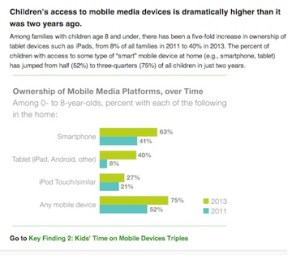
Common Sense Media has published a 2013 report on young children and their access and use of mobile media devices, Zero to Eight, Children’s Media Use in America 2013. The new research study aims to get a reading on how media use has changed since the organization completed and published its 2011 media and children study. Common Sense Media plans to redo this research biennially and publish the collected data.

The 2013 results are based on a nationally representative survey of parents with children under eight years of age. Researchers surveyed 1,463 parents utilizing the same methodology that was used in the 2011 survey and making sure that African-American and Latino representation was large enough to ensure statistically valid conclusions. To further ensure the reliability of the data, investigators provided devices and Internet access to survey participants when necessary.

Several of the Most Interesting 2013 Findings

  • The survey data indicate that almost twice as many children, eight years and younger now use mobile media when compared to the 2011 Common Sense Media results.
  • Television, DVD, and video game use on traditional screens is decreasing, but television still dominates.
  • Although access to mobile media for poor and underserved children has increased since the 2011 survey, a digital divide still exists.

Continue reading “Children’s Media Use in America – 2013 Report”

Posted in 21st Century Learning, 21st Century parenting, 21st Century teaching, Library of Congress, parents and technology, plagiarism

Teach Digital Kids to Respect Ownership: Copyright Resource Update

copyright wordleSome time ago I chatted with a parent about the concept of copyright. Both of us were concerned that digital kids understand very little about intellectual property. The free-for-all digital information climate ensures that children have considerable ease accessing information and considerable difficulty comprehending what belongs to whom. Given this easy access parents and educators need to spend time helping children understand the basics.

Copyright laws are arcane, and even a bit crazy, but it’s critical to teach kids that protecting the intellectual property of others is a necessary 21st Century skill. With your child take the Copyright Challenge quiz at Copyright for Kids to see how much you know. When you finish the quiz check out these frequently asked questions about copyright.

Continue reading “Teach Digital Kids to Respect Ownership: Copyright Resource Update”

Posted in 21st Century Learning, 21st Century parenting, connected learning, Great TED Talks, parent education, parents and technology, teaching digital kids

Real Answers to Parents’ Digital Questions? You Bet!

Digital World QuestionsMy greatest connected learner satisfaction comes when I discover answers to questions that I haven’t yet thought to ask — something that occurs almost every day in my digital world. Online I’ll search on a topic, read, or merely glance over a site, and suddenly I discover a resource and think — I need to know about that!

As I read the blog post, Learning Online: Real Answers to Real Questions, by colleague and master teacher, Susan Lucille Davis, that’s exactly how I felt. Davis shares a range of digital parenting resources that help to answer parents’ 21st Century learning questions, and along the way, she helps us realize just how much more we can learn in our connected world.

Writing for A Platform for Good, Davis offers resource suggestions that parents can use to gain digital skill and knowledge right along with their children, and teachers can share with their students’ parents.

A Few of My Favorite Tips  — For links and more information read the entire post.

  • I had no idea that parents can set up subsidiary e-mail accounts, despite the fact that I am on Google and Gmail countless times each day.
  • Somehow I’ve missed Joyce Valenza’s TEDTalk about helping kids expand online research skills, but it’s a resource to share widely in an academic community.
  • Good quality COPPA information sources, that provide basic information to share with parents, are hard to find, but Davis found one and it’s good.

I, too have found that parents need lots of information about digital kids and learning.  On my “class-on-a-blog,” initially set up for parents at my school,  I write about tools, apps, and sites. On this other site, Discover Your Child’s Digital World, my posts concentrate on digital adventures that kids experience and adults may not know much about.

Posted in 21st Century Learning, 21st Century parenting, 21st Century teaching, digital citizenship, digital kids, ethical behavior, parents and technology

Is It Digital Citizenship or Just Plain Citizenship?

dewey quoteAs the lives of my students, online and off, grow more complex by the day, I spend a good deal of time helping them learn more about digital citizenship. Today the digitally connected, always-on world presents students, teachers, and parents with confusing questions and baffling behavior expectations.

But wait a minute!

Is this digital citizenship or just plain citizenship? Building strong 21st Century citizens is of paramount importance whether we are living our lives offline or on, and we need to avoid using old-fashioned compartmentalized instruction in a connected world.

The Merriam Webster Dictionary defines citizenship as “The qualities that a person is expected to have as a responsible member of a community,” and helping students shape themselves into responsible community members is what caring adults do. We model appropriate behavior and help children learn how to participate as respectful and ethical members of society. No matter where they work or play, our citizenship goals are the same.

Continue reading “Is It Digital Citizenship or Just Plain Citizenship?”

Posted in 21st Century Learning, 21st Century parenting, blogging, commenting, conversations on commenting, digital footprints, family conversations, parents and technology

Encouraging Digital Kids to Write Polished Comments

commenting sprialPart of becoming a strong 21st Century digital learner is mastering the art of writing and sharing comments online.

If you read comments at the end of articles or blog postings — even at some of the respected newspapers and magazines — you have surely discovered more than a few inappropriate and sometimes distasteful remarks. Sometimes people leave these comments anonymously — individuals who do not understand why websites invite visitors to share thoughts and ideas. Sadly, many unfiltered remarks are permanently attached to websites — personal indiscretions (digital footprints) waiting for the whole world to discover. Even leaving an anonymous comment is not particularly secure, though many people — kids and adults — think they are off the hook and hiding when they leave comments without a name attached.

Read a short post and watch a video on newspaper comments, uploaded by the Nieman Journalism Lab at Harvard. Some newspapers sites, such as the Boston Globehave updated their policies and now post a short and succinct comment policy that tells users what the publication expects from comment writers.

Helping your child avoid public website blunders, not to mention future humiliation, is one reason to discuss commenting etiquette on a regular basis. Children don’t know or they forget that all comments leave digital footprint trails, little paths of information that last much longer than a child’s pre-adolescent and even teenage years.

Confusion arises because many children first encounter commenting opportunities in places where adult supervision is scarce. As a result, an impulsive idea can beat out good common sense even when a child knows better. Bottom line — response and commenting areas are not places to leave nasty, sarcastic, rude, or hateful conversation.

Continue reading “Encouraging Digital Kids to Write Polished Comments”