Posted in 21st Century Learning, 21st Century parenting, parents and technology, password security

Keeping Track of Passwords

If you are anything like me, you find password management to be challenging — thinking of them, storing them, and recalling them. I’ve tried several password security programs on my iPhone. They work well, but not in a way that satisfies my concern about privacy. and security. I still have to type in my passwords, which means that anyone on an unsecured network where I am working can potentially discover my passwords.

Of course, our digital children need lots of practice when it comes to secure passwords. Twenty-first Century learners need to understand how to be safe, savvy, and secure as they go about their digital lives. But how can we set good examples when it’s hard to do it for ourselves?

DashlaneHelp appears to be on the way.

In his June 5, 2013 New York Times column, tech reporter and guru David Pogue shared information about password memorization programs, and in the process he addressed many of my concerns.  In Remember All Those Passwords? No Need Pogue writes that he is especially fond of Dashlane, a free program that memorizes passwords and also fills them in for a user, so no typing is involved. Because the program remembers the passwords, a person does not need to recall them, and that means it’s possible to use words or phrases that are long, detailed, and extra secure. Dashlane can also be used to automatically fill in credit card info — another set of personal information that it’s wise to avoid typing.                      Continue reading “Keeping Track of Passwords”

Posted in 21st Century parenting, 21st Century teaching, digital parenting, family conversations, parents and technology, privacy, understanding privacy

Privacy: I’ve Got Nothing to Hide So I’m Not Worried …

imageI often hear people of all ages, including children, say, “It doesn’t matter that my digital information is collected because I have nothing to hide.” What bothers me most about this comment is the limited understanding that it demonstrates — a lack of knowledge about how fast the traditional walls of privacy are tumbling down and how little of it has to do with the bad things that people do.

  • People who make the comment usually know little about what happens to collected digital data, most of it documenting everything we do in our daily digital lives and almost none of it destined to identify wrongdoings or help to find “bad guys.” So much data is now collected about each of us in so many different ways, that almost nothing about us cannot be found out.

Our phones document where we go, our cars move through intersections with mounted cameras that note our license plates, the grocery stores keep track of the foods we prefer, and our Internet searches document the things we want to do, what we want to purchase, and often our worries about how to solve certain problems. Our data even document our medical conditions (despite physicians and insurance companies complying obsessively with HIPPA privacy rules) as we go about checking on symptoms and prescription side effects, or merely try to learn more.

So I was pleased to discover a May 2013 article, Why Privacy Matters Even If You Have Nothing to Hide, by Daniel J. Solove, a professor of law at George Washington University. In easy-to-understand terms, Professor Solove addresses the myths associated with narrow interpretations of privacy issues.

Continue reading “Privacy: I’ve Got Nothing to Hide So I’m Not Worried …”

Posted in digital citizenship, digital footprints, digital parenting, kids and privacy, privacy

Privacy Matters So Talk With Kids About It

Privacy spiral
Created with Festisite

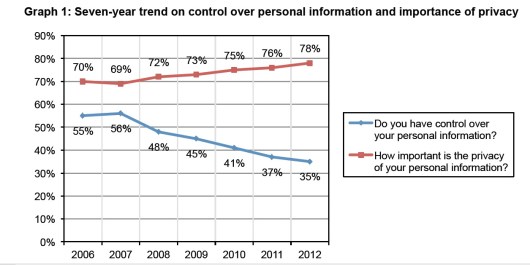
After recent news reports about the National Security Agency (NSA) and its data collecting, we adults are thinking much more about the lack of privacy in our lives. We need to remember, however, that including children and adolescents in the conversation is important if they are to become competent and confident digital citizens.

With our online profiles, social media accounts, mobile devices, and files saved to the cloud, almost no one doubts that we have less privacy; however, what is an ideological or big discussion issue for adults is far more complicated and abstract for children. For most adults the sentinel issue — how much data collection intrudes on a family’s or individual’s personal life — is a primary focus. The issue for children, on the other hand, is that without a basic understanding of privacy concepts they lack the information and the skills that they need to recognize and avoid potential problems.

Many years ago my parents designated important topics for dinner table conversations — broad subjects that we recycled again and again as the four of us shared family meals. When one or the other parent said, “We should talk about that at dinner,” my brother and I knew it was something that Mom and Dad wanted us to take seriously.

Today children and adolescents need to experience this same type of dinner table conversation to help them learn about privacy and develop strategies for maintaining as much of it as possible.   Continue reading “Privacy Matters So Talk With Kids About It”

Posted in 21st Century parenting, digital parenting, social media, social media friends, social networking, supervising digital kids

Google+ vs. Facebook

Google Facebook privacy
This clip is from the info graphic.

Please check out my post comparing Facebook and Google+  over at Discover Your Child’s Digital World another blog that I maintain.

My content addresses issues of interest for parents whose kids use either or both of the sites and focuses on interesting facts, some of the differences between Google+ and Facebook, and privacy issues.

I  illustrate with a terrific infographic from Veracode Application Security.

Posted in 21st Century Learning, digital citizenship, digital learning, family conversations, parents and technology, privacy, teaching digital kids

Digital Footprints Video – Check it Out!

A well done and interesting presentation about digital footprints found at Harvard’s Berkman Center for Internet and Society website.

Good for middle school as well as older students. Parts of this video can be shared with fifth graders, but the whole video may a bit too scary for that age.

Parents, on the other hand, may consider this as an excellent resource for family conversations about digital life.

You might also enjoying reading my post, Digital Footprints, Changing What We Teach.

Posted in digital learning, digital parenting, digital world conversations, interesting research, parents and technology, research on the web, social media, social networking

Parents Use More Social Media – Often to Ensure Children’s Security

pew parents teen social media responses
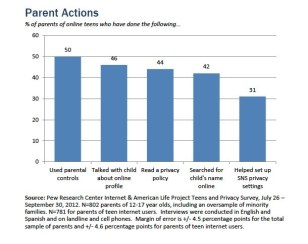
Graph from Pew Internet Teens and Privacy report

In November the Pew Center on Internet and American Life together with Harvard’s Berkman Center for Internet and Society published a new survey, Parents, Teens, and Online Privacy. This 2012 Teens and Privacy Management Survey gathered data from 802 teens and their parents. Everyone who participated in the survey lived in the United States; however, participants could take the survey in either English or Spanish.

Interesting Results

  • Parents report they are using a lot more social media — 66% of parents with children who use social media now use it themselves (compared with 58% in the 2011 survey).
  • One reason that parents are increasing their use of social media sites is to be able to facilitate ongoing family conversations about content.
  • Parents appear to worry more about advertisers who gather information about a child’s online activities than about a child’s possible contact with unfamiliar people.
  • Some teens whose parents are friends have learned how to restrict the information that parents see, but in general, they are positive about friending a parent.
  • Parents are increasingly aware of privacy policies — 44% have read a policy for a social media that one of their children uses and 39% told the survey that they are helping their children set up social media privacy settings.
  • Parents are concerned about a child’s online reputation, but the concerns are the highest as children get closer to applying to college.
  • Reputation management, when juxtaposed with the adolescent years, is tricky for teens.