Posted in 21st Century parenting, curating digital footprints, digital footprints, digital kids, parents and technology

Resolution 2015: Focus on Family Members’ Digital Footprints

Digital Footprint Venn Diagram Project
Student Digital Footprint Venn Diagram Project

Digital footprints — those small bits of digital information collected and compiled on each individual — can portray a person in all sorts of ways. Everything we do on the web or with when we interact with other connected sites is saved somewhere. We may think first of email, texts, social media, and web searches, but our information gets collected when we shop, travel, drive, make mobile phone calls, and even when we buy groceries.

Below are a few links that can help parents and educators think about managing and curating digital footprints. Everyone, child and adult, has a digital footprint profile.

Posted in 21st Century life, 21st Century parenting, parents and technology, privacy

Project Eavesdrop: NPR’s Story About Our Unintentional Sharing

detective-2
Picture courtesy of Ollie Olarte on Flickr. Click to visit his site.

Just what can our Internet activity tell about us, and who can find the information? What do we unintentionally share? We tell our children not to share specifics kinds of personal information, but much of that information is somewhere — in the digital ether — a result of our various digital footprints, searches, apps settings, and smartphone connections, and waiting to be discovered.

Given the news about the massive amount of data collected by the National Security Agency, NPR reporter Steve Henn set out to find out how much of our data “seeps” out, potentially allowing others to learn all kinds of personal information about a person. Henn used himself as a test subject.

He called his story Project Eavesdrop, and NPR featured a radio report and posted the story online during the second week of June 2014 (a time when so many of us, busy with the end of the school year or the beginning of summer activities, missed this story).   Continue reading “Project Eavesdrop: NPR’s Story About Our Unintentional Sharing”

Posted in 21st Century Learning, connected learning, online learning, online tracking, privacy

Is Privacy Protected When a Student Learns Online?

Image made with Wordfoto with a picture taken at the Library of Congress.

If you think that the digital world may be getting it together on the privacy front, at least when it comes to children, think again.

A disturbing article, Data Mining Your Children, published in Politico, describes how for-profit online learning companies provide digital textbooks, connected learning programs, and record keeping options while collecting an enormous amount of information on individual students. The question is, what will they do with this personal data? Politico is a Washington newspaper that covers national government policy and politics.           Continue reading “Is Privacy Protected When a Student Learns Online?”

Posted in 21st Century parenting, apps, digital devices, digital life, social media, spelling and editing

New York Times Report on FCC Snapchat Settlement

The Federal Communications Commission (FCC) just announced a settlement with Snapchat over questions of privacy and mis-information.  New York Times reporter Jenna Wortham published an article, Off the Record in a Chat App: Don’t Be Sure, a May 8, 2014 piece that describes the situation and the terms of the settlement.  I’ve written a post, Have A Chat If Your Child Uses Snapchat, with more details at my other blog, Discover Your Child’s Digital World.

Twenty-first century parents — take note.

Posted in 21st Century life, online tracking, parents and technology, privacy

Retailers Track Adults by Monitoring Device Wifi

We most often worry about advertisers tracking our children online but sometimes forget to think about how much we adults are followed around digitally.

FTC Privacy Series
FTC Privacy Seminar on Mobile Device Tracking

Check out the Washington Post article, Privacy Advocates Push Back on Stores’ Tracking, describing how retailers keep track their customers by monitoring smartphone wifi signals. No guidelines currently regulate this type of information collecting so no privacy parameters exist. Essentially this mobile device tracking is a way to get more information about shoppers, track what they do, and target advertising and target advertising more effectively.

The article, by Amerita Jayakuma, describes how a Maryland legislator has proposed a bill to require retailers to inform people if the store is watching them while they shop.  The Federal Trade Commission recently held a seminar on mobile device tracking.

I’ve been wondering for some time if I was tracked a few months ago when I visited a huge regional outlet mall with my husband.

Continue reading “Retailers Track Adults by Monitoring Device Wifi”

Posted in digital learning, Facebook, family conversations, parents and technology, privacy, social media

Privacy Settings Can’t Always Protect You

All of us — children, parents, and teachers — need to think about the security of our privacy settings. Part of learning to live in the digital world involves understanding and competently using these settings, but we also must recognize their limitations.

Privacy WaveOnce we post or share digital content, the privacy of the information depends on the good judgment of others. No matter how securely the  settings, our friends, who in theory understand our expectations, can err in judgment by copying, taking screen shots, or sharing the content in another digital location. When we post data via social media, we cede control of that information to others who may not abide by our privacy preferences.

In a Wired article, Don’t Make My Mistake: Always Think Before You Tweet, Randi Zuckerman, the sister of Facebook founder Mark Zuckerman, describes how she shared a picture with friends, only to have one of those friends share it in a more public way and eventually widely via Twitter. The picture caused a huge media stir, with people laughing that Zuckerman, the sister of the Facebook founder, did not understand the privacy settings. But she understood perfectly — it was her friend who did not get it.

Best Quote

Continue reading “Privacy Settings Can’t Always Protect You”

Posted in 21st Century Learning, digital footprints, digital kids, digital world conversations, parents and technology

Digital Footprint Series on All Things Considered

collecting dataWe cannot discuss digital footprints and privacy with children and family members too much or too often. The point is not to scare anyone — the virtual trails that we leave are becoming almost routine — but rather to help family members consider how much data we share, intentionally or otherwise, and whether at times we should consider making at least a few changes in our online behavior.

On September 30, 2013, NPR’s All Things Considered program aired the first of a series of reports on digital footprints, and it’s worth taking the time to listen or read and to learn more about just how much data is collected on each of us. I expect the other reports will be just as compelling. NPR is collaborating on the series with the Center for Investigative Reporting (CIROnline.org).

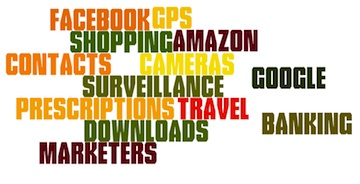
Reporter Daniel Zwerdling describes the obvious digital trails we leave behind with our computers, mobile phones, GPS-guided car trips, and credit card purchases, and also our less-than-obvious footprints from prescription drug purchases, traffic camera sitings, and wifi tracking and facial recognition cameras that track us in shopping malls. That we make digital footprints is not surprising, however, the amount of data that is collected about us and used to form profiles is extensive and worrisome.  Privacy — our privacy — has gone out the window.             Continue reading “Digital Footprint Series on All Things Considered”