Posted in 21st Century life, 21st Century parenting, 21st Century teaching, parents and technology, personal data, privacy

Are You Thinking Enough About Phone Apps & Personal Privacy?

childing-typing1It seems so simple when we install apps. Download, click agree and OK a few times, and use. But it’s not as simple as it seems because we may be unintentionally giving free access to lots of our data. When is the last time you read the user agreement before clicking “agree?” When was the last tune you made sure your 21st Century digital kid to read the agreement?  The app install process is not that simple a process after all, because your data is valuable, and not just for you.

To learn more about what apps are inclined to do when you install them, check out a terrific privacy video (below) produced by Silentcircle.com, a company that makes secure communication products.                                                                                     Continue reading “Are You Thinking Enough About Phone Apps & Personal Privacy?”

Posted in 21st Century Learning, 21st Century life, 21st Century parenting, 21st Century teaching, online communication, online security, parents and technology, privacy, public vs private comments, teachers, teaching digital kids

Digital Communication Disrupts the Rules of Civility, Privacy, & Integrity

Click to read the article.
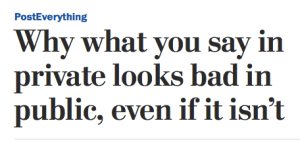
Click to read the Washington Post article.

After spending years teaching digital citizenship and civility in the K-12 world, I’ve now come to the conclusion that we parents and teachers should, in the midst of teaching children, stress that there is never privacy online. Yes, I know that we already teach this — or try to — in most schools and homes, but election 2016, accompanied by the theft and sharing of emails and other connected world materials, is scary. It has proven that everyone can be hurt by what they say online — even when what is said is not intended to generate hurtfulness.

To learn much more about the lack of privacy in private communication read Deborah Tannen’s October 28, 2016 Washington Post column, Why What You Say In Private Looks Bad in Public, Even if It Isn’t. Tannen is a professor at Georgetown University and the author of the bestseller, You Just Don’t Understand.

Our confidential comments may differ from what we say in public. When our candid thoughts become widely available — yes, through hacking, but with kids, it’s through intentional sharing, gossip, or the unintentional mistakes that kids make — words can often be interpreted negatively. Moreover, at least for the time being, we live in a world where stealing a public figure’s private communications and making them public appears to be OK.

Good Quotes from Deborah Tannen’s Article  (Read the entire article for much more)           Continue reading “Digital Communication Disrupts the Rules of Civility, Privacy, & Integrity”

Posted in parents and technology

Quizzes? Fun, but Each Quiz Wants Your Information

If like me you get a kick out of taking Facebook quizzes and sharing your results with friends, it’s time to think a bit more about caution and privacy. Have you ever wondered why these quizzes pop up on your account? Parents, teachers, and students all need to understand that these quizzes have little to do with entertainment and lots to do with getting people to part with personal information.

What is an IP Address?

If you do not know much about online quizzes, and you take them or are tempted by many of them, spend a few minutes reading What You Need to Know About Online Quizzes and Surveys over at the Webroot website and Facebook Quizzes: What Happens to Your Data at the BBC. Essentially, when you take a quiz you freely give out your personal information — and it’s not just the answers you provide, but also the data you allow the quiz creator to access. You also give up a bit more of your personal privacy and may have a small app installed on your Facebook page.

Continue reading “Quizzes? Fun, but Each Quiz Wants Your Information”

Posted in 21st Century life, data collecting, digital life, kids and privacy, online data collecting, online tracking

How Much Privacy Do I Have? DuckDuckGo Gives More

book-dg3-150wAlthough I believed that I had taken significant steps to maintain a modicum of privacy in my 21st Century digital life, I was wrong.

I am less than halfway through Bruce Schneier’s book, Data and Goliath, all about the hidden methods of collecting our personal data, and already I am discovering that my personal privacy plan has many holes. I’m not that different from most adults. Privacy, however, is going away, and we collaborate in the process by not making any specific decisions and by going along with the ways the Internet tracks us. We do have choices, and we educators and parents need to learn a lot more about maintaining privacy and then share what we’ve learned with young people.

Screen Shot 2016-06-09 at 10.19.26 PM
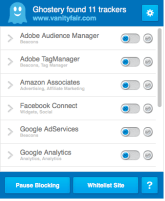
Vanity Fair has 11 trackers and widgets.

In the book’s first chapters Schneier addresses data collection, how trackers get added to my computers and digital devices as little files called cookies. With a quick search, I found over 1,000 cookies and cache files on my laptop, despite the fact that I only allow cookies from places that I visit (about 650 were cookies). Some of these are useful and don’t bother me — like the cookies for the several catalogs where I  regularly make purchases, the newspapers which I read, and the educational and musical organizations which I like. Read more about cache. Continue reading “How Much Privacy Do I Have? DuckDuckGo Gives More”

Posted in 21st Century life, 21st Century parenting, data collecting, digital footprints, digital life, kids and privacy, online data collecting, parents and technology, privacy

How Photos & Data Collecting Take Away Our Privacy

Screen Shot 2016-05-22 at 6.54.28 PM
A bank of computers in a data center. Via Pixabay.

Finding good resources to help young people learn and understand more about data and photo collecting is key to building strong citizens in our 21st Century digital world. We adults can also learn a lot in the process.

Interestingly, no matter how we set privacy settings (stipulating who can see our images), the sites where we post and share continually accumulate information about us  — much, but not all, gleaned from the photos themselves.  Yes, it’s about digital footprints, but it’s much bigger than that.

One article we should read is Why Photos Are The Next Big Battleground in the Fight for Privacy, over at The Next Web news site. The report is chock full of interesting information about big data and how it zeros in on our photos. It also includes sobering statistics about the number of pictures that people share in sites like Facebook, Instagram, and Google. It’s good information to share with the digital kids in your family or school. Continue reading “How Photos & Data Collecting Take Away Our Privacy”

Posted in 21st Century life, 21st Century parenting, personal data, social media, social media content, understanding data

U.S. Government to Search Social Media Accounts for Security Clearances

Who’s data is it?
Who’s data is it?

Are there specific situations when others — people we do not know — check out and examine our social media data?

An article in the Washington Post, U.S. to Scan Social Media Accounts Before Issuing Security Clearances, describes a directive issued by James Clapper, the Director of National Intelligence, about searching social media files.

According to officials responsible for formulating policy and implementing the directive, future government employment security clearance investigations will include a search of social media content. Applicants will not be asked for passwords and investigators will not log into (or break into) accounts. Investigators will seek to identify the range of an individual’s public content, looking for information that might raise red flags and adversely affect a decision to give a person a security clearance.

Continue reading “U.S. Government to Search Social Media Accounts for Security Clearances”