Posted in digital devices, digital kids, digital parenting, media and family life, networking, parenting, parents and technology

Digital Parenting: Recently Released Research from Northwestern University

Media & Family Conflicts
One of many charts and graphs in the report.

A new study, Parenting in the Age of Digital Technology, was recently released by Northwestern University’s Center on Media and Human Development. The 52-page report is easy to read and chock full of interesting graphics and charts.

Data were gathered through a survey of 2,326 parents whose children were eight years old and younger. The surveys were conducted in English and Spanish. Check out page nine of the report for more information on the methodology of the research project.

Most Interesting Report Findings (more are available in the report)

  • A large number of the parents in the survey do not believe that increased use of media has made parenting easier.
  • Most parents in the survey did not report many or significant family conflicts around media use.
  • There continues to be a big gap between those who can afford new digital devices and those who cannot afford them.
  • The study identified three types of parenting styles when it comes to family media use.
    1. Media-centric family life centers around various types of screens, and parents as well as children enjoy using media a lot of the time.
    2. Media moderate family life includes less media access, and the television is turned off a lot more of the time. Video games are not as important to daily life as in a media-centric family.
    3. Media lite family life includes screen time but less than the other two parenting styles. They tend to do to less television watching as a family, and they do not use television to distract children so that parents can accomplish other tasks.

The blog at the Joan Ganz Cooney Center at Sesame Workshop also describes the study in detail.

Posted in advertising, media literacy, violent images

Parents Ask to Turn Off Movie: Cabin Crew Calls It a Security Risk?

I received this description about an unfortunate experience of a family traveling by commercial airline from the Campaign for a Commercial Free Childhood (CCFC), a not-for-profit children’s policy group that addresses and seeks to stop kids’ exposure to for-profit and exploitative commercial and media images. 

The parents in the story below were attempting to prevent their children from seeing violent images in the movie, Alex Cross, playing on the movie monitors — a perfectly sensible thing for parents of today’s digital kids to do. Common Sense Media offers this review of Alex Cross.

Click to get more information about CCFC.

Seems like pretty poor customer service training and extreme lack of judgement on the part of the airline crew, if this type of request represents a security breach. The family had to waste time going through the ordeal of interrogation by law enforcement authorities in Chicago — authorities who, in turn, wasted their time questioning parents who were merely trying to protect their children from exposure to violent images. This took valuable time away from the real work of these law enforcement professionals — protecting us from violent criminals, but maybe the airline crew forgot this.

Here’s the story from CCFC.              Continue reading “Parents Ask to Turn Off Movie: Cabin Crew Calls It a Security Risk?”

Posted in 21st Century parenting, 21st Century teaching, digital citizenship, digital kids, ethical behavior, teaching digital kids, values in digital life

Beauty Contests? What Will It Take for Us to Really Lead Our Digital Kids?

socialmediakidsIt is a truth universally acknowledged that whenever a new technology feature comes into vogue, children and adolescents come into possession of digital skills in want of copious adult tutelage.

Or at least this should be universally acknowledged.

Just now, in my part of the world, we are in the midst of an Instagram beauty contest phase. Interestingly, however, parents and educators who have spent the past 10 years connected in any way to the teen-tween digital world will recognize that, at a minimum, this is actually beauty contest 3.0.

I recall two other student beauty contest episodes, each occurring on a different digital playground. Initially, they appeared on make-your-own websites, then on MySpace. Now we have Instagram.

As I said the other morning to a concerned mom, behaviors get recycled each time a neat new whiz-bang digital opportunity emerges. Typical kid behavior gets paired with a powerful app, but mostly without the benefit of that adult tutelage referred to above. Also, kids love contests so it’s natural that the idea comes up.

Children are growing up in two worlds. Families and schools now have two childhood environments to supervise —  face-to-face and the digital — and kids are learning and playing in two places, irrevocably intertwined. School and home guidance acclimate children mostly to the face-to-face world, assuming that the lessons automatically carry over to digital endeavors. They don’t.

Continue reading “Beauty Contests? What Will It Take for Us to Really Lead Our Digital Kids?”

Posted in advertising, American Academy of Pediatrics, digital kids, digital world conversations, media diet, media literacy, screen time

Advertising With Kids as Targets

For several months I’ve been carrying around a New York Times article, How Advertising Targets Our Children, from the February 11, 2013 edition. Written by pediatrician Perri Klass the Well Blog post points out that recently published research links, even more strongly, the exposure of alcohol advertising to a child’s movement toward unhealthy behaviors.

Health Children Media Ed
Check out the Media Resources at HealthyChildren.org.

Dr. Klass writes about Exposure to Alcohol Advertisements and Teenage Alcohol-Related Problems (abstract), a Pediatrics article describing new research that finds a stronger association between unhealthy behaviors and the amount of advertising in the lives of children and adolescents. The researchers followed nearly 4,000 children in grades seven through ten.

Read the full text of the Pediatrics article.

In her article Klass quotes the researchers, experts from the Yale Rudd Center for Food Policy, and pediatrics professors from the Children’s Hospital at Stanford University who have studied the links between childhood obesity and screen time.

Continue reading “Advertising With Kids as Targets”

Posted in 21st Century Learning, collaboration, digital kids, digital parenting, extreme professional development, NAIS Conference Reports, parents and technology

Workshop Planning As Extreme Professional Development: My NAIS Conference #3

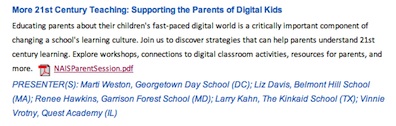
OurStoriesI’ve just returned from the 2013 National Association of Independent Schools (NAIS) annual conference, where I presented a workshop with three colleagues, Renee Hawkins, Vinnie Vrotny, and Larry Kahn. In our Thursday afternoon session we shared our ideas about coaching the parents of 21st Century learners to help them understand more about the digital lives of their children.

As I reflect on our wonderfully collaborative NAIS presentation project — coming up with an idea and developing it over time — I now understand that the workshop planning process led me and my colleagues on a substantial journey featuring what I think of as extremely connected professional development.

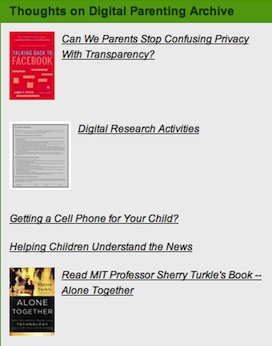
Thoughts on Digital Parenting
An example of digital parenting book resources

This workshop’s journey began a year ago at EdCampSeattle, where I shared an idea about the importance of educating 21st Century parents. At my school I work hard at educating parents about their digital kids, so I wanted to learn lots more about what my colleagues do at other schools.

Actually, I initially shared my idea with independent school colleague, Liz Davis, a dedicated EdCamp advocate, and she told me that I just had to attend EdCampSeattle. (Note: Liz is also one of the main people responsible for getting me to start blogging, but that’s another story.)

If you’ve attended EdCamp, you know that participants suggest lots of great ideas, but not everyone becomes part of the program. At the beginning of every EdCamp people walk around the room suggesting and choosing the topics they are most interested in — called the “law of two feet” in “EdCampSpeak.” They go on to experience, a day-long collegial event that they have planned, essentially carrying out their own program — in itself extreme professional development. Expanding this idea, my workshop colleague, Larry Kahn, will shortly experiment with inviting parents to attend an EdCamp along with teachers.

Continue reading “Workshop Planning As Extreme Professional Development: My NAIS Conference #3”

Posted in 21st Century Learning, digital citizenship, digital kids, digital learning, digital parenting, NAIS Conference Reports, parents and technology, social media, social media friends

Learning Lots More About Topics I Know Lots About: My NAIS 2013 Conference #1

You are in a good workshop when it’s on a topic that you know well, and you end up learning a whole lot more, and when you feel new knowledge pathways opening up, you say “Wow!”  That’s what happened to me on Friday morning at the 2013 National Association of Independent Schools (NAIS) annual conference, this year in Philadelphia.

I attended a workshop, “It’s Just Facebook: Ethical Questions in Social Media Use,” and discovered first-hand how much I can still learn about educating children, their parents, and educators when it comes to 21st Century digital citizenship and media literacy problem-solving. What’s  especially interesting to me since, just the day before, I presented a workshop with three of my NAIS colleagues on a similar topic.

Ethics institute
Check out the Ethics Institute teacher workshops.

In their “Ethical Questions” workshop, Kent Place School presenters Kimberly Coelho and Karen Rezach helped us compare moral with ethical dilemmas sharing case studies that are designed to help students examine and address the life challenges that pop up in their 21st Century learning and digital lives.

The two leaders, part of the Ethics Institute at Kent Place, walked us through the discussion process, emphasizing how they  include a range of different perspectives. Often right and wrong answers are not so clear because the dilemmas usually present competing values, so the problems are not examined or solved easily.

Continue reading “Learning Lots More About Topics I Know Lots About: My NAIS 2013 Conference #1”

Posted in 21st Century Learning, communicating with grandparents, digital parenting, family conversations, grandparents, intention versus consequence, parents and technology, teaching digital kids

Whose Eyes Are Checking Out That Digital Content?

In his recent post over at the Changing Aging blog, Kavan Peterson describes a short video, Forwarders. Intended as a parody of people who continuously forward e-mail, the video reinforces stereotypes about elders and aging. It’s sad that this short film focuses solely on one older adult, especially since so many people of all ages are extreme (and irritating) forwarders.

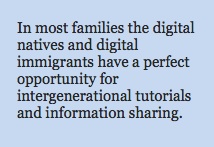
generational tutorialsWhile it’s intended to be funny, the video’s other message is that old people with wrinkles are silly and inept — at least that’s my interpretation. I’ll bet that the video producer — I am guessing an adolescent or young adult — probably cherishes a fair number of lifelong relationships with grandparents. This parody promotes a stereotype that could have been alleviated simply by adding in a few younger characters who also need reforming. (I posit a guess about the creator/producer’s age after looking over other published web content.)

The video and others like it also raise a question. How do we help 21st Century learners who are natural Internet content “whizzes” to understand that everything uploaded is subject to interpretation?

As a teacher who concentrates on educational technology, I frequently hear the refrain, “But I did not mean to hurt that person,” usually after a student has created and uploaded what he or she considered to be amusing content. Sometimes it is, sometimes it isn’t, and sometimes various readers or viewers interpret the message differently. What my students slowly learn is that digital content may be funny to one person, not funny to another, and for some individuals downright insulting.

In today’s connected society digital natives — born into a world of computers, cell phones, and various other gadgets — find it easy to create content, but sometimes they forget that what they do and say (and upload) circulates far and wide. Different people will watch and may reach different conclusions about the work. One person’s joke can unintentionally malign others. Humor that is appropriate for a person at one age is not so funny when it’s uploaded into the world at large for everyone to see. Digital natives need to learn and respect the ways that different people view the world through slightly different lenses. Most professional writers of parody think long and hard about every detail of a project, interchanging those lenses as they create.

Continue reading “Whose Eyes Are Checking Out That Digital Content?”