Posted in 21st Century life, digital learning, digital life, digital parenting, parents and technology

5 New Year’s Resolutions to Improve Parents’ & Kids’ Digital Literacy Skills

The New York Times recently published For the New Year, Let’s Resolve to Improve Our Tech Literacy, about the need for leaders, law enforcement officials and policymakers to increase their digital world literacy. The December 23, 2015 article, written by Farhad Manjoo, points out that many the big problems that occur in our world become even more complicated because the leaders and law enforcement personnel do not have a big-picture understanding of the vast changes technology brings to today’s world. Greater understanding might strengthen our leaders’ problem-solving skills.

This article looks at the importance of digital literacy on a large-scale.

Tech Literacy

As I finished reading, I began thinking about resolutions on a smaller scale — those steps that adults and children can take in 2016 to improve a family’s tech literacy and perhaps prevent at least some of the potential connected-world problems. It’s a fast-paced, always-changing 21st Century world and everyone has a lot to learn. Many of the issues that do occur are made worse because kids and parents do not have enough knowledge to anticipate what might go wrong and take steps to steer clear of problems.

Below are five digital literacy resolutions that parents can make, and all of them can help people — both adults and children — become more sensible and savvy connected world citizens.                                                                  Continue reading “5 New Year’s Resolutions to Improve Parents’ & Kids’ Digital Literacy Skills”

Posted in 21st Century life, digital life, family life, Gratitude, parents and technology

Digital Opportunities That Make Life Better — Thanksgiving 2015

Thanksgiving GratitudeIt’s Thanksgiving 2015 and time for my annual list celebrating what’s good about our digital world.
As a parent, teacher, and 21st Century learning advocate with a digital parenting focus, I spend lots of time suggesting ways that families, educators, and children, can strategize, enrich, and improve their digitally connected lives. And, of course, I am always encouraging people — kids and parents —  to learn and understand enough about digital life to avoid potential problems.

This year I am especially grateful for a young new family member and for the digital tools that allow me to continually stay in touch. The ability to see, chat, laugh, watch reactions, and almost touch family members who live at a distance enriches life in countless ways.

My 2015 Thanksgiving List 

I am thankful that digital life allows me to:       Continue reading “Digital Opportunities That Make Life Better — Thanksgiving 2015”

Posted in 21st Century Learning, connected learning, digital citizenship, digital health and wellness, digital wellness, mentoring digital kids, monitoring kids online, parents and technology, teaching digital kids

Connected World Coaching for Digital Natives? Read Connecting Wisely

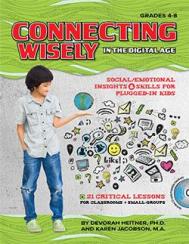
3002_01021048If you teach or think a lot about digital citizenship, take a few minutes to get acquainted with Connecting Wisely in the Digital Age. This new book is simple yet powerful, with content and context for adults who seek to support and mentor 21st Century digital kids. The goal is to help children develop a deeper understanding of the responsibilities that accompany their connected lives.

Authors Devorah Heitner, Ph.D., and Karen Jacobson, MAbase their book on a singular premise — that the 21 activities introduced in their book, when facilitated by imaginative adults, will make a positive difference in kids’ daily online lives. With its flexibility and its focus on adults as connected world coaches and mentors (not lecturers), Connecting Wisely stands head and shoulders above many other curricula in this category.                 Continue reading “Connected World Coaching for Digital Natives? Read Connecting Wisely”

Posted in 21st Century life, digital parenting, digital parenting checklist, education not fear, family conversations, parents and technology

Digital Parenting Back-to-School Checklist

Read the 2016 updated version of this post.

back to school digital parents checklist
Click to download a PDF of the Digital Parenting Checklist.

It’s back-to-school 2015, a time to list the many tasks we need to accomplish before the start of the new academic year. We think about school supplies, new clothes and shoes, new lunch boxes, and, of course, new digital devices and computers. We check off our lists as we go, getting our 21st Century children ready to return to school.

Yet back-to-school season is also a useful time for parents to list, consider, and articulate connected-life expectations, old and new, for the coming year. What do you want your children to do or not do? How do you expect them to behave when a friend encourages behavior that is not allowed at home?

To help you consider the issues of your child’s digital life, and your own, use the eight-item checklist below to get started.                               Continue reading “Digital Parenting Back-to-School Checklist”

Posted in 21st Century life, digital learning, parents and technology

So What Else Can Google Do?

Made with Tagul!
Made with Tagul!

Did you know that, besides searching, Google can carry out a variety of simple tasks in daily life — making 21st Century connected life easier or at least a bit quicker? Amaze your children or students by trying out and sharing a few of these Google bells and whistles. A few of the tasks may also support learning activities.

  1. Use Google as a timer by typing set time to 24 minutes.
  2. Find a movie release by typing the name of the movie and the word release: e.g., Second Best Exotic Marigold Hotel release.
  3. Check out the sunrise and sunset times by typing sunrise in [town or city].
  4. Get the weather forecast by typing forecast [town or city].
  5. Get a definition by typing define [word here].
  6. Figure out a tip by typing tip calculator.
  7. Get songs by groups you like by typing songs by the [group name].
  8. Convert measurements by typing convert and the units that you want to convert to: e.g., convert 3 yards to meters.
  9. Find books by a certain author by typing books by [author’s name].
  10. Get a definition by typing define [word here].

Check out even more!      Continue reading “So What Else Can Google Do?”

Posted in 21st Century life, connected learning, social media, social networking

Social Media Week? What a Great Idea for Schools!

Screen Shot 2015-02-22 at 11.37.21 AMJust imagine what we could teach our 21st Century students and ourselves if, together with students, we organized social media weeks (or days) with presentations, demonstrations, and talks about all aspects of social networking — what’s good, what’s not so good, and what can be done with social media to make our lives better?

More importantly, what if in the process, we educators and some of our social-media-savvy parents demonstrated to students that we understand the role that social media plays in all of our lives while also emphasizing the need to manage and curate our profiles?

Social Media Weeks seek to do just that. The mission of social media week events is to promote a discussion about our always-connected lives, examining how things have changed, how to make the world a better place, and perhaps most importantly, how to learn from our mistakes. Online conferences, offline events, lectures, and dialogues are scheduled during four official social media weeks, held in major cities around the world.    Continue reading “Social Media Week? What a Great Idea for Schools!”

Posted in 21st Century Learning, 21st Century teaching, parents and technology, searching for information

Word Order: When You Search It Matters!

The word order of a search matters in today’s connected world, so 21st Century learners — of all ages — should understand how search results change when a user rearranges the words. A short video on word order, uploaded by Google’s Search Anthropologist Daniel Russell – check out his Search-Research blog – teaches this lesson effectively.

Use this less-than-two-minute video — I found it in a blog post at Free Technology for Teachers — as a quick and succinct teaching tool with students, parents, and other educators.