Although I am a big fan of encouraging students to begin any research project with curated resources such as the online databases at a school or public library, I know that many learners head straight for Google.
When students make garden-variety searches on Google, teach them to investigate and ask questions about what they find, especially if they are planning to use a website to learn more about a topic. The strongest 21st Century learners will make the process of asking evaluative questions second nature — examining each and every site before deciding whether or not to use the information.
After the December holidays, lots of digital kids are using new digital devices.
Each new digital gadget requires that parents update or introduce a family digital device action plan — akin to the rules-of-the-road that are so critical to new drivers.
These days flashy new smartphones, iPads, iPod Touches, music players, computers, laptops, notebooks, and video games are connected in some way to the exciting, but rough and tumble world of the Internet. Sometime during the first week of gadget ownership parents and children need to sit together and review digital behavior and expectations.
Parents report they are using a lot more social media — 66% of parents with children who use social media now use it themselves (compared with 58% in the 2011 survey).
One reason that parents are increasing their use of social media sites is to be able to facilitate ongoing family conversations about content.
Parents appear to worry more about advertisers who gather information about a child’s online activities than about a child’s possible contact with unfamiliar people.
Some teens whose parents are friends have learned how to restrict the information that parents see, but in general, they are positive about friending a parent.
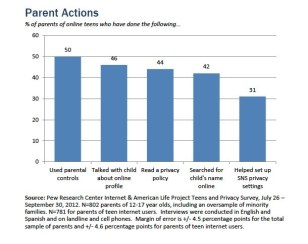
Parents are increasingly aware of privacy policies — 44% have read a policy for a social media that one of their children uses and 39% told the survey that they are helping their children set up social media privacy settings.
Parents are concerned about a child’s online reputation, but the concerns are the highest as children get closer to applying to college.
Reputation management, when juxtaposed with the adolescent years, is tricky for teens.
Wikipedia is cool, Wikipedia is filled with information, and Wikipedia is great fun to visit.
That said, reminding children about the authority of references and the expertise of authors — whenever children begin research — is an important part of teaching and parenting. A critical 21st Century and life skill is understanding how to go about judging the quality of references and especially learning how to figure out when information is not up to snuff.
If students start out a project by looking up a topic on Wikipedia, and many of them do, they should hear — over and over at every age — about the importance of seeking out and reading other resources to confirm the facts. Adults, too, need to make this a habit.
Image from Amazon site.
A new book, Wikipedia: 3.5 Million Articles and Counting, offers parents and educators a great opportunity to read together and learn more — lots more — about Wikipedia. Author Heather Hasan writes in detail about the history and philosophy of this mammoth open-source encyclopedia, explaining how Wikipedia works and describing how the editors keep track of new entries, edits, and re-edits.
Hasan points out the ways that Wikipedia writers occasionally argue over topics, and she notes that editors often decide to lock down a subject or entry. Other short sections of the book share Wikipedia facts and myths, a glossary, and several pages of bibliographic references.
If you read this book with children in your family or students in your class, be sure to have continuing conversations, both while reading the book and afterwards, about the importance of expertise and authority, pointing out that another reason to confirm the facts — aside from worrying about misinformation — is to learn whether even the experts disagree.
An excellent Wikipedia documentary, Truth in Numbers, is available at Amazonand includes interviews with many of the people who have helped the Internet to develop and grow — the movers and shakers of the World Wide Web.
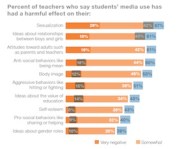
Technology reporter Matt Richtel shares information about two recent studies that examine, on the basis of educator surveys, how today’s digital children may be learning differently than in the past. Although individual responses are subjective, the results of the surveys “are considered significant because of the vantage points of teachers who spend hours a day observing students.”
It all comes down to attention span. In both surveys, teachers expressed concern that students, used to fast-paced, always changing activities, are less able to focus on an academic task for a prolonged period.
As we approach the end of 2012 and the holiday season that will surely introduce new gadgets and devices into many of our households, it’s a good time to reassess family digital expectations.
Learning in the 21st Century requires that children competently use digital resources much of the time. To do this each student needs plenty of experience making choices, understanding limits, and mastering the art of filtering out what is immaterial at any given point. Children who get this guidance at home and at school are the most prepared to become effective learners.
These eight tips aim to help parents of digital kids to get started. If you teach, consider sharing them with your students’ parents.
1. Place computers and tablet devices in central, well-traveled locations — away from bedrooms and private spaces.
2. Make adults, not children, the administrators on all computers, including laptops until you are certain of each child’s decision-making. Know what is installed on your child’s mobile devices.
3. Print and post rules and expectations. Specify the times when you do notwant your children using computers. Emphasize that your family rules are in effect when your child goes to a friend’s house.
4. Help your children to come up with a strategy that helps them to distance themselves whenever and wherever inappropriate digital activities occur.
The other day I chatted with a parent about the concept of copyright. Both of us are concerned that digital kids understand very little about intellectual property. The free-for-all digital information climate ensures that children have considerable ease accessing information and considerable difficulty comprehending what belongs to whom. Given this easy access parents and educators need to spend time helping children understand the basics.
Copyright laws are arcane, and even a bit crazy, but it’s critical to teach kids that protecting the intellectual property of others is a necessary 21st Century skill. With your child take the Copyright Challenge quiz at Copyright for Kids to see how much you know. When you finish the quiz check out these frequently asked questions about copyright.
Younger children might enjoy taking the Cyberbee Copyright Quiz by moving the mouse over pictures of students. When the mouse hovers over an image, a question flashes. To get the answer, click on the picture.

 Although I am a big fan of encouraging students to begin any research project with curated resources such as the online databases at a school or public library, I know that many learners head straight for Google.



 Media! Tech! Parenting!
You must be logged in to post a comment.