Posted in 21st Century Learning, digital citizenship, digital learning, family conversations, parents and technology, privacy, teaching digital kids

Digital Footprints Video – Check it Out!

A well done and interesting presentation about digital footprints found at Harvard’s Berkman Center for Internet and Society website.

Good for middle school as well as older students. Parts of this video can be shared with fifth graders, but the whole video may a bit too scary for that age.

Parents, on the other hand, may consider this as an excellent resource for family conversations about digital life.

You might also enjoying reading my post, Digital Footprints, Changing What We Teach.

Posted in communicating with grandparents, digital learning, digital literacy, parents and technology, social media, social networking, technology changes

Senior Family Members Expand Social Media Access – With Kids’ Help

Those of us with seniors and elders in our families know how important it is, in this digital age, to ensure that children communicate with grandparents, older relatives, and even elder family friends.

In many families, grandparents and other senior relatives benefit and gain more technology skill with the help of their digital-age grandchildren, nieces, and nephews. Once a family senior gets immersed in intergenerational digital communication, he or she often wants even more connections — at first more contact with younger family members and then with … the world.
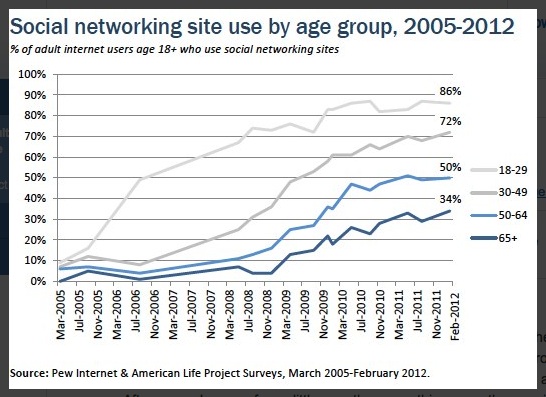
pew-internet-aging-social-networkingInterestingly, only a few years ago most seniors were satisfied with e-mail communication or the occasional video to watch. Not anymore. Today a growing number of people over 65 are enthusiastically latching on to social networking sites and using them on a fairly regular basis, and these numbers are growing.

This amazing graph depicts the percentage of adults at various ages who used social media sites over seven years, and it demonstrates how fast the use of these sites is increasing for all age groups, but especially for seniors.

Published in the Pew Internet’s July 2012 report on Older Adults and Internet Use, the information in the image comes from a Pew survey that collected data between March 2005 and February 2012.

Note the growth for the 50-64 age group and the over 65 age group (data that could hardly be detected back in 2005) over the years of the survey. Moreover, the social networking adoption percentage numbers for people 50 and older picked up a lot of steam, between July and November 2008.

Bottom line? Many more older adults are signing up and using social media sites, and their numbers are continuing to increase. One way that young family members can be especially helpful is to be on the lookout for seniors relatives who can use extra support as they learn more about living lives in the digital world.

The French essayist Joseph Joubert (1754-1824) wrote, “To teach is to learn twice.” Children relearn and review their own digital world lessons when they teach senior family members about learning and communicating in today’s always connected world. It doesn’t matter whether they are helping with privacy issues, teaching a senior to understand a cell phone, or demonstrating the many other virtual world tasks that a grandparent or elder relative might need to know. In helping that older family member learn something new, the child refocuses on the lesson.

That’s pretty cool for everyone involved.

Posted in 21st Century Learning, connected learning, digital devices, online communication, parents and technology

Inauguration 2013: Digitally Connected All Day Long

Maureen's inauguration pic
Inauguration Day photo taken by my friend and colleague, Maureen Boucher.

Events like today’s inauguration offer teachers and parents unique opportunities to demonstrate what connected learning is all about in the 21st Century. In my house, Inauguration Day 2013 was filled with digital connections.

We turned on the television around 10:30 this morning and did not turn it off until mid-evening — unusual for us. We also tuned our radios to NPR. A laptop, iPad, and iPhone finished out our Inauguration Day 2013 connections.

When we had things to do around the house we listened to our radios, though I kept my iPhone nearby to check on Facebook friends at the Capitol and along the parade route. When we sat in front of the television, I also used my laptop and iPhone, and my husband used his iPad.

Throughout the day we heard and responded to Facebook pictures and comments, and I often used my iPhone to respond to text messages from friends who shared observations from the Mall. While I thought about tweeting, the tweets were coming in so fast and furiously under the inauguration hashtags that I could not possibly read many of them while multi-tasking on my other devices, so I skipped Twitter for the day.

As we watched television, I opened a laptop window to the live blogging at the New York Times website. At the same time, I used another window to look up things when I wanted to learn more — interesting historical inauguration facts, for instance. I also searched for poet Richard Blanco’s bio to find more about his work, and another discovery was a terrific PBS News Hour interview with Richard Blanco. After President Obama finished speaking, I also looked for and found a link to the text of his speech at the White House website. Continue reading “Inauguration 2013: Digitally Connected All Day Long”

Posted in digital parenting, media and sleep patterns, media diet, parents and technology

Can Healthy Media Intervention Improve a Child’s Sleep?

association sleep patternsThe results of a study published in the September 2012 issue of Pediatrics indicate that parents may be able to positively affect a preschooler’s sleep patterns by making healthier and more educational choices in a child’s media diet.

The journal article, The Impact of a Healthy Media Use Intervention on Sleep in Preschool Childrenexamines whether healthy media interventions in the lives of preschool children can improve sleep patterns. Researchers at the Seattle Children’s Research Institute explain how they conducted a randomized controlled study to discover if the sleep of preschoolers might be improved when families were helped to replace inappropriate and sometimes violent media content with a healthier and more educational media diet. This article is freely available or read the abstract.

The study, which included 617 children and their families from the Seattle area, used two-phase sampling (defined below). In the first phase researchers selected the clinics in the Seattle metropolitan area, making selections that reflected Seattle’s demographic make-up and including providers that served Medicaid patients. In the next phase, researchers invited preschool patients (and their parents) from those clinics to take part in the study. Patients and who met the guidelines for inclusion and agreed to participate were then randomized into a control group (this group received usual pediatric care) and an interventional group (researchers suggested media changes to these participants).

At the beginning, a survey asked everyone about sleep habits, and the researchers classified into categories. Additional information about each child’s media exposure was collected at 6, 12, and 18 months. Of the 617 families who completed the initial sleep survey questionnaire, 565 completed at least one follow-up survey.

Continue reading “Can Healthy Media Intervention Improve a Child’s Sleep?”

Posted in 21st Century Learning, family conversations, great sites for students, parents and technology

Learn Google Flu Trends and CDC – Winter 2013

Flu is here and for the next couple of months so many of us will need to take precautions to prevent, if possible, getting sick. Your family will probably have a few conversations about the flu, so here are some data-rich public health websites to use as a part of the conversation with 21st Century learners.

Some influenza seasons are worse than others, and this year appears to be more severe than the last few flu seasons. But no matter what year it is, it’s doubly important to help children and everyone else in your family avoid influenza exposure as much as possible — and no one should get very far into the fall months without receiving a vaccination at a physician’s office, pharmacy, or local clinic.

google-trends
Google Flu Trends Data Map

Today I went to Google Flu Trends to learn where in the United States influenza is hitting the hardest, and right now this dynamic mapping site indicates that the flu is just about everywhere. Google collects its data by keeping track of internet searches for symptoms such as fever, headache, or sore muscles. The collected search statistics turn out to be good predictors of what parts of the country are experiencing influenza-like illnesses.

Right now, January 18, 2013, the Google flu map shows that the flu is widespread — almost every state in the U.S. is the same bright red color, indicating that lots of people are sick with the flu and searching to learn more. A user can click in each state to look at the influenza-related searches from there. Click on the map to visit Google Flu Trends to see what it looks like.

CDC influenza
CDC Data Map

The data depicted by Google Flu Trends often corresponds to, but is not a substitute for, the hard data that the Centers for Disease Control and Prevention (CDC) receives when epidemiologists from around the country collect and submit data about actual diagnosed influenza cases in their states. In tracing the course of an epidemic, epidemiologists and health officials need to collect the specifics about place and time of an illness as well as general characteristics of the people who are sick (age, gender, ethnicity, seriousness of illness, pre-existing health conditions, etc.).

At this time, Google Flu Trends, while predictive of case counts, does not provide public health officials enough detailed information. Look at the CDC Influenza Summary Update.

Resources on Influenza Continue reading “Learn Google Flu Trends and CDC – Winter 2013”

Posted in digital citizenship, digital learning, digital parenting, family conversations, kids changing lives, parents and technology

8 Wishes Connected Kids Have For Their Parents

With more than 30 years as a teacher including over 20 in the educational technology field, I’ve heard many kids reflect thoughtfully, and not so thoughtfully, on their parents’ digital skills. Kids often wonder why parents don’t always model the digital citizenship expectations that they want their children to learn and apply.

I wish my parents wouldHere are the eight most common “I Wish” statements that I’ve heard expressed by children over the last 16 or 17 years. Two of them, I can report, my daughter also mentioned to me ages ago.

Kids Wish Their Parents and Other Adults Would

  1. Try to learn a lot more about computers in particular and technology in general.
  2. Stop saying they don’t know much about technology (mom’s especially)
  3. Do not use Blackberries and phones at sports games and school events
  4. Learn to play some of the kids’ online games.
  5. Understand more about helping with searches on the Internet.
  6. Understand how hard it is to learn the technology rules and regulations and not always threaten to take away technology access when there’s a problem.
  7. Stop automatically saying that new things like Wikipedia are questionable.
  8. Don’t act dumb about technology – act like you want to learn new things.
To learn a bit more read 4 Lessons for Parents in a Constantly Connected World over at the Mashable site.

Continue reading “8 Wishes Connected Kids Have For Their Parents”