Posted in 21st Century Learning, 21st Century parenting, acceptable use, cell phones, digital devices, digital devices and gadgets, parents and technology

Getting Your Child a Cell Phone This Summer? Read This First!

It’s summer 2013…

…and lots of families will soon purchase a new mobile phone for a fifth, sixth, or seventh grade child.

cell phoneRemember, however, you are not just handing over a telephone. A child is getting a mini-computer — a digital device  that takes pictures, shares locations, communicates via text, e-mail, and phone calls, and easily installs apps that connect in all sorts of other ways. A new cell phone networks your child in nearly unlimited ways to the entire world, and most of what he or she sends on the web via cell phone will never be deleted.

Before handing over the new mobile device, 21st Century parents need to think about how they want digital kids to use their new prized possessions and also about what they don’t want children to do.

Adults can be specific and clear about what is acceptable by setting up a cell phone user contract. Use an agreement word-for-word from the list of links on this blog. Or copy one of the contracts as a template and write a more personalized version that is appropriate for your family. Today’s kids are 21st Century learners, eager to use and explore the digital world — a great way to be — but parents need to set clear expectations that help to ensure that a child explores and experiments as much as possible without humiliation and  embarrassment.            Continue reading “Getting Your Child a Cell Phone This Summer? Read This First!”

Posted in cell phones, digital devices, gadget ownership, iPhones and iPads, parents and technology, tips and tricks

40 Really Cool Tips for iPhone Users

emojis
The emoji keyboard has several icon screens.

iPhones seem to have unlimited features to tweak. Since I have owned iPhones for more than four years, I tend to believe I am pretty expert about using them.

Then I read this Christian Science Monitor article, 40 iPhone Tips and Tricks Everyone Should Know, and discovered that I still have quite a few cool new things to learn. The February 2012 report, by Megan Riesz, Eoin O’Carroll, and Chris Gaylord, includes a few far-fetched suggestions that I will never do — in my case some the ideas for tweaking Siri — but it also includes several iPhone tweaks that I’ve already added as I was making my way through the 40 tips.

A Few of My Favorites

  1.   Create an “app “out of a website that you visit a lot.
  2.   Take better pics with HDR photography.
  3.  Install the “emojis” keyboard with lots of little pics and icons — especially nice for texting.
  4.  Take a screen shot on the iPhone.


Posted in digital kids, parents and technology, privacy, social media, social networking

Teens, Social Media and Privacy — From Pew Internet

Teen Sharing Facebook PewData from a joint Pew Internet and Harvard Berkman Center research report, Teens, Social Media and Privacy, identify a discrepancy between the ways teens and adolescents preserve their privacy and their lack of concern about the invasive collection of personal information by third parties.

The May 21, 2013 report also points out that while teens are increasing the amount of sharing they do on social media, many adolescents are tiring of Facebook because so many adults use the site and because of the excessive sharing that Facebook seems to prod people to do. The researchers gathered much their Facebook data through focus groups. Continue reading “Teens, Social Media and Privacy — From Pew Internet”

Posted in advertising, American Academy of Pediatrics, digital parenting, marketing to kids, media messages, parents and technology

The Media Is the Message for Our Children

Listen to a Los Angles CBS video about the story.
Listen to a Los Angles CBS video about the controversy and read the story.

In light of the extraordinary negative media messages about body image in children’s lives, ensuring the strength and confidence of preadolescents and teens is a continuing challenge for parents and teachers. So much of the advertising markets thinness, popularity, sexuality, and one type of attractiveness, so it can be difficult for adults to counteract the effect of the of this pressure on a child.

Sometimes the entire ethos of a company emphasizes values that we do not want children in our care to adopt.

A distressing article over at the Huffington Post, A Message to Abercrombie’s CEO from a Former Fat Girl by Sara Taney Humphreys, highlights how one company has made exclusion, intentionally or otherwise, a part of its mission. Humphreys’ article isn’t about something that happened recently, but rather a quote from a 2006 Salon article about the CEO of Abercrombie and Fitch. While the article is more than six years old, the comments are disturbing, especially given the number of children who like to shop at Abercrombie and the many others who struggle with body image. Below is a quote from the Salon article.

As far as Jeffries is concerned, America’s unattractive, overweight or otherwise undesirable teens can shop elsewhere. “In every school there are the cool and popular kids, and then there are the not-so-cool kids,” he says. “Candidly, we go after the cool kids. We go after the attractive all-American kid with a great attitude and a lot of friends. A lot of people don’t belong [in our clothes], and they can’t belong. Are we exclusionary? Absolutely. Those companies that are in trouble are trying to target everybody: young, old, fat, skinny. But then you become totally vanilla. You don’t alienate anybody, but you don’t excite anybody, either.”

You can also listen to this ABC Chicago television story (after an airlines advertisement), including interviews with teenagers — many of whom can fit into the Abercrombie clothes but choose not to buy them. The teens are demonstrating at one of the stores in Chicago.

You might also want to look over the American Academy of Pediatrics (AAP) statement on media and children.

Posted in libraries, parents and technology, reading, research on the web

Parents, Libraries, and Reading in Today’s Digital World

parents libraries reading PewLibraries continue to play a significant role in the development of young readers, even as digital resources increase and children engage in more digital activities.

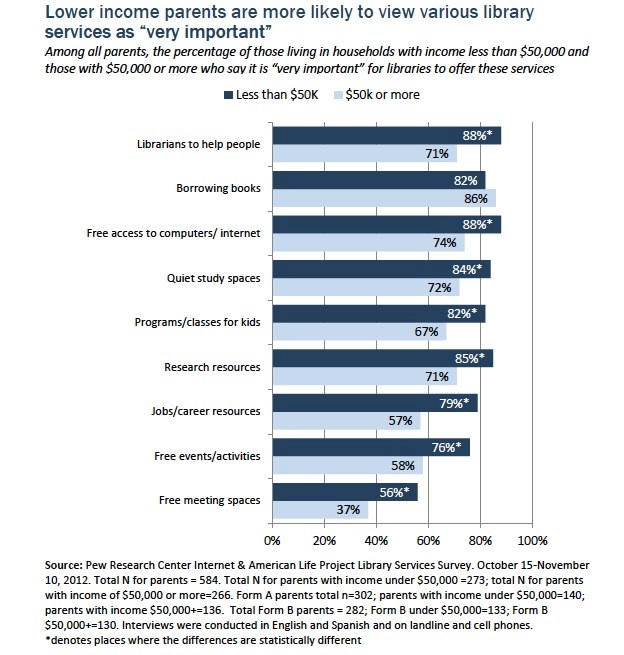
Recent research by the Pew Internet and American Life Organization finds that families with incomes under $50,000 consider libraries to be an important resource in the lives of their children.

Whether they are considering digital or non-digital opportunities, these families are more likely to rate library services as important than parents in families with higher incomes.

Some interesting research findings, quoted from the report:

  • 94% of parents say libraries are important for their children and 79% describe libraries as “very important.” That is especially true of parents of young children (those under 6), some 84% of whom describe libraries as very important.
  • 84% of these parents who say libraries are important and a major reason they want their children to have access to libraries is that libraries help inculcate their children’s love of reading and books.
  • 81% say a major reason libraries are important is that libraries provide their children with information and resources not available at home.

Too see other graphs and learn more about the research released on May 1, 2013, read the report, Parents, Children, Libraries, and Reading.

Posted in acceptable use, apps, cell phones, digital devices, nothing is permanently erased, parents and technology

SnapChat: Instantly Deletable Images? Sort of…

Snapchat: the free mobile app that promotes itself as a disappearing act. Parents and educators need to know just enough to understand its attraction to children and adolescents and the potential problems that may occur

Teens and, yes, some tweens are now playing with Snapchat because it’s designed to make pictures disappear at their destination — in ten seconds or less.

I’ve tried to use the app, and pictures really do disappear. Voilà! The content is gone. So does this mean a child (or an adult) can go ahead and send all sorts of pictures?

Well, not exactly. Read A Warning about SnapChat, Teenagers, and Online Photo Sharing, appearing on February 11, 2013, over at the Forbes website.

After downloading and installing the Snapchat app on a mobile phone, a user chooses a picture, text, or drawing and decides how long to allow the picture to reside on the recipient’s screen — anywhere from 1 to 10 seconds. For Snapchat to work the sender must trust that the recipient will allow the picture to delete and that the recipient will be trustworthy and respect the wishes of the sender. Any user is supposed to be 13 or older.

So yes, the content does disappear, but even a picture residing for just a few seconds gives an unreliable recipient enough time to take a quick screenshot, preserving the image. Read this April 10, 2013 New Yorker article, Delete This Picture When You’re Done, by Matt Buchanan, who points out that the Snapchat site is handling over 60 million images a day. Another informative article is SnapChat: Sexting Tool or Next Instagram, a CNN report by Doug Gross.      Continue reading “SnapChat: Instantly Deletable Images? Sort of…”

Posted in acceptable use, digital citizenship, parents and technology

4 Axioms of Digital Life

four axioms

I keep thinking that grown-up politicians and celebrities will stop humiliating themselves when they use digital media.

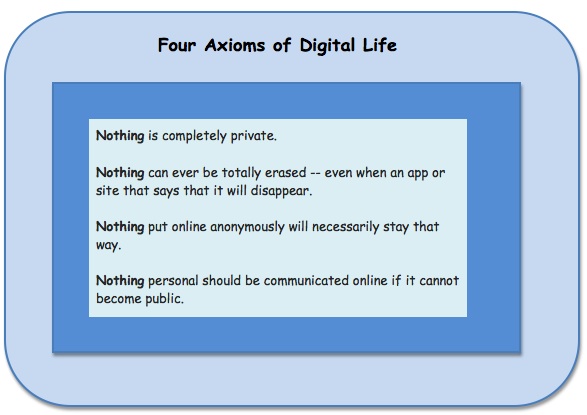
But then another event occurs, and I am reminded that a good number of adults, just like many kids, have not absorbed four primary fundamentals or axioms of digital life.

  • Nothing is completely private.
  • Nothing can ever be totally erased — even when an app or site that says that it will disappear.
  • Nothing put online anonymously will necessarily stay that way.
  • Nothing personal should be communicated online if it cannot become public.

Continue reading “4 Axioms of Digital Life”