Posted in digital kids, digital parenting, kids' advice for parents, parent child conversations, parents and technology

Advice from Digital Kids to Parents

Given the chance, kids can offer remarkable insight — good ideas for their parents to consider.

I’ve heard many kids reflect thoughtfully, and not so thoughtfully, on their parents’ digital skills. I often hear my students wonder aloud about why parents don’t always model the digital citizenship expectations that they want their children to learn and apply.

I wish my parents wouldBelow are the nine most common “I Wish” statements expressed over the past several years by digital children that I teach.  Two of them, I’ll admit, were even mentioned to me by my daughter some years ago. Mea culpa…

Kids Wish Their Parents and Other Adults Would

  1. Try to learn a lot more about computers in particular and technology in general.
  2. Stop saying they don’t know much about technology (mom’s especially)
  3. Not use Blackberries and phones at sports games and school events.
  4. Don’t talk on the phone so much in the car.
  5. Learn to play some of the kids’ online games.
  6. Understand more about helping with searches on the Internet.
  7. Understand how hard it is to learn the technology rules and regulations and not always threaten to take away technology access when there’s a problem.
  8. Stop automatically saying that new things like Wikipedia are questionable.
  9. Try not to act dumb about technology. Even if you don’t understand something, please act like you want to learn new things.        Continue reading “Advice from Digital Kids to Parents”
Posted in digital citizenship, digital devices and gadgets, digital kids, digital learning, digital parenting, parents and technology

Back-to-School Digital Parenting Tips – 2013

The back-to-school season is a great time for adults to think about what they can do to help children avoid some of the typical online and social media mistakes and difficulties.

backtoschool cyber rules

These adult strategies can help elementary and middle school children develop safe, secure, and disciplined digital life skills.

Teachers can also share this list with the parents of their students.

Posted in 21st Century Learning, 21st Century parenting, parents and technology, password security

Keeping Track of Passwords

If you are anything like me, you find password management to be challenging — thinking of them, storing them, and recalling them. I’ve tried several password security programs on my iPhone. They work well, but not in a way that satisfies my concern about privacy. and security. I still have to type in my passwords, which means that anyone on an unsecured network where I am working can potentially discover my passwords.

Of course, our digital children need lots of practice when it comes to secure passwords. Twenty-first Century learners need to understand how to be safe, savvy, and secure as they go about their digital lives. But how can we set good examples when it’s hard to do it for ourselves?

DashlaneHelp appears to be on the way.

In his June 5, 2013 New York Times column, tech reporter and guru David Pogue shared information about password memorization programs, and in the process he addressed many of my concerns.  In Remember All Those Passwords? No Need Pogue writes that he is especially fond of Dashlane, a free program that memorizes passwords and also fills them in for a user, so no typing is involved. Because the program remembers the passwords, a person does not need to recall them, and that means it’s possible to use words or phrases that are long, detailed, and extra secure. Dashlane can also be used to automatically fill in credit card info — another set of personal information that it’s wise to avoid typing.                      Continue reading “Keeping Track of Passwords”

Posted in parents and technology

Ode to Teachers: A Back-to-School Reflection

Thank you teachers… Who Helped My Daughter Learn and Grow

The school year will begin over the next several weeks, mostly right after a relaxing three-day Labor Day weekend. Each year at this time I reflect on the teachers who influenced members of my family.

Last year my three-days were more special than most, because I spent the time with my thirty-something daughter. As I thought about beginning the school year my mind kept wandering back to the years the two of us started school together, she as a student and me as a teacher.

During a recent Labor Day holiday I listened to my daughter, now a physician, talk about her work and her life, marveling at her competence, eagerness to learn, empathy, discipline, and, yes, her sense of fun. More than once during our conversations I thought about the teachers who helped her develop and strengthen these skills, people who took her interests into consideration — as well as the required topics.

A preschool teacher encouraged my daughter to get up and keep going after a fall or a spat, and her kindergarten teacher recognized her love of books but also reminded her to relax and play. In second grade her teacher came to the rescue when my daughter wanted to bring a book to read at recess, and this same gifted educator suggested that she “become an author” and write her own books.

Continue reading “Ode to Teachers: A Back-to-School Reflection”

Posted in 21st Century parenting, 21st Century teaching, digital parenting, family conversations, parents and technology, privacy, understanding privacy

Privacy: I’ve Got Nothing to Hide So I’m Not Worried …

imageI often hear people of all ages, including children, say, “It doesn’t matter that my digital information is collected because I have nothing to hide.” What bothers me most about this comment is the limited understanding that it demonstrates — a lack of knowledge about how fast the traditional walls of privacy are tumbling down and how little of it has to do with the bad things that people do.

  • People who make the comment usually know little about what happens to collected digital data, most of it documenting everything we do in our daily digital lives and almost none of it destined to identify wrongdoings or help to find “bad guys.” So much data is now collected about each of us in so many different ways, that almost nothing about us cannot be found out.

Our phones document where we go, our cars move through intersections with mounted cameras that note our license plates, the grocery stores keep track of the foods we prefer, and our Internet searches document the things we want to do, what we want to purchase, and often our worries about how to solve certain problems. Our data even document our medical conditions (despite physicians and insurance companies complying obsessively with HIPPA privacy rules) as we go about checking on symptoms and prescription side effects, or merely try to learn more.

So I was pleased to discover a May 2013 article, Why Privacy Matters Even If You Have Nothing to Hide, by Daniel J. Solove, a professor of law at George Washington University. In easy-to-understand terms, Professor Solove addresses the myths associated with narrow interpretations of privacy issues.

Continue reading “Privacy: I’ve Got Nothing to Hide So I’m Not Worried …”

Posted in 21st Century Learning, educating digital natives, parents and technology, teaching digital kids, writing

English Teachers: The Skills Students Need for the Future

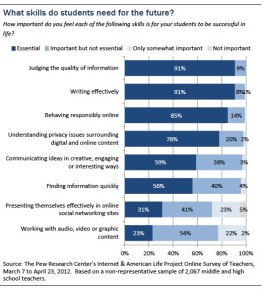
06 skills for future
English teachers suggest skills for the future.

A new report by the Pew Internet and American Life Project, The Impact of Digital Tools on Student Writing and How Writing is Taught in Schools, shares the results of a survey of 2,462 Advanced Placement and National Writing Project teachers. Data were collected in online and in-person focus groups.

Pew researchers asked educators about the effect of digital tools on their students’ writing skills. They also wanted to gather more information about the digital tools that teachers use in their classrooms and find out whether these tools help students become better writers. Survey participants were also asked to share their views about the skills their 21st Century students’ will need to be successful in their future lives.

A Few of the Pew Findings

  • Many teachers believe that the increasing digital world audience for writers encourages students of all ages to taking writing more seriously.
  • Seventy-nine percent of the educators surveyed agree or strongly agree that digital tools encourage students to collaborate with one another.