Posted in 21st Century Learning, digital citizenship, digital learning, digital learning resources, educating digital natives, online learning

Action Words that Describe Digital World Learning

digital-citizenship Can we teach pre-adolescents and teens to reflect on what’s happening as they use digital world tools and interact with online content? Can we help them understand more about what they are doing when they work and play online?

Educators often provide a checklist or rubric for students to use as they work on assignments or projects. A rubric usually contains editing specifications, project requirements, resource documentation, and expectations — all for students to consider while completing the work.

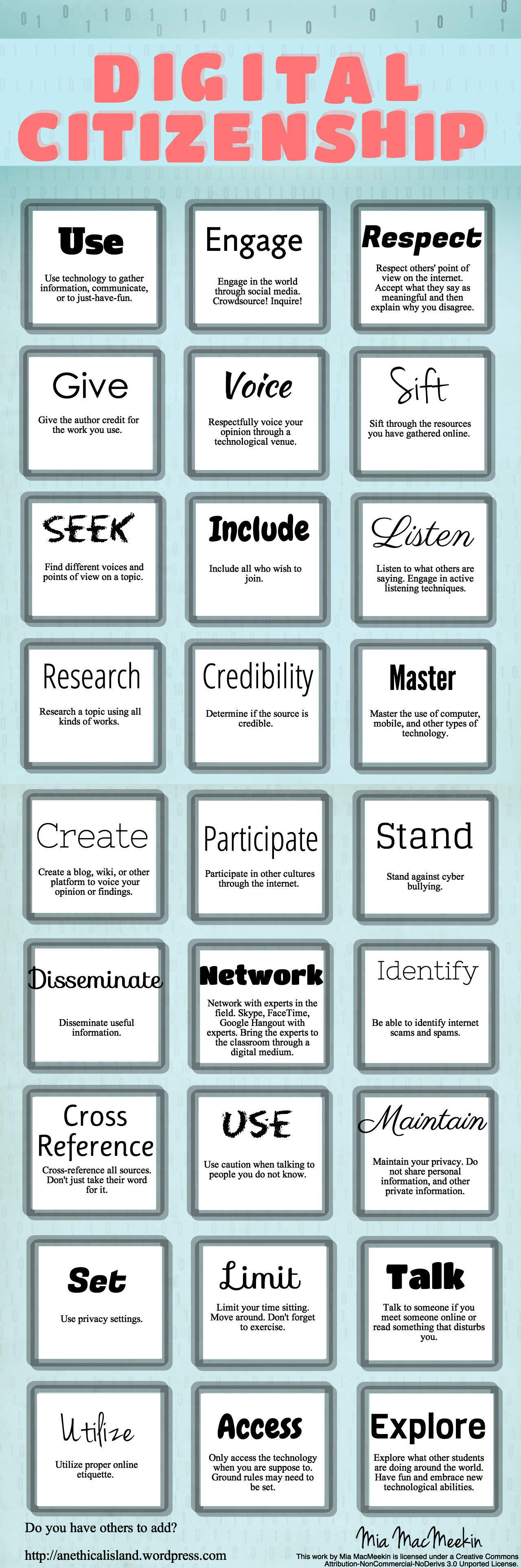
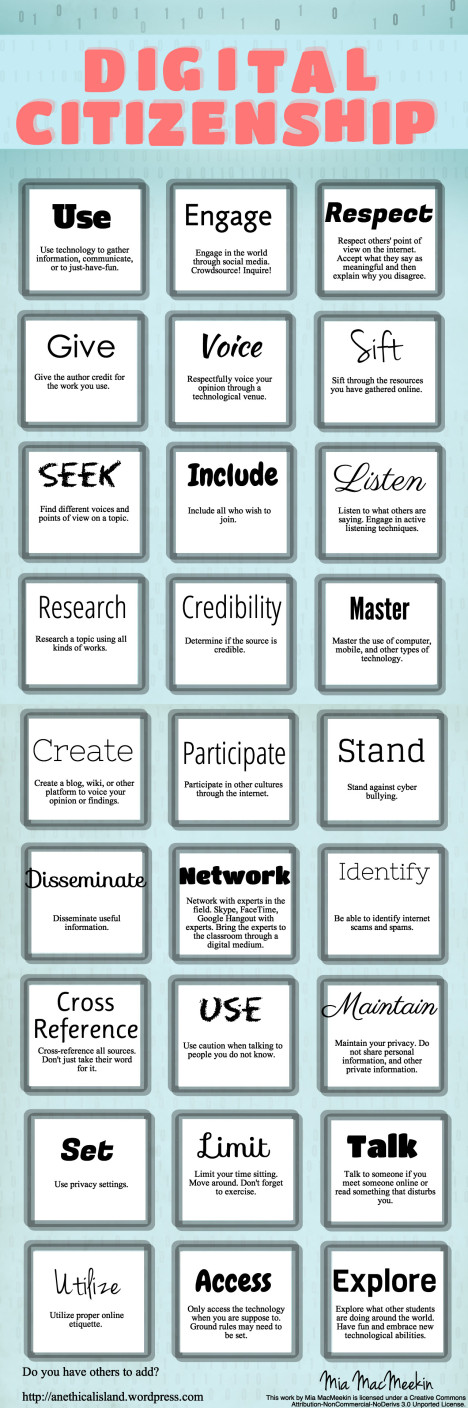
Now I’ve discovered that Mia MacMeekin over at the An Ethical Island blog offers what I think of as a digital learning graphical rubric. The easy-to-understand graphic features World Wide Web nouns and action verbs that describe the ways people encounter, process, and use online information. MacMeekin thinks of her infographic as a digital citizenship tool, but it’s much more than that. The chart offers educators with opportunities to ask questions as they teach, and more importantly, expect students to answer them.          Continue reading “Action Words that Describe Digital World Learning”

Posted in 21st Century Learning, 21st Century parenting, digital learning, diversity, parents and technology, reading on the web

The International Children’s Digital Library (ICDL): Changing the World One Book at a Time

What if our children had instant access to a library with thousands of books from countries all over the world — a place that invited them to drop by, read, and learn about one another (without any driving)? Imagine what they could find out about the world’s cultures, celebrations, languages, differences, and also about what they have in common  with all these other people and places!

That just about describes the mission of the International Children’s Digital Library (ICDL), a World Wide Web destination hosted at the University of Maryland. The massive website includes digitized books in 61 languages, and it’s the largest online collection of multicultural children’s literature with a mission to the promote the love of reading AND the love of diversity. The books are beautiful filled with colorful and detailed illustrations — you almost feel like you are holding an old-fashioned book!

By clicking on the animated Read Books! icon in the middle of the ICDL home page readers, young and old, are off and reading. The multi-cultural aspect comes from interacting with books that are read and languages spoken by children in 42 other countries as well as seeing pictures by artists from around the world.      Continue reading “The International Children’s Digital Library (ICDL): Changing the World One Book at a Time”

Posted in 21st Century Learning, 21st Century parenting, digital citizenship, digital footprints, digital kids, digital learning, parents and technology

How We Teach Digital Citizenship Makes a Difference

Digital Citizenship Posters Become a Hallway Exhibit
Digital Citizenship Posters Become a Month Long Hallway Exhibit

When it comes to digital citizenship, we cannot just lecture or watch videos.

Everyone learns best by doing — whether it’s tying a shoe, mastering letter sounds, figuring out a science concept, learning to drive, parenting a new baby, or any other activity, including what we need to figure out on computers and digital devices. When people tell us how to do something by talking a lot, most of us can’t wait for the person to stop talking so we can try to do it ourselves.

Now consider how we have gone about teaching 21st Century children — at home and at school — about digital devices and digital world behavior. Mostly adults talk and talk, telling children, pre-adolescents, and teens about all the things that can go wrong and explaining what we don’t want them to do.

Over the past 15 years, I’ve spent way too much time talking to kids about digital life issues and not nearly enough time doing things with them. So these past few years I’ve changed the way I teach.                              Continue reading “How We Teach Digital Citizenship Makes a Difference”

Posted in 21st Century Learning, 21st Century teaching, connected learning, digital kids, digital learning, digital literacy, digital world conversations

Innovative Teaching: How on Earth Do We Get Started?

innovative teachersYears ago as a beginning teacher, I asked one of my University of Chicago professors how it was that my mentoring teacher seemed to do everything at once — teaching one group, keeping an eye on other parts of the classroom, and continuously but quietly communicating with everyone in the room — all at the same time. She even knew when a student some distance behind her was not completing the assigned task.

“She acquired those skills step-by-step,” my professor replied.

Today as we cope with the challenge of transforming our teaching skills to make what goes on in our classrooms applicable to the ever-changing world of digital information (a.k.a. innovation or 21st Century learning), many of us are renewing our commitment to lifelong learning as we explore and acquire a range of new skills and behaviors. We are learning, step-by-step, how to teach differently and stretch ourselves in ways that help students access, process, and use information in innovative but sensible ways.          Continue reading “Innovative Teaching: How on Earth Do We Get Started?”

Posted in 21st Century life, apps, digital devices, reviews

A Few Apps for Parents to Learn More About

Check out these apps.  Just two months ago, when presented to a group of parents, some of these were not on the radar for preadolescent and teen digital life. I’ve linked each to an article. For additional reviews, but not for every app, visit the Common Sense Media App Review Page.

Poof

hide mobile phone apps

4Chan

image bulletin board – pretty good up front rules

Whisper

share secrets

Wanelo

social media shopping

Yic Yac

anonymous texting

Rumr

more anonymous messaging

Secret

share with friends secretly

Pheed

share everything, including video, pretty good rules

Posted in 21st Century life, online tracking, parents and technology, privacy

Retailers Track Adults by Monitoring Device Wifi

We most often worry about advertisers tracking our children online but sometimes forget to think about how much we adults are followed around digitally.

FTC Privacy Series
FTC Privacy Seminar on Mobile Device Tracking

Check out the Washington Post article, Privacy Advocates Push Back on Stores’ Tracking, describing how retailers keep track their customers by monitoring smartphone wifi signals. No guidelines currently regulate this type of information collecting so no privacy parameters exist. Essentially this mobile device tracking is a way to get more information about shoppers, track what they do, and target advertising and target advertising more effectively.

The article, by Amerita Jayakuma, describes how a Maryland legislator has proposed a bill to require retailers to inform people if the store is watching them while they shop.  The Federal Trade Commission recently held a seminar on mobile device tracking.

I’ve been wondering for some time if I was tracked a few months ago when I visited a huge regional outlet mall with my husband.

Continue reading “Retailers Track Adults by Monitoring Device Wifi”

Posted in 21st Century parenting, connected learning, digital kids, digital life, family conversations, Internet statistics, parents and technology

Amaze Digital Kids with Internet Statistics!

Royal PingdomDo you wish you could amaze the digital kids in your life with trivia or fun facts about the connected world?

For the past couple of years, the Royal Pingdom site has posted a yearly overview of Internet statistics. The post, Internet 2012 in Numbers, shares some interesting figures, and they will indeed help you amaze the digital natives in your life. Moreover, these statistics can serve as excellent conversation starters and provide good context to help connected learners understand more about the size and scope of the digital world that they take for granted.

Here’s a sampling from the 2012 post. By the end of the year the Internet featured:

  • 425 million active Gmail users
  • 635 million web sites
  • 51 new web sites added during the year
  • 246 million domain name registrations
  • 2.4 billion Internet users and 565 million of them are in China
  • 175 million Tweets per day
  • 40.5 years as the average age of a Facebook user
  • 4 billion hours watched on YouTube per month

Check out the many other stats and some nifty graphs. Remember, though, that the statistics are from 2012. Royal Pingdom has also compiled numbers for 2008, 2009, 2010, and 2011, so you can have some fun comparing and contrasting the numbers from year to year (and watching them grow). The site has not posted statistics for 2013 – at least not yet.