Posted in 21st Century Learning, 21st Century parenting, digital learning, libraries, reading

It’s Summer: Take this Quiz and then Visit Your Local Library

Pew Internet Libraries
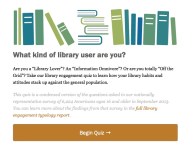
Click to visit the Pew site and take the quiz.

It’s summer and if you and your children — those digital kids you are raising —  are not regular library users, you should be. Almost any teacher will tell you that children who regularly use libraries develop better and more sustained reading habits. More significantly, I’ve observed that my 21st Century students with public library habits are often more critical and thoughtful users of digital materials, whether they use those digital materials at home, school, or even away from adult supervision.

No matter where you are located this summer, a library is probably nearby. Moreover, in addition to great books, many public libraries provide excellent tutorials on searching, evaluating resources, and digital commonsense. Be sure to visit.

Continue reading “It’s Summer: Take this Quiz and then Visit Your Local Library”

Posted in 21st Century Learning, collaborating with kids, digital kids, digital learning, parents and technology

10 Digital Summer Projects for Parents and Kids: Collaborate!

Summertime, summertime, sum, sum, summertime.  

Yup, it’s almost summer 2014! summer digital projects

With less frenetic schedules the summer months are a good time to learn more about the digital whirl that’s such a huge part of kids’ 21st Century lives. So when school is out, plan to do some connected world exploring and learning together, concentrating on projects that can help family members — children and their parents — figure out even more about digital life.

Below are 10 family digital project summer suggestions — all activities require collaboration —  to consider for the upcoming vacation. Note: Be sure to collaborate on these projects so that adults and children make meaningful contributions.

Ten Summer Digital Projects for Families                        Continue reading “10 Digital Summer Projects for Parents and Kids: Collaborate!”

Posted in 21st Century Learning, connected learning, online learning, online tracking, privacy

Is Privacy Protected When a Student Learns Online?

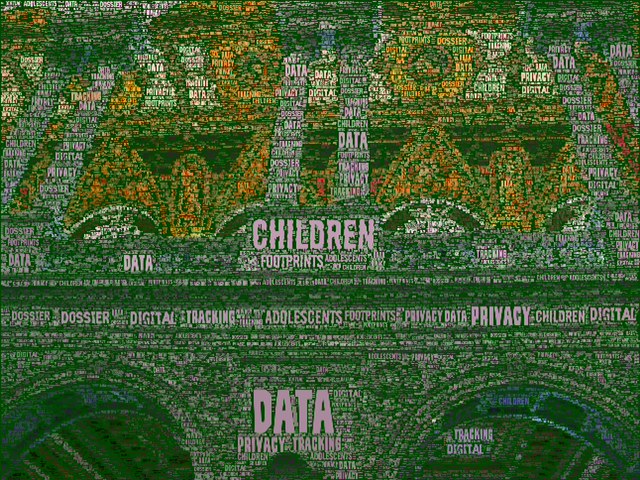
Image made with Wordfoto with a picture taken at the Library of Congress.

If you think that the digital world may be getting it together on the privacy front, at least when it comes to children, think again.

A disturbing article, Data Mining Your Children, published in Politico, describes how for-profit online learning companies provide digital textbooks, connected learning programs, and record keeping options while collecting an enormous amount of information on individual students. The question is, what will they do with this personal data? Politico is a Washington newspaper that covers national government policy and politics.           Continue reading “Is Privacy Protected When a Student Learns Online?”

Posted in 21st Century parenting, apps, digital devices, digital life, social media, spelling and editing

New York Times Report on FCC Snapchat Settlement

The Federal Communications Commission (FCC) just announced a settlement with Snapchat over questions of privacy and mis-information.  New York Times reporter Jenna Wortham published an article, Off the Record in a Chat App: Don’t Be Sure, a May 8, 2014 piece that describes the situation and the terms of the settlement.  I’ve written a post, Have A Chat If Your Child Uses Snapchat, with more details at my other blog, Discover Your Child’s Digital World.

Twenty-first century parents — take note.

Posted in 21st Century Learning, 21st Century teaching, connected learning, educating digital natives, teaching digital kids

AIMS 2014 Retreat Report #1: Grant Lichtman Presentation

Lichtman graphic
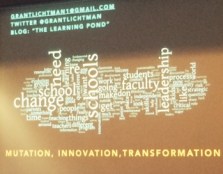
A photo of Lichtman’s title screen. Click to visit his blog.

The 2014 AIMS Technology Retreat is off to a terrific start with Grant Lichtman’s presentation about the challenges inherent in educational innovation and transformation. I’m attending this retreat with 150 tech leaders, librarians, administrators, and teachers representing more than 60 independent schools in the Washington, DC and Baltimore area.

Many of us think a good deal about how our schools might change and innovate. We consider how best to help our students make good use of their 21st Century access to vast amounts of knowledge. Most of us take seriously a new mission that requires us to enable students as they mold themselves into collaborators, dynamic learners, good problem solvers, and experiential learners. We also know that it’s critical to help them become confident enough to learn in a world that continuously changes (and at great speed).

This conversation is actually about becoming better progressive educators.

Continue reading “AIMS 2014 Retreat Report #1: Grant Lichtman Presentation”

Posted in 21st Century Learning, 21st Century life, 21st Century teaching, parents and technology, searching

Why Word Order Matters When You Search!

The word order of a search matters in today’s connected world, so 21st Century learners of all ages should understand how search results change when a user rearranges the words. A short video on word order, uploaded by Google’s Search Anthropologist Daniel Russell – check out his Search-Research blog – teaches this lesson effectively.

Use this less-than-two-minute video, featured some months ago in a blog post at Free Technology for Teachers, as a quick and succinct teaching tool with students, parents, and other educators.

Posted in 21st Century Learning, 21st Century teaching, parents and technology, spelling and editing, writing

Spell Check Your Spell Checker!

spellcheck spell checker2Spring vacations are just about finished for 2014, so now it’s time to think about staying challenged and strong for the last few months of school.

One aspect of completing a school year is to pay special attention to writing and editing while completing assignments and projects. And an important part of editing is searching for misspelled words using two steps.

In spell-check, step one, a computer program or website, runs through a person’s prose,  identifies the misspelled words, and offers the writer options for correcting, changing or leaving a word alone. These days many programs and sites spell check as a person writes, but that is no excuse for not going through the editing process.

The second, more challenging step — and perhaps the bigger responsibility — requires a writer to follow-up the spell checker, searching for errors that the automated process may have missed. Many of the remaining errors are not technically mistakes. Instead they are correctly spelled words that the writer typed by accident (or with the help of auto-word completion) or misused homonyms — accurately spelled but used incorrectly.  So the spell checker missed these words.                 Continue reading “Spell Check Your Spell Checker!”