Posted in 21st Century parenting, curating digital footprints, digital footprints, digital kids, parents and technology

Calculate Your Digital Footprints: Then Curate Them

I’ve written before about the need for all of us — 21st Century kids and parents — to understand just how many digital footprints we create during a single day — from email and texts to social media entries to credit card purchases to travel to smartphones and smart cards of all sorts, and much more. Each year, when my fifth graders keep a family diary on paper, just for a day, they watch in amazement as the digital footprints add up.

It’s fun to use an old-fashioned paper diary, but a few other online resources are available to help individuals and families learn more and get a sense of just how fast our digital footprints accumulate. Check them out, and you, too, will be amazed.

EMC offers a digital footprint estimate and offers a calculator to keep counting.

— EMC, a company that builds network infrastructures for businesses, offers a digital footprint calculator, downloadable for Mac or PC. The calculator is a mini-program. After it’s installed it asks a user a series of questions — the answers are not saved — and then it begins to speedily calculate that person’s footprints. Once an individual fills in all of the blanks, the program calculates how many megabytes of digital footprints accumulate, and it offers a small calculator that keeps track over a period of time. You can watch the number increase moment-by-moment.

Continue reading “Calculate Your Digital Footprints: Then Curate Them”

Posted in choosing reliable resources, curated resources, health information, parents and technology, Wikipedia

Wikipedia as a Trusted Source for Ebola? Yes!

Several weeks ago I wrote Why Wikipedia: The Questions that Parents Keep Asking, published over at the Platform for Good blog. I wrote about the challenges that adults face when children use the giant online encyclopedia, the activities that are occurring to make Wikipedia better, and the concerns that adults have with sourcing. Now I share a situation that illustrates Wikipedia at its best — an example that the parents of digital kids may want to point out to their children.

Screen Shot 2014-10-27 at 8.06.16 PMThe New York Time recently  published Wikipedia Emerges as Trusted Internet Source for Ebola Information, an October 26, 2014 article which describes the steps that medical professional are taking to edit and vet Ebola information on Wikipedia. Written by Noam Cohen, the Times’s piece says that Wikipedia’s Ebola article had more than 17 millions views last month and profiles some of the medical professionals who are writing and editing the information about this terrible epidemic.

Continue reading “Wikipedia as a Trusted Source for Ebola? Yes!”

Posted in 21st Century Learning, 21st Century parenting, parents and technology, writing, writing online

Good Writing Online? Fifth Graders Give Advice

Last year, after a lesson comparing formal and informal online writing, I asked GDS fifth graders to reflect on what they had learned. We also discussed the effect writing can have on a reading audience and the conclusions a reader just might form about a writer. To learn a bit about what we did, you can read my lesson overview, Writing Online — What to Think About.keyboard

Below are some student contributions to the conversation, written in response to my post on their fifth grade blog. These 21st Century learners understand the differences between various types of writing – but they need adult help when it comes to applying what they know as much as possible and adult commendation when they get it right.  Parents of digital kids — take note.

A Few Student Reflections on Writing                          Continue reading “Good Writing Online? Fifth Graders Give Advice”

Posted in 21st Century Learning, 21st Century teaching, connected learning, digital literacy, online education, programming

Learning How to Code: Relearning How to Learn – Report #1

scratch_logo
Check out Scratch!

I am learning how to code, and right now it’s hard. With all of the talk about teaching children to code — I agree, but sometimes the world of education goes overboard on our newly recognized philosophies — I decided to organize a small before-school activity using MIT’s Scratch coding site. There was only one problem with my program idea. I only knew a little bit about Scratch.

So I started the morning activity during the second week of school and by day two, a few of the 10-15 attendees (children in grades 3-5) were ahead of me. “What’s a variable?” one of them asked. “Do you know how to make a game where the sprite (the little person on the screen who carries out the coding commands) bumps into a ball?” asked another. My answer in both cases was no. Sure I knew how to do many beginning tasks in Scratch, but not what these children wanted to know.

Now those of you readers who are educators and parents know that kids often take care of things like this by figuring out things for themselves — and my students did just that, experimenting and trying things out  — but I wondered, “If these questions were coming up on the second day, what would the second week be like?” I needed to master some new Scratch skills and fast.                                Continue reading “Learning How to Code: Relearning How to Learn – Report #1”

Posted in 21st Century life, apps, digital devices, parents and technology

Top Mobile Apps? Interesting Data from ComScore

top-25-mobile-apps-by-unique-visitor_reference
Click for a larger image.

Parents and educators often wonder aloud just who produces the most popular mobile apps and how many people, especially preadolescents and adolescents, actively use them on mobile devices.

Check out this ComScore image that depicts the most popular apps. Click on the image to visit a larger one at the company’s website that is much easier to read. The numbers represent unique visitors, though we cannot figure out ages. Still, it is interesting to wonder how many of these apps are on your digital devices? Your children’s digital devices?

ComScore is a company that statistically measures the activities of people on the web. It collects information from all over the world and the website is available in a range of languages. If you visit ComScore you can discover all sorts of interesting digital-world info-snapshots depicted with charts and graphs.

I am not at all surprised by this list of most popular apps in our 2014 21st Century lives. Are you?

Posted in digital devices, digital parenting, family conversations, parent education, parents and technology, setting technology limits

Many Tech Executives Are Low Tech Parents

iPad MelangeWhen a new iPhone, iPad, Android, extra cool website, or app debuts, many of us, right along with our kids, can’t wait to indulge. One only has to observe homes, schools, shopping malls, athletic events, or even carpool lines (both parents and kids) to see the extent of our devotion to digital devices — sometimes in lieu of face-to-face interaction.

So what surprised me about a New York Times article Steve Jobs Was a Low Tech Parent was that at the height of the early iPad onslaught, Steve Jobs did not give one to his kids. The September 10, 2014 article, by technology reporter Nick Bilton, points out that Jobs was not alone. Many tech executives, it turns out, are conservative about the amount of time their children have access to digital activities and gadgets. Many of these digital world leaders, Bilton writes,: “…strictly limit their children’s screen time, often banning all gadgets on school nights, and allocating ascetic time limits on weekends.”  Others, the reporter points out, don’t even let their children have social media accounts.                    Continue reading “Many Tech Executives Are Low Tech Parents”

Posted in 21st Century life, 21st Century parenting, online security, parents and technology, privacy

So I Just Won’t Use the Cloud! Really?

cloud storage
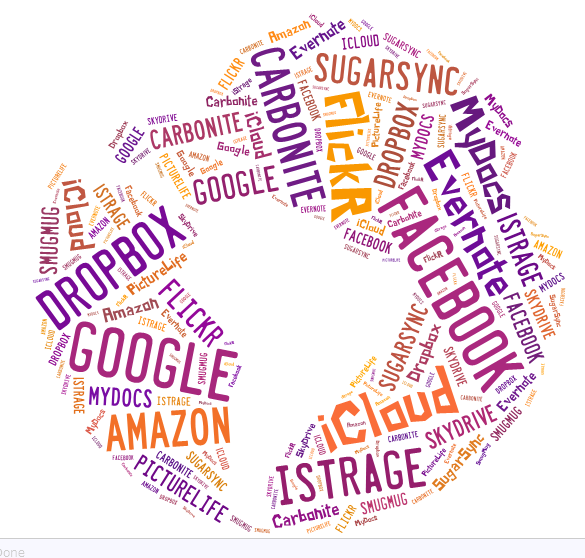
Just a few of the sites where people I know store data and photos.

Over the past several days I’ve heard more people say that they will stop using the cloud — a reaction to the stolen pictures, possibly taken from iCloud, of movie stars and celebrities (September 2014).

Hmmm…  How about being a bit more realistic?

This is a great teaching moment for 21st Century parents, kids, and anyone who works with children. We need to remind ourselves that, no matter what a website tells us, our security depends on the many steps that each of us takes to protect and reinforce our information — passwords, privacy settings, 2-step verifications. Most of use the cloud, and often we don’t even think about it or take our privacy that seriously until something goes wrong.

Continue reading “So I Just Won’t Use the Cloud! Really?”