Posted in digital footprints, digital parenting, marketing to kids, media literacy, parents and technology, privacy, teaching digital kids

Can We Stop Confusing Kids’ Privacy with Transparency?

Our digital society hasn’t figured out what to do about privacy. More importantly, it hasn’t figured what to do about the privacy of our kids — we keep confusing privacy with transparency.

It’s problematic enough that adults are diving willy-nilly into the digital world, sharing everything about themselves, private and not so private, but it’s even worse to observe a world where everything a child does and almost every mistake he or she makes is now public. These days we are giving children and adolescents no cover and no protection as they blithely explore the digital world while making what in any other era would be common and developmentally appropriate errors.

Lest I sound like a digital Luddite, I’m not. I love participating in the activities of my digital world, actively but moderately, and I have an arsenal of digital gadgets in my purse, book bag, and lying around my house. As an educator, however, I am keenly aware of how much we are forgetting to nurture and honor kids’ developmental stages as they grow up in this digitally dense world. Part of solving that problem involves ensuring that children have a guaranteed amount of privacy.

Continue reading “Can We Stop Confusing Kids’ Privacy with Transparency?”

Posted in answers to media questions, digital citizenship, digital parenting, family conversations, media literacy, parent child conversations, parents and technology, teaching digital kids

Campaign Advertising — Media at Its Worst for Kids

The tenor of the political advertising in this election season is appalling, and it will get worse. Because no code of best practices exists when it comes to campaign advertising, the current presidential election cycle media will feature unending ads that stretch the truth or make up the facts outright and deliver them straight into the lives of kids. While it’s a fine opportunity to help citizens, young and old, strengthen their media literacy skills, television is over-exposing all of us to some unfortunate and distressing content.

Click to visit.

To Learn a lot more, listen to a recently broadcast Diane Rehm Show about the non-candidate SuperPACs that are spending enormous sums on political advertisements. Jane Mayer’s recent New Yorker article, Attack Dog, is another comprehensive article. Talking to children about what they are seeing on television is critical, especially during an election cycle.

In a February 26, 2012 piece published at the USA Today Teachers’ Lounge (link no longer available), media lit guru, Frank Baker pithily describes the situation. He writes:

Continue reading “Campaign Advertising — Media at Its Worst for Kids”

Posted in American Academy of Pediatrics, digital parenting, marketing to kids, media literacy, parents and technology

Kids’ Television Shows as Advertising

Today the medium is a lot less about a message and more about the toys!

Just about everyone — parents, teachers, grandparents, youth leaders — should read the New York Times article, Hasbro, Intent on Expanding Its Toy Brands, Is Playing All the Angles.

The days of interesting television shows with good story plots are fast disappearing because many of today’s shows are a composite of toys and programming about those toys.

Concerned parents and other adults may want to consider additional limits on  television and carefully evaluate whether the end result of a toy or game purchase is simply more television watching.

Continue reading “Kids’ Television Shows as Advertising”

Posted in digital parenting, family conversations, media literacy, parents and technology, teaching

Media Literacy in Bhutan

Question: What’s the last nation in the world to have television reception?

Answer: Bhutan, which used to be an absolute monarchy and is now building democratic institutions as a constitutional monarchy.

Bhutan map from the CIA Factbook.

What a great bit of digital world trivia to begin a family media literacy conversation!

According to this press story from Ithaca College, the Kingdom of Bhutan invited representatives from the school’s media literacy initiative, Project Look Sharp, to work with the Ministry of Education and help train the country’s teachers to understand and use media literacy principles.

As Bhutan develops democratic institutions, encouraging citizens to assume the responsibilities of civic participation, the country’s leaders want to ensure that the strengths of traditional Buddhist life are not overwhelmed by the exposure to western media influences.

Continue reading “Media Literacy in Bhutan”

Posted in answers to media questions, digital parenting, media literacy, parents and technology, social media, social networking

You Can be Media Savvy with Your Kids in 2012!

Common Sense Media recently posted Six Ways to be a Media Savvy Parent in 2012. The December 2011 report suggests all sorts of ideas that can help parents (and other adults) develop stronger media (and media literacy) skills.

Suggestions include downloading a game to play with the kids, trying out a social media site, investigating YouTube, and much more. Some these can ideas will provide great fun for kids and parents over the holiday vacation.

Visit Common Sense Media and try out some of these features.

Thanks to my colleague and friend Renee Hawkins for spotting a good media post (one that I had missed). Renee blogs with another friend and colleague, Susan Davis, at The Flying Trapeze.

Posted in digital parenting, family conversations, media literacy, parents and technology, social media, social networking, teens and technology

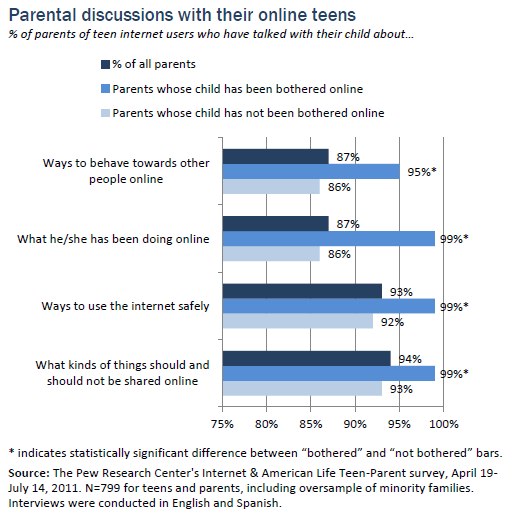
Pew Report on Teen Behavior and Social Media Sites

Pew infographic. Click and view larger version of this image.

Take a few minutes to read at least the main points of the November 2011 report on teens and social networking, published in November 2011 by the Pew Internet and American Life Project. The executive summary is a fairly quick read.

During the spring and summer of 2011 researchers made calls to 799 teens between the ages of 12 and 17, and they also spoke with a parent or guardian of each adolescent. Interestingly, a large number of the teens surveyed reported that their parents and teachers provided them with the best and most helpful advice on digital citizenship issues and other virtual concerns. The media were the third most significant influence.

Browse all of the infographics from this Pew Internet report.

A Few Other Interesting Points

Continue reading “Pew Report on Teen Behavior and Social Media Sites”

Posted in American Academy of Pediatrics, answers to media questions, digital devices and gadgets, media literacy, parents and technology

Discouraging News on the Media Lit Frontier

Zero to Eight: Children’s Media Use in America, p 11

The New York Times has reported on a Common Sense Media (CSM) sponsored study, Zero to Eight, Children’s Media Use in America (PDF). The Times article, Screen Time Higher Than Ever for Children, describes the study and points out that kids are in front of a screen more than ever despite the recommendations of their doctors.

After reading this I am feeling a bit more pessimistic than usual. Adults are used to tossing health caution to the wind for themselves, but we were vigilant about protecting the health of our children. Now we seem to disregard the recommendations of pediatricians — the very people who can help us do the most possible to ensure that our kids grow into strong and productive adults. Are we as a society less and less concerned about the development of strong minds? Times reporter Tamar Lewin writes:

Despite the American Academy of Pediatrics’ longstanding recommendations to the contrary, children under 8 are spending more time than ever in front of screens…

Continue reading “Discouraging News on the Media Lit Frontier”