Posted in 21st Century life, civics, media literacy, parents and technology

So What’s Media Literacy?

screen-shot-2016-11-21-at-8-58-03-pm

Media and news literacy skills are critical for people who seek to become strong citizens. The above definition aptly describes the meaning of media literacy. Unfortunately, the Media Literacy Project, where this graphic came from, closed its doors in 2015.

Three organizations and websites that actively focus on media literacy issues are the Center for Media Literacy and the National Association for Media Literacy Education in the United States and Media Smarts in Canada. You can also follow the top ten news literacy Twitter accounts.described in a blog post by Samantha Stanley.

Consider reading these media literacy posts from MediaTechParenting.

Posted in 21st Century life, 21st Century parenting, body image, media literacy, media messages

Media Literacy, Girls, Women, and Beauty Magazines

medialit-mag-video-thumbnail
Check out the video below.

Each month I receive several teen and women’s magazines to look over, and I immediately go through each one to tear out scads of perfume advertisements. My allergies react to the scented pages, and it is much easier to read the articles when I vanquish the perfume ads.

Recently I began thinking about how many advertising pages — perfumes and everything else — publishers cram into each issue that we read, knowing that almost all of them focus on female body image and portray unrealistic, and usually unattainable perfection. These days, so much of what kids see is digital, but these magazines still loom large in the lives of pre-teen and adolescents girls.

Continue reading “Media Literacy, Girls, Women, and Beauty Magazines”

Posted in advertising, media literacy, violent images

Parents Ask to Turn Off Movie: Cabin Crew Calls It a Security Risk?

I received this description about an unfortunate experience of a family traveling by commercial airline from the Campaign for a Commercial Free Childhood (CCFC), a not-for-profit children’s policy group that addresses and seeks to stop kids’ exposure to for-profit and exploitative commercial and media images. 

The parents in the story below were attempting to prevent their children from seeing violent images in the movie, Alex Cross, playing on the movie monitors — a perfectly sensible thing for parents of today’s digital kids to do. Common Sense Media offers this review of Alex Cross.

Click to get more information about CCFC.

Seems like pretty poor customer service training and extreme lack of judgement on the part of the airline crew, if this type of request represents a security breach. The family had to waste time going through the ordeal of interrogation by law enforcement authorities in Chicago — authorities who, in turn, wasted their time questioning parents who were merely trying to protect their children from exposure to violent images. This took valuable time away from the real work of these law enforcement professionals — protecting us from violent criminals, but maybe the airline crew forgot this.

Here’s the story from CCFC.              Continue reading “Parents Ask to Turn Off Movie: Cabin Crew Calls It a Security Risk?”

Posted in advertising, American Academy of Pediatrics, digital kids, digital world conversations, media diet, media literacy, screen time

Advertising With Kids as Targets

For several months I’ve been carrying around a New York Times article, How Advertising Targets Our Children, from the February 11, 2013 edition. Written by pediatrician Perri Klass the Well Blog post points out that recently published research links, even more strongly, the exposure of alcohol advertising to a child’s movement toward unhealthy behaviors.

Health Children Media Ed
Check out the Media Resources at HealthyChildren.org.

Dr. Klass writes about Exposure to Alcohol Advertisements and Teenage Alcohol-Related Problems (abstract), a Pediatrics article describing new research that finds a stronger association between unhealthy behaviors and the amount of advertising in the lives of children and adolescents. The researchers followed nearly 4,000 children in grades seven through ten.

Read the full text of the Pediatrics article.

In her article Klass quotes the researchers, experts from the Yale Rudd Center for Food Policy, and pediatrics professors from the Children’s Hospital at Stanford University who have studied the links between childhood obesity and screen time.

Continue reading “Advertising With Kids as Targets”

Posted in digital parenting, media literacy, parents and technology, social media

The Children are Watching and Seeing, Listening and and Hearing

They watch us all the time. The students, that is. They listen to us sometimes. They learn from all that watching and listening.

                            –Theodore and Nancy Faust Sizer, The Students are Watching, 1999, Beacon Press

The Sizers wrote about classrooms and schools, explaining that students learn from what their teachers do and say and also from the things their teachers do not do or say. The authors illustrated their points in many ways, demonstrating how much our students learn from the things we do not do.

I read the Sizer’s book in the later 1990s with my growing child at home, so it was easy to see how the lessons applied not just to teachers but also to everyday family life. The message — that children learn from what we don’t do and don’t say as much as from the things we intentionally teach — applies well at home and at school.

This week, with so many media-rich events, I thought about the Sizers’ book. Adults spent a huge amount of time-consuming news about superstorm Sandy, the election, and for a few minutes, many of us gazed at a viral short video of a little girl crying out “No more Bronco Bama and Mitt Romney.” We encountered non-stop negative television commercials, disaster pictures and videos, television news programs, robo telephone calls, radios tuned into programs all day long (yes, I am guilty of keeping NPR on most of the day when I am home), and plain old-fashioned magazines and newspapers. Lot’s of us may have felt like crying. But my question is, “Why did Abby hear or see so much that she started to cry?”

Muppet Lydia Whatnot summed things up in her YouTube response

Continue reading “The Children are Watching and Seeing, Listening and and Hearing”

Posted in digital parenting, family conversations, media literacy, parent child conversations, parents and technology, web research

Before and After the Super Storm: Resources for Parents

Click to access the tips (in PDF form).

If ever there is a time to keep our media literacy skills front and center, it’s after a national disaster. Adults need to regulate and monitor what children see and, more importantly, adults need to remember that children see and hear a lot more than we sometimes think.

Check out the blog posting Protecting Children From the Media’s Storm Coverage. Written by K.J. Dell’Antonia, the New York Times Motherlode blogger, the November 2, 2012 article focuses on the need to limit children’s exposure to storm-related media coverage.
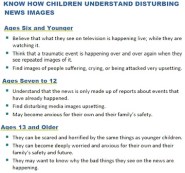
The Motherlode article directs readers to a two-page document that offers even more information about protecting children from prolonged traumatic event coverage — a free PDF available from the New York City Department of Health and Mental Hygiene website. The two-page article, Protecting Children from Disturbing Media Reports During Traumatic Events, offers tips for parents and caregivers, going into detail about what children understand at each age level.        Continue reading “Before and After the Super Storm: Resources for Parents”

Posted in digital parenting, family conversations, media literacy, parents and technology

Another Tragedy for Digital Kids to Absorb — Aurora, Colorado

Watch the video at Common Sense Media.

Yet again we are living through a horrible tragedy, this time in Aurora, Colorado, and this incident is extra frightening because the shooting and killing occurred as people went about normal activities in a movie theater. What’s more a part of kids’ daily lives than movie theaters?

Any connected child or adolescent can learn about this event and others via a digital device or television. In the digital world, the news cycle never stops, and most children do not possess the media literacy skills to evaluate the sources of information. The traditional walls that used to insulate kids from information about violent events just aren’t that thick anymore.

What are digital parents and teachers to do?

If you need support or at least some extra perspective before you initiate a parent-child conversation in your family, check out a video, Explaining the News to Our Kids, over at the Common Sense Media. This short presentation provides thoughtful suggestions that can help adults get started with difficult conversations about the news when scary and discomforting events occur.