Posted in digital devices, digital kids, digital parenting, media and family life, networking, parenting, parents and technology

Digital Parenting: Recently Released Research from Northwestern University

Media & Family Conflicts
One of many charts and graphs in the report.

A new study, Parenting in the Age of Digital Technology, was recently released by Northwestern University’s Center on Media and Human Development. The 52-page report is easy to read and chock full of interesting graphics and charts.

Data were gathered through a survey of 2,326 parents whose children were eight years old and younger. The surveys were conducted in English and Spanish. Check out page nine of the report for more information on the methodology of the research project.

Most Interesting Report Findings (more are available in the report)

  • A large number of the parents in the survey do not believe that increased use of media has made parenting easier.
  • Most parents in the survey did not report many or significant family conflicts around media use.
  • There continues to be a big gap between those who can afford new digital devices and those who cannot afford them.
  • The study identified three types of parenting styles when it comes to family media use.
    1. Media-centric family life centers around various types of screens, and parents as well as children enjoy using media a lot of the time.
    2. Media moderate family life includes less media access, and the television is turned off a lot more of the time. Video games are not as important to daily life as in a media-centric family.
    3. Media lite family life includes screen time but less than the other two parenting styles. They tend to do to less television watching as a family, and they do not use television to distract children so that parents can accomplish other tasks.

The blog at the Joan Ganz Cooney Center at Sesame Workshop also describes the study in detail.

Posted in advertising, American Academy of Pediatrics, digital parenting, marketing to kids, media messages, parents and technology

The Media Is the Message for Our Children

Listen to a Los Angles CBS video about the story.
Listen to a Los Angles CBS video about the controversy and read the story.

In light of the extraordinary negative media messages about body image in children’s lives, ensuring the strength and confidence of preadolescents and teens is a continuing challenge for parents and teachers. So much of the advertising markets thinness, popularity, sexuality, and one type of attractiveness, so it can be difficult for adults to counteract the effect of the of this pressure on a child.

Sometimes the entire ethos of a company emphasizes values that we do not want children in our care to adopt.

A distressing article over at the Huffington Post, A Message to Abercrombie’s CEO from a Former Fat Girl by Sara Taney Humphreys, highlights how one company has made exclusion, intentionally or otherwise, a part of its mission. Humphreys’ article isn’t about something that happened recently, but rather a quote from a 2006 Salon article about the CEO of Abercrombie and Fitch. While the article is more than six years old, the comments are disturbing, especially given the number of children who like to shop at Abercrombie and the many others who struggle with body image. Below is a quote from the Salon article.

As far as Jeffries is concerned, America’s unattractive, overweight or otherwise undesirable teens can shop elsewhere. “In every school there are the cool and popular kids, and then there are the not-so-cool kids,” he says. “Candidly, we go after the cool kids. We go after the attractive all-American kid with a great attitude and a lot of friends. A lot of people don’t belong [in our clothes], and they can’t belong. Are we exclusionary? Absolutely. Those companies that are in trouble are trying to target everybody: young, old, fat, skinny. But then you become totally vanilla. You don’t alienate anybody, but you don’t excite anybody, either.”

You can also listen to this ABC Chicago television story (after an airlines advertisement), including interviews with teenagers — many of whom can fit into the Abercrombie clothes but choose not to buy them. The teens are demonstrating at one of the stores in Chicago.

You might also want to look over the American Academy of Pediatrics (AAP) statement on media and children.

Posted in 21st Century parenting, connected learning, digital devices, digital parenting, frightening events, social media, too much media?

When Digital and Social Media Combine With Crisis

Moderation. Even with the best intentions, the decisions we make each day about what to do and how to live become more complex as our digital lives expand. Yet making choices about when and how long to stay connected could not be more important for us, and during times when a tragedy grips the country or the world, our connection choices become even more important.

moderationNow I spend considerable time on my blogs and at my job encouraging parents, kids, and teachers to embrace digital life while also choosing to pursue plenty of offline activities. Making choices about what to do and not to do is especially critical when children live in the house, but all of us should pay attention to the length of time we spend in the digital world.

Choosing does not necessarily mean avoiding long periods of connected time if we are learning or accomplishing something significant (and yes, a game can count). Good choices, however, keep us from wasting time and from missing valuable face-to-face interactions.

I am usually pretty good at moderating my time online — at least I was until the bombs exploded at the Boston Marathon. After that tragic event, and for the ensuing six days I’ve not been able to disconnect myself for very long. My husband is a lifelong runner who loves the Marathon, though he’s never run it, but two friends were in this race, so we immediately tried to find more information about them. Moreover, my daughter works at one of the teaching hospitals in Boston.

Digital Mod

So all week-long I could not disconnect from the digital coverage. I checked three newspapers (Washington Post, New York Times, Boston.com) several times a day, added a slew of new Twitter feeds (#BostonMarathon #Marathon #CambridgePolice @Boston_Police, #Boston), and used Public Radio apps on my phone and iPad to listen to Boston radio programs, especially WBUR. (Note: One of my middle school students, a confident 21st Century learner, asked me why I wasn’t using the Public Radio app to listen everywhere I went.) Every day this week I’ve made a final iPhone news check just before going to bed and grabbed my mobile again as soon as I have awakened. I even listened during exercise.

Continue reading “When Digital and Social Media Combine With Crisis”

Posted in 21st Century Learning, 21st Century parenting, apps, digital devices, digital parenting, parents and technology

More Apps, More Experimenting, More Tween-Teen Public Mistakes

Image snapped on my mobile device.

Read Washington Post reporter Cecilia Kang’s April 6, 2013 article, Instagram Beauty Contests Worry Parents, Privacy Advocates, a piece that brings teachers and parents up to date on the current Instagram beauty contest craze among tweens and younger teens.

It’s all so simple. Combine normal growing up with unsupervised digital device apps and add in kids’ occasionally poorly thought-out decisions — and you have a recipe for problems. Many educators, who are aware on a daily basis of the increasing difficulties created by kids’ freewheeling app use, will tell you that it’s predictable. Also, it’s destructive to 21st Century learning communities.

An April 4, 2013 post, Beauty Is Only Skin Deep but Instagram Is to the Bone, by Huffington Post blogger Holly Actman Becker, offers a chatty but detailed romp through the current beauty contest experience from a mom’s perspective and with an interesting result. (Note: I enjoyed reading this post, but if you prefer your prose formal and straight-laced, this isn’t for you. I also wonder just how the author did not know that the minimum age is 13?)

Make no mistake –I love my digital devices. I enjoy using them, talking about them, and sharing information about how they work with my students. Moreover, I do not believe that children and adolescents should have their mobile devices taken away. (OK, a few of these children do need to have an old-fashioned time out from their new-fangled gadgets.)  Continue reading “More Apps, More Experimenting, More Tween-Teen Public Mistakes”

Posted in 21st Century Learning, collaboration, digital kids, digital parenting, extreme professional development, NAIS Conference Reports, parents and technology

Workshop Planning As Extreme Professional Development: My NAIS Conference #3

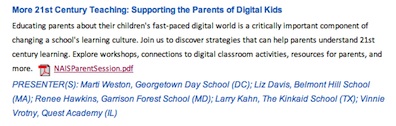
OurStoriesI’ve just returned from the 2013 National Association of Independent Schools (NAIS) annual conference, where I presented a workshop with three colleagues, Renee Hawkins, Vinnie Vrotny, and Larry Kahn. In our Thursday afternoon session we shared our ideas about coaching the parents of 21st Century learners to help them understand more about the digital lives of their children.

As I reflect on our wonderfully collaborative NAIS presentation project — coming up with an idea and developing it over time — I now understand that the workshop planning process led me and my colleagues on a substantial journey featuring what I think of as extremely connected professional development.

Thoughts on Digital Parenting
An example of digital parenting book resources

This workshop’s journey began a year ago at EdCampSeattle, where I shared an idea about the importance of educating 21st Century parents. At my school I work hard at educating parents about their digital kids, so I wanted to learn lots more about what my colleagues do at other schools.

Actually, I initially shared my idea with independent school colleague, Liz Davis, a dedicated EdCamp advocate, and she told me that I just had to attend EdCampSeattle. (Note: Liz is also one of the main people responsible for getting me to start blogging, but that’s another story.)

If you’ve attended EdCamp, you know that participants suggest lots of great ideas, but not everyone becomes part of the program. At the beginning of every EdCamp people walk around the room suggesting and choosing the topics they are most interested in — called the “law of two feet” in “EdCampSpeak.” They go on to experience, a day-long collegial event that they have planned, essentially carrying out their own program — in itself extreme professional development. Expanding this idea, my workshop colleague, Larry Kahn, will shortly experiment with inviting parents to attend an EdCamp along with teachers.

Continue reading “Workshop Planning As Extreme Professional Development: My NAIS Conference #3”

Posted in 21st Century Learning, digital citizenship, digital kids, digital learning, digital parenting, NAIS Conference Reports, parents and technology, social media, social media friends

Learning Lots More About Topics I Know Lots About: My NAIS 2013 Conference #1

You are in a good workshop when it’s on a topic that you know well, and you end up learning a whole lot more, and when you feel new knowledge pathways opening up, you say “Wow!”  That’s what happened to me on Friday morning at the 2013 National Association of Independent Schools (NAIS) annual conference, this year in Philadelphia.

I attended a workshop, “It’s Just Facebook: Ethical Questions in Social Media Use,” and discovered first-hand how much I can still learn about educating children, their parents, and educators when it comes to 21st Century digital citizenship and media literacy problem-solving. What’s  especially interesting to me since, just the day before, I presented a workshop with three of my NAIS colleagues on a similar topic.

Ethics institute
Check out the Ethics Institute teacher workshops.

In their “Ethical Questions” workshop, Kent Place School presenters Kimberly Coelho and Karen Rezach helped us compare moral with ethical dilemmas sharing case studies that are designed to help students examine and address the life challenges that pop up in their 21st Century learning and digital lives.

The two leaders, part of the Ethics Institute at Kent Place, walked us through the discussion process, emphasizing how they  include a range of different perspectives. Often right and wrong answers are not so clear because the dilemmas usually present competing values, so the problems are not examined or solved easily.

Continue reading “Learning Lots More About Topics I Know Lots About: My NAIS 2013 Conference #1”

Posted in 21st Century Learning, communicating with grandparents, digital parenting, family conversations, grandparents, intention versus consequence, parents and technology, teaching digital kids

Whose Eyes Are Checking Out That Digital Content?

In his recent post over at the Changing Aging blog, Kavan Peterson describes a short video, Forwarders. Intended as a parody of people who continuously forward e-mail, the video reinforces stereotypes about elders and aging. It’s sad that this short film focuses solely on one older adult, especially since so many people of all ages are extreme (and irritating) forwarders.

generational tutorialsWhile it’s intended to be funny, the video’s other message is that old people with wrinkles are silly and inept — at least that’s my interpretation. I’ll bet that the video producer — I am guessing an adolescent or young adult — probably cherishes a fair number of lifelong relationships with grandparents. This parody promotes a stereotype that could have been alleviated simply by adding in a few younger characters who also need reforming. (I posit a guess about the creator/producer’s age after looking over other published web content.)

The video and others like it also raise a question. How do we help 21st Century learners who are natural Internet content “whizzes” to understand that everything uploaded is subject to interpretation?

As a teacher who concentrates on educational technology, I frequently hear the refrain, “But I did not mean to hurt that person,” usually after a student has created and uploaded what he or she considered to be amusing content. Sometimes it is, sometimes it isn’t, and sometimes various readers or viewers interpret the message differently. What my students slowly learn is that digital content may be funny to one person, not funny to another, and for some individuals downright insulting.

In today’s connected society digital natives — born into a world of computers, cell phones, and various other gadgets — find it easy to create content, but sometimes they forget that what they do and say (and upload) circulates far and wide. Different people will watch and may reach different conclusions about the work. One person’s joke can unintentionally malign others. Humor that is appropriate for a person at one age is not so funny when it’s uploaded into the world at large for everyone to see. Digital natives need to learn and respect the ways that different people view the world through slightly different lenses. Most professional writers of parody think long and hard about every detail of a project, interchanging those lenses as they create.

Continue reading “Whose Eyes Are Checking Out That Digital Content?”