Posted in 21st Century Learning, digital citizenship, digital devices and gadgets, digital parenting, leadership, research on the web

Back-to-School Research Tips: Use Curated Online Databases

September brings the start of a new school year, and once classes begin, it’s not long before the first research reports and projects are assigned. To get started, your child will head right to his or her computer; however, adult assistance at home ensures that a student uses quality sources, as well as develop stronger 21st Century research skills.

Just about any time digital kids search for information at home, they fire up Google. While their teachers use substantial classroom time and energy introducing students to the best online research resources, children often need assistance, not to mention frequent reminders about applying these research lessons on their home computers.

As often as possible adults should remind children that results from Google — as wonderful as Google searching is — provide a huge number of links, many of them of questionable quality. A better way to search for information is to access library online resources and databases — the crown jewels of student research (Links at the bottom of this post will take readers to a few libraries that describe their virtual databases.) Searching in these databases decreases quantity and dramatically increases quality — which, in turn, improves the caliber of a student’s assignment. A web page chart at Illinois Institute of Technology compares  Google searches and database inquiries. A library tutorial from Western Oregon University also compares research on Google and online databases.                       Continue reading “Back-to-School Research Tips: Use Curated Online Databases”

Posted in 21st Century Learning, cultural changes, digital learning, digital parenting, parent education, parents and technology, teaching digital kids

Beloit College 2016 Mindset List: How Fast Life Changes

The new Beloit College 2016 Mindset List — a great start-of-the-school-year conversation piece for adults — is out.

Watch a video about the list.

At the beginning of each academic year, several faculty members at Beloit compile a list to demonstrate how students in the entering freshman college class experience life, learning, and culture differently from many of the adults they know. Some items are silly, others compare digital kids with their parents’ generation; some I don’t understand; and others I can fit into a bit of context, but they are mostly unfamiliar to me.

The list’s mission is to remind educators and parents that it takes energy and openness to new literacies to understand how dramatically the “growing-up” and learning processes change over time (and many of these have nothing to do with digital life). 

Every fall I look forward to the release of this list, which Beloit releases just before the start of the school year. I’ve included a few of my favorites from this year.          Continue reading “Beloit College 2016 Mindset List: How Fast Life Changes”

Posted in digital parenting, good books to read, innovation, parent education, parents and technology

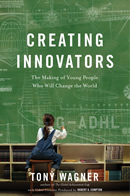
Creating Innovators by Tony Wagner: A Short Review

For some time on this blog I’ve listed Creating Innovators as my current read.

Tony Wagner’s book looks at young adults who are successfully navigating a transforming world of work, where a deep understanding of teamwork and innovation is a prerequisite for success. His profiles focus especially on the educational and parenting experiences that helped each young person flourish. Wagner prods us to identify what we — educators, parents, concerned adults — need to do to engage young learners and help many more of them grow into innovative and creative thinkers.

Creating Innovators features two blended tracks — one text and the other media. Wagner supplements the traditional book with a host of videos that extend and amplify what we have just read. QR codes in each chapter make it easy to access the videos, so we need only scan the image with a smartphone app and off we go to view the related media. If a reader does not own a smartphone — and I’ve discovered that for financial reasons quite a few of my younger colleagues don’t — Wagner’s website includes a page with links to all of the videos.      Continue reading “Creating Innovators by Tony Wagner: A Short Review”

Posted in digital parenting, family conversations, media literacy, parents and technology

Another Tragedy for Digital Kids to Absorb — Aurora, Colorado

Watch the video at Common Sense Media.

Yet again we are living through a horrible tragedy, this time in Aurora, Colorado, and this incident is extra frightening because the shooting and killing occurred as people went about normal activities in a movie theater. What’s more a part of kids’ daily lives than movie theaters?

Any connected child or adolescent can learn about this event and others via a digital device or television. In the digital world, the news cycle never stops, and most children do not possess the media literacy skills to evaluate the sources of information. The traditional walls that used to insulate kids from information about violent events just aren’t that thick anymore.

What are digital parents and teachers to do?

If you need support or at least some extra perspective before you initiate a parent-child conversation in your family, check out a video, Explaining the News to Our Kids, over at the Common Sense Media. This short presentation provides thoughtful suggestions that can help adults get started with difficult conversations about the news when scary and discomforting events occur.

Posted in digital parenting, parent child conversations, parents and technology, social media, social networking

Summer, Social Media, and Digital-Age Parenting

Read the research here.

Summer is a good time for parents to learn more about the social media activities of their children, developing additional skill and more understanding about what’s happening in the digital whirl that is a huge part of kids’ social lives.

A 2011 Pew Internet and American Life Project report, Teens, Kindness, and Cruelty on Social Networking Sites, noted that 95% of children ages 12 – 17 are online, many on social networking sites. Since that Pew report was published, media sources report that children several years younger than 12 are also using social media. Read the NPR piece, Social Networks: Thinking of the Children. Children continue to need guidance and limits-setting from their parents.

The goal is not to prevent children from exploring — that’s not realistic. Instead, parents need to gather enough information to be able to keep an eye on activities, facilitate discussions when required, and intervene when it’s necessary to insulate their kids from impulsive digital behavior on computers, smartphones, and tablets.        Continue reading “Summer, Social Media, and Digital-Age Parenting”

Posted in digital parenting, parents and technology, social media, social media friends

Facebook and Younger Kids: Will They or Won’t They?

Earlier this month a spate of articles (see links below) reported that Facebook is testing features to help it decide whether to expand its social networking access to children under the age of 13.

Now a group of child advocacy organizations sent a June 18, 2012, letter to Facebook’s CEO, Mark Zuckerberg, strongly urging the company to avoid advertising for kids as well as to offer a guarantee of no tracking of children’s online activity. Read the entire letter at the bottom of this Consumer’s Union page.

The following organizations signed the letter:

Consumers Union, Center for Digital Democracy, Academy of Child and Adolescent Psychiatry, Center for Media Justice, Center for Science in the Public Interest, ChangeLab Solutions/Public Health Law & Policy, Children Now, Consumer Action, Consumer Federation of America, Consumer Watchdog, Privacy Rights Clearinghouse, Privacy Times, Public Citizen, and World Privacy Forum.

Articles to Read                         Continue reading “Facebook and Younger Kids: Will They or Won’t They?”

Posted in cyber-bullying, digital parenting, electronic communication, online safety, parents and technology, social media, social media friends, teens and technology

Good, Bad, Ugly… Internet? – Danah Boyd

Check out Danah Boyd’s short commentary, The Good, the Bad, the Ugly … and the Internet in Boston Magazine. In the June 15, 2012 piece Boyd describes how fears about children’s safety have curtailed their time out in the real, face-to-face world for several generations. Today many parents have transferred their fears into the digital world.

Read some of Boyd’s blog posts here.

Boyd points out that many serious behavioral issues, bullying, for instance, have been and continue to be huge problems. Yet they tend to be more frequent and serious face-to-face than in the digital world (though the digital problems get more media coverage). As one of the most well-regarded observers of teen social networking behavior, Boyd conducts research for Harvard’s Berkman Center and for Microsoft.

Continue reading “Good, Bad, Ugly… Internet? – Danah Boyd”