Posted in 21st Century life, digital learning, digital life, sharing media, social media

Getting to Know Pinterest: A Parent’s Guide

Pinterest digitizes image collecting, the non-digital activity that lots of us have been doing for years. In a sense Pinterest offers a 21st Century way to bookmark and collect images instead of accumulating pieces of paper. I’m loving it!

Visit Pinterest.

Many people spend time looking through magazines and catalogs, identifying images such as the best-looking clothes, interesting plants, comfortable shoes, or pictures with ideas for an upcoming home construction project. An individual cuts out (or tears out) the image and puts it into a folder. I used to have folders (and more folders) filled with images on all sorts of topics, waiting for me to consult. And I used them from time-to-time, especially at the beginning of a project.

Continue reading “Getting to Know Pinterest: A Parent’s Guide”
Posted in 21st Century Learning, 21st Century parenting, digital learning, libraries, reading

It’s Summer: Take this Quiz and then Visit Your Local Library

Pew Internet Libraries
Click to visit the Pew site and take the quiz.

It’s summer and if you and your children — those digital kids you are raising —  are not regular library users, you should be. Almost any teacher will tell you that children who regularly use libraries develop better and more sustained reading habits. More significantly, I’ve observed that my 21st Century students with public library habits are often more critical and thoughtful users of digital materials, whether they use those digital materials at home, school, or even away from adult supervision.

No matter where you are located this summer, a library is probably nearby. Moreover, in addition to great books, many public libraries provide excellent tutorials on searching, evaluating resources, and digital commonsense. Be sure to visit.

Continue reading “It’s Summer: Take this Quiz and then Visit Your Local Library”

Posted in 21st Century Learning, collaborating with kids, digital kids, digital learning, parents and technology

10 Digital Summer Projects for Parents and Kids: Collaborate!

Summertime, summertime, sum, sum, summertime.  

Yup, it’s almost summer 2014! summer digital projects

With less frenetic schedules the summer months are a good time to learn more about the digital whirl that’s such a huge part of kids’ 21st Century lives. So when school is out, plan to do some connected world exploring and learning together, concentrating on projects that can help family members — children and their parents — figure out even more about digital life.

Below are 10 family digital project summer suggestions — all activities require collaboration —  to consider for the upcoming vacation. Note: Be sure to collaborate on these projects so that adults and children make meaningful contributions.

Ten Summer Digital Projects for Families                        Continue reading “10 Digital Summer Projects for Parents and Kids: Collaborate!”

Posted in 21st Century Learning, digital citizenship, digital learning, digital learning resources, educating digital natives, online learning

Action Words that Describe Digital World Learning

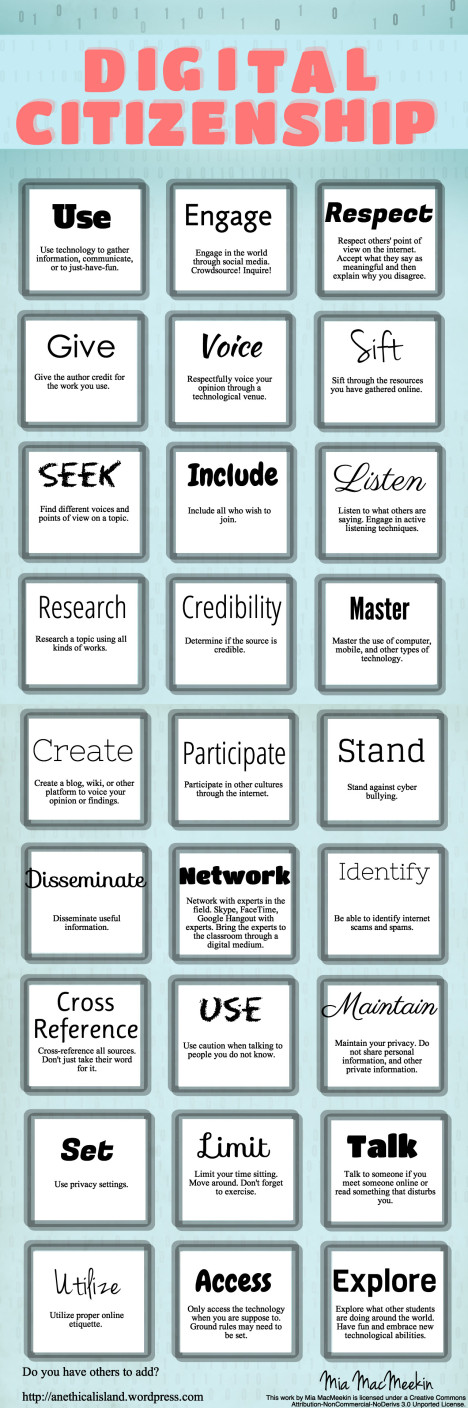
digital-citizenship Can we teach pre-adolescents and teens to reflect on what’s happening as they use digital world tools and interact with online content? Can we help them understand more about what they are doing when they work and play online?

Educators often provide a checklist or rubric for students to use as they work on assignments or projects. A rubric usually contains editing specifications, project requirements, resource documentation, and expectations — all for students to consider while completing the work.

Now I’ve discovered that Mia MacMeekin over at the An Ethical Island blog offers what I think of as a digital learning graphical rubric. The easy-to-understand graphic features World Wide Web nouns and action verbs that describe the ways people encounter, process, and use online information. MacMeekin thinks of her infographic as a digital citizenship tool, but it’s much more than that. The chart offers educators with opportunities to ask questions as they teach, and more importantly, expect students to answer them.          Continue reading “Action Words that Describe Digital World Learning”

Posted in 21st Century Learning, 21st Century parenting, digital learning, diversity, parents and technology, reading on the web

The International Children’s Digital Library (ICDL): Changing the World One Book at a Time

What if our children had instant access to a library with thousands of books from countries all over the world — a place that invited them to drop by, read, and learn about one another (without any driving)? Imagine what they could find out about the world’s cultures, celebrations, languages, differences, and also about what they have in common  with all these other people and places!

That just about describes the mission of the International Children’s Digital Library (ICDL), a World Wide Web destination hosted at the University of Maryland. The massive website includes digitized books in 61 languages, and it’s the largest online collection of multicultural children’s literature with a mission to the promote the love of reading AND the love of diversity. The books are beautiful filled with colorful and detailed illustrations — you almost feel like you are holding an old-fashioned book!

By clicking on the animated Read Books! icon in the middle of the ICDL home page readers, young and old, are off and reading. The multi-cultural aspect comes from interacting with books that are read and languages spoken by children in 42 other countries as well as seeing pictures by artists from around the world.      Continue reading “The International Children’s Digital Library (ICDL): Changing the World One Book at a Time”

Posted in 21st Century Learning, 21st Century parenting, digital citizenship, digital footprints, digital kids, digital learning, parents and technology

How We Teach Digital Citizenship Makes a Difference

Digital Citizenship Posters Become a Hallway Exhibit
Digital Citizenship Posters Become a Month Long Hallway Exhibit

When it comes to digital citizenship, we cannot just lecture or watch videos.

Everyone learns best by doing — whether it’s tying a shoe, mastering letter sounds, figuring out a science concept, learning to drive, parenting a new baby, or any other activity, including what we need to figure out on computers and digital devices. When people tell us how to do something by talking a lot, most of us can’t wait for the person to stop talking so we can try to do it ourselves.

Now consider how we have gone about teaching 21st Century children — at home and at school — about digital devices and digital world behavior. Mostly adults talk and talk, telling children, pre-adolescents, and teens about all the things that can go wrong and explaining what we don’t want them to do.

Over the past 15 years, I’ve spent way too much time talking to kids about digital life issues and not nearly enough time doing things with them. So these past few years I’ve changed the way I teach.                              Continue reading “How We Teach Digital Citizenship Makes a Difference”

Posted in 21st Century Learning, 21st Century teaching, connected learning, digital kids, digital learning, digital literacy, digital world conversations

Innovative Teaching: How on Earth Do We Get Started?

innovative teachersYears ago as a beginning teacher, I asked one of my University of Chicago professors how it was that my mentoring teacher seemed to do everything at once — teaching one group, keeping an eye on other parts of the classroom, and continuously but quietly communicating with everyone in the room — all at the same time. She even knew when a student some distance behind her was not completing the assigned task.

“She acquired those skills step-by-step,” my professor replied.

Today as we cope with the challenge of transforming our teaching skills to make what goes on in our classrooms applicable to the ever-changing world of digital information (a.k.a. innovation or 21st Century learning), many of us are renewing our commitment to lifelong learning as we explore and acquire a range of new skills and behaviors. We are learning, step-by-step, how to teach differently and stretch ourselves in ways that help students access, process, and use information in innovative but sensible ways.          Continue reading “Innovative Teaching: How on Earth Do We Get Started?”