Don’t wait until pre-adolescent years to start talking about digital topics such as password privacy. Family conversations, at home and at school, can begin as soon as children receive their first passwords, and over time these talks help kids develop a sense of personal privacy. Discussions can be brief and range over lots of digital topics, but they should occur regularly.
Many adults will be pleasantly surprised that children want to talk about these issues. My post, The Digital Citizenship Minute at the Teaching Tolerance blog, highlights some of the topics fifth graders want adults to address.
What if our children had instant access to a library with thousands of books from countries all over the world — a place that invited them to drop by, read, and learn about one another (and without driving)? Imagine what they could find out about the world’s cultures, celebrations, languages, differences, and also about what they have in common.
Click here to visit the library.
That just about describes the mission of the International Children’s Digital Library (ICDL), an online destination hosted at the University of Maryland. The massive website, with digitized books in 61 languages is the largest online collection of multicultural children’s literature, and everything on the site promotes reading and the love of diversity.
I am peripherally involved with a new middle school Khan Academy project. As I’ve watched the program get started and observed the teacher combining her experienced teaching skills with the online opportunities that Khan presents, I am impressed. This dynamic classroom environment combines the best of face-to-face interaction with online learning tools, but the teacher-student connection continues, just as it always has. It’s a joy to watch children work in this setting.
What makes my colleague’s classroom so amazing is how she blends learning resources together — the activities that have always been in her classroom are now expanded with the online Khan materials. And with these additional digital materials she can more easily analyze the needs of her students, reinforce skills, and expand assignments. It’s this blend of rich teaching together with a unique online educational resource, that creates a strong educational environment in her classroom
How sad it will be if some children only have an opportunity to learn online, because the human interaction — and by this I mean the face-to-face moment-by-moment connections and not the digital communications between teacher and student — will never be completely replaced. As one of my colleagues commented recently, blended instruction (a combination of online and connections to real people) will always the easiest way to learn.
We are all living in a time of transformative cultural change. These days teaching — and learning for that matter — seem to be under fire everywhere we look — even in districts with the highest achievement levels in their states. Good digital resources present us with lots of opportunity and the potential to expand and improve the traditional classroom in infinite and exciting directions. Run-of-the-mill digital resources do very little and may, in fact, create more problems.
Even in today’s fast-paced virtual world, these tips never seem to age. Help kids learn to make good choices.
1. Who made the site? Is it from a university or other institution? Is it for-profit or non-profit. Corporate? Look for an “about” link that describes the site.
2. When was the site made and how often is the site updated? Somewhere, usually at top or bottom it should tell. Is this site updated recently? If not this may be a reason to check out another website on your topic.
3. Is it possible to contact the webmaster or the sponsor of the site? Is there a “contact us” link somewhere on the page?
4. How much advertising is on the page, and how aggressive is it? Good sites that use advertising are careful to keep it from being “in your face.”
5. Does the site state its mission? Why was it set up?
If you find yourself thinking about the digital research activities of children, especially older students who complete significant amounts of their research using the unlimited resources available on the World Wide Web, you are not alone. Over the past 10 years I have wondered — more than once and sometimes with great angst — if my child and the many children I’ve known really understand the need to evaluate the resources that they find on the web.
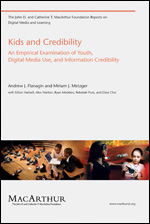
Earlier this year I discovered a small book, published by the MacArthur Foundation, describing research that explored how children perceive the quality and reliability of digital media. It’s a book that concerned parents may want to read. In Kids and Credibility: An Empirical Examination of Youth, Digital Media Use, and Information Credibility, authors Andrew J. Flanagin and Miriam J. Metzger, summarize their study as a “…comprehensive investigation into youth’s Internet use and their assessment of the credibility of online information.” The authors wondered whether young digital media users, while sophisticated and fearless about using technology, could evaluate information and determine its quality.
To learn more about young people and web credibility the researchers planned and executed a web-based survey of more than 2,000 children age 11 – 18. Study participants also completed a range of Internet tasks, evaluating information, making judgements about content, and explaining how and why they complete web tasks in certain ways. While there is far too much to cover in one blog post — check out the many interesting graphs in the publication — I’ve listed a few of the most interesting observations below. Continue reading “Kids and Web Resource Credibility”→
Common Sense Media recently published a solid piece aimed at helping parents and kids refine and strengthen digital research skills.
Teach Your Kids the Secrets of Smart Web Searchingfocuses on good research practices, with tips on how to search effectively and and explanations about why it matters. This piece can help parents stay front and center, guiding their kids (and themselves) on the road to becoming stronger digital information consumers.
Also included are a few Google tips — ideas that can help Google work for the learner rather than the other way around.

 A recent New York Times article, Young, in Love, and Sharing Everything, Including a Password, reminds parents and teachers to take time to talk to adolescents about password privacy. Pulitzer Prize-winning journalist, Matt Richtel, reports that kids share passwords — just as they share gifts and secrets — as tokens of trust and affection. But often an adolescent relationship doesn’t last and neither does the trust. What happens afterward can lead to hurt and humiliation.



 Media! Tech! Parenting!
You must be logged in to post a comment.