Posted in 21st Century life, 21st Century teaching, advertising, civics, civility, credibility, digital devices, digital health and wellness, digital kids, digital life, ethical behavior, information credibility, media and family life, parents and technology, social media, teaching digital kids

Civility Is Now Devalued — So What Will Adults Do About It?

dry-cracked-earth-texture-408x544
Image from http://www.public-domain-image.com.

If there is ever a time to emphasize ideas on civility, commenting, fact-checking, and media literacy, it’s during an election. Children, preadolescents, and teens will learn much during the 2016 presidential campaign just from all the watching. (Read my post The Children are Watching and Seeing, Listening and Hearing.)

Our traditional expectations for civility and ethical behavior are cracking apart right before our eyes.

On the basis of what’s happened at recent political conventions and the beginning of the election season, young people will be witnessing name-calling, stereotyping, hateful comments, online hate, and in some cases veiled bodily threats. Kids will hear things on TV at home and on the televisions that are broadcasting in lounges, waiting rooms, doctor’s offices, and everywhere else. They will hear radios broadcasting the news at home and in other peoples’ homes. And, of course, there’s social media.

Continue reading “Civility Is Now Devalued — So What Will Adults Do About It?”

Posted in 21st Century life, 21st Century parenting, citizenship, digital citizenship, digital health and wellness, digital parenting, parents and technology

Digital Kids & Parents Talk About Technology Rules

dig cit 2
Digital Citizenship Principle for Kids

A recent study, about parents, children and the technology rules that families adopt will be a terrific resource for schools and parent groups to share. Most parts of the research paper are fairly easy to read as are two articles, one from the University of Washington and the other from the University of Michigan. The research findings, with an extra focus on children’s expectations, are full of discoveries and observations that schools may want to share, almost word for word, with the parents of digital kids.

Alexis Hiniker and Julie A. Kientz at the University of Washington and Sarita Y. Schoenebeck at the University of Michigan conducted the study about digital life rules that parents make and enforce and the expectations that digital kids and their parents have of one another. A National Science Foundation research grant supported the academic work.

text drive dig cit 3 (1)
Digital Citizenship Principal for Kids

Interestingly, a few years ago I ask my students, after a year of working together, what messages they would give to their parents about the digital world and their parents’ roles. The answers these young people wrote down were so remarkable that I shared the children’s comments in a September 2013 blog post, and I’ve also included some of the posters that my students designed graphic depictions of the digital rules-of-the-road that parents and teachers expect them to uphold.                     Continue reading “Digital Kids & Parents Talk About Technology Rules”

Posted in 21st Century Learning, 21st Century life, 21st Century parenting, digital health and wellness, parents and technology

Building Habits of Moderation into the Conversation & the Curriculum

Screen Shot 2016-04-01 at 11.28.15 AM
21st Century Vocabulary Words — Moderation

When my brother and I were growing up in the Midwest, my dad had a big sign — about one foot by two feet — with the word MODERATION. The sign sat in the living room, just off the study, so that it was impossible to miss when we were watching television, reading, doing our homework, playing games, eating, and entering or leaving the house. Dad’s goal was for us to think as often as possible about self-regulating and managing what we did each day, even when we were even engaged in a favorite (or not so favorite) activity.

Understanding the importance of moderation is increasingly critical today as we live 21st Century lives that center on the media and on the digital devices that we — and our children — carry around all day long. Read an earlier post on moderation.

vocabulary 4
Check out other posts in this series.

You hear a lot these days about people eagerly pursuing their passions — which is great — but we don’t hear nearly as much about moderation. Understanding how to moderate and, yes, self-regulate daily activities is a digital world literacy skill for everyone at every age. For each child who cannot disconnect from Minecraft or other video games, there’s an adult, often a parent, who can’t put the phone down while taking a walk with kids or who uses the phone while driving. Everyone needs to learn how to moderate and disengage, and possessing these skills helps people develop digital strength and wellness.                                          Continue reading “Building Habits of Moderation into the Conversation & the Curriculum”

Posted in 21st Century Learning, 21st Century life, 21st Century parenting, Conversation skills, digital devices, digital health and wellness, parents and technology

Does Digital Life Distort Our Conversation Skills?

Jacket-for-Reclaiming-Conversation
Learn more about the book.

Do our conversation skills weaken as we continually connect — virtually and physically — with our digital devices? How does this always-connected environment affect our children and youth? Are conversational and empathy skills developing as they should?

Sherry Turkle describes these problems in Reclaiming Conversation, a book that relates how the individuals in many of her interviews note — uncomfortably so — that they are less and less able to carry on a conversation confidently. More worrisome, children, in general, appear to be less able to converse, put themselves in another individual’s shoes, and empathize with that person. Turkle backs up her assertions with evidence.

Continue reading “Does Digital Life Distort Our Conversation Skills?”

Posted in 21st Century Learning, connected learning, digital citizenship, digital health and wellness, digital wellness, mentoring digital kids, monitoring kids online, parents and technology, teaching digital kids

Connected World Coaching for Digital Natives? Read Connecting Wisely

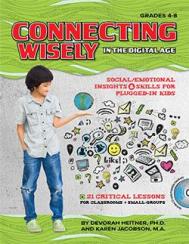
3002_01021048If you teach or think a lot about digital citizenship, take a few minutes to get acquainted with Connecting Wisely in the Digital Age. This new book is simple yet powerful, with content and context for adults who seek to support and mentor 21st Century digital kids. The goal is to help children develop a deeper understanding of the responsibilities that accompany their connected lives.

Authors Devorah Heitner, Ph.D., and Karen Jacobson, MAbase their book on a singular premise — that the 21 activities introduced in their book, when facilitated by imaginative adults, will make a positive difference in kids’ daily online lives. With its flexibility and its focus on adults as connected world coaches and mentors (not lecturers), Connecting Wisely stands head and shoulders above many other curricula in this category.                 Continue reading “Connected World Coaching for Digital Natives? Read Connecting Wisely”

Posted in 21st Century parenting, digital health and wellness, digital parenting, digital wellness, media and family life, parents and technology

Now In Top 10 Child Health Concerns: Internet Safety & Sexting

C.S. Mott Children’s Hospital National Poll on Children’s Health conducts regular surveys several times each year polling adults in around 2000 randomly selected, nationally representative households, about significant health issues that relate to children. The goal of this survey and others in the C.S. Mott program is to collect information and identify trends that are useful to health providers, community public health organizations, and public policymakers.

CS Mott health probllem results
Image from CS. Mott Children’s Hospital Survey report site.

One of these surveys on children’s health asks adults to rate the issues or problems that are of greatest concern when it comes to kids’ health.

This year, 2015, parents rated internet safety as the fourth most important health problem for children, moving from eighth place in 2014. Sexting, which was in 13th place in 2014, was rated as the sixth greatest health concern for children in the 2015 survey.

These findings indicate that 21st Century parents are increasingly concerned about the vulnerability of their kids in today’s media-dense environment. Increasingly today’s adults seek to focus on the digital health and wellness of their children and seek to learn how to parent digital natives more effectively and more positively.     Continue reading “Now In Top 10 Child Health Concerns: Internet Safety & Sexting”