Check out these apps. Just two months ago, when presented to a group of parents, some of these were not on the radar for preadolescent and teen digital life. I’ve linked each to an article. For additional reviews, but not for every app, visit the Common Sense Media App Review Page.
Where a digital device is charged is a health issue for 21st Century children.
With so many different electronic devices in our lives, it’s easy to get distracted and use them for extended periods and inappropriate times. Concerns about overuse abound, but one of the most significant issues is the way that digital devices keep people, especially 21st Century preadolescents and teens, from getting enough good quality sleep.
To improve sleep habits in your house, consider purchasing or one or two digital gadget charging stations where family members can charge phones and other devices. Locate the charging stations away from the bedrooms.
A Google search for charging stations gets you started, or you can begin with this Mashable post, 10 Chic Charging Stations.
Charging station at Pottery Barn.
I recently discovered, in a small way, just how a cell phone screen can disrupt sleep. I received a new Solitaire game app and began playing two or three games on my iPhone just before bed several nights in a row. A few games grew into 20 or 30 minutes of play, and for three nights in a row, when I put down the phone, it took me a long time to settle down and get to sleep. The fourth night I did not play, and sleep came easily.
Lesson learned.
One of my favorite charging stations is the red box at the top right of this post, a nifty do-it-yourself craft project made from a filing box. Click on the image link and check it out at MakeZine.
Twenty-first century parenting demands are unending and sometimes difficult to solve, but introducing charging stations into a home is a simple and elegant solution that addresses sleep deprivation issues for everyone in the family.
Other than ensuring a child gets all of the recommended vaccinations, supervising good sleep is just about the best thing a parent can do for a child’s health.
A Few Resources on Sleep Deprivation and Digital Device Screens (repeated from the previous post)
Read the excellent blog post by Sue Scheff over at A Platform for Good. In Digital Resolutions for Parents, the author reviews some of the 21st Century connected world parenting resolutions that parents will want to consider implementing as families move into 2014 digital life.
Scheff offers some good suggestions to help children and adolescents (and their parents) stay safe, learn more, and develop savvy digital street smarts.
If new gadgets and devices have arrived in your family it’s not too late to check out the holiday contract cards over at A Platform for Good. You can use the cards, take the language and organize on your own paper, or personalize the cards themselves them a bit. These cards are a wonderful resource that can help family members get started in 2014 with clear and well-stated digital life expectations.
If you are searching for more information on digital age contracts to use with children and their digital devices, check out the contracts and agreements page on this blog. It lists everything on the topic that Media Tech Parenting has discovered on the web and judges to be a worthwhile resource.
Sometimes you think something is permanently lost, but with a bit of perseverance, it can be found again.
We parked our car near a restaurant and started to get out. I was holding my iPhone, but just as I opened the door something made me lose my balance a bit, and I dropped my cell. Usually this is not a problem, because I have a well-lined case that ensures my phone is not damaged when I drop it.
Unfortunately, this time when I looked down I saw my iPhone 4s hit the ground and — almost in slow motion — slide into the storm drain. I was stunned.
My husband tried to get me to explain what had happened, but it took a while, because for a few moments I stood there, speechless. Then I threw up my hands tearfully, assuming that after dinner at the restaurant we would head over to the Apple Store where I would purchase a new model that I was planning to buy anyway.
On a fairly regular basis I hear presenters and parents cite research results about technology and 21st Century kids. Often they justify their points by making comments such as “According to research,” or “Research demonstrates that…”
Some time ago, for instance, I heard a presenter comment that too much use of digital devices causes students’ lack of concentration, and she cited a university research study. Trouble is, when I subsequently checked out the research, it was based on 25 participants — a small number on which to form a conclusion and make assumptions about a dramatic outcome. After I read the abstract, I discovered that the researchers who conducted the study concluded that the outcome is an association with kids’ lack of concentration and not a cause. The data did not indicate that too much technology causes a lack of concentration.
The difference between association and causation is significant, and parents, as well as those of us in the educational technology community, need to recognize the difference. Much of our accumulated data about technology outcomes are collected over a short-term, and in many areas we have no data collected long-term. Television statistics are the exception because, after years and years of well-designed, science-based studies, the causal connection between television viewing and childhood behaviors is only now being firmly established. That’s because enough data exist to enable researchers to draw firmer conclusions about how TV screen time affects certain childhood problems.
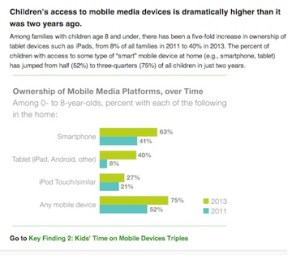
Common Sense Media has published a 2013 report on young children and their access and use of mobile media devices, Zero to Eight, Children’s Media Use in America 2013. The new research study aims to get a reading on how media use has changed since the organization completed and published its 2011 media and children study. Common Sense Media plans to redo this research biennially and publish the collected data.
The 2013 results are based on a nationally representative survey of parents with children under eight years of age. Researchers surveyed 1,463 parents utilizing the same methodology that was used in the 2011 survey and making sure that African-American and Latino representation was large enough to ensure statistically valid conclusions. To further ensure the reliability of the data, investigators provided devices and Internet access to survey participants when necessary.
Several of the Most Interesting 2013 Findings
The survey data indicate that almost twice as many children, eight years and younger now use mobile media when compared to the 2011 Common Sense Media results.
Television, DVD, and video game use on traditional screens is decreasing, but television still dominates.
Although access to mobile media for poor and underserved children has increased since the 2011 survey, a digital divide still exists.






 Media! Tech! Parenting!
You must be logged in to post a comment.