
Posted in digital citizenship, digital footprints, digital parenting, kids and privacy, privacy

Privacy Matters So Talk With Kids About It

Privacy spiral
Created with Festisite

After recent news reports about the National Security Agency (NSA) and its data collecting, we adults are thinking much more about the lack of privacy in our lives. We need to remember, however, that including children and adolescents in the conversation is important if they are to become competent and confident digital citizens.

With our online profiles, social media accounts, mobile devices, and files saved to the cloud, almost no one doubts that we have less privacy; however, what is an ideological or big discussion issue for adults is far more complicated and abstract for children. For most adults the sentinel issue — how much data collection intrudes on a family’s or individual’s personal life — is a primary focus. The issue for children, on the other hand, is that without a basic understanding of privacy concepts they lack the information and the skills that they need to recognize and avoid potential problems.

Many years ago my parents designated important topics for dinner table conversations — broad subjects that we recycled again and again as the four of us shared family meals. When one or the other parent said, “We should talk about that at dinner,” my brother and I knew it was something that Mom and Dad wanted us to take seriously.

Today children and adolescents need to experience this same type of dinner table conversation to help them learn about privacy and develop strategies for maintaining as much of it as possible.   Continue reading “Privacy Matters So Talk With Kids About It”
Posted in acceptable use, digital citizenship, parents and technology

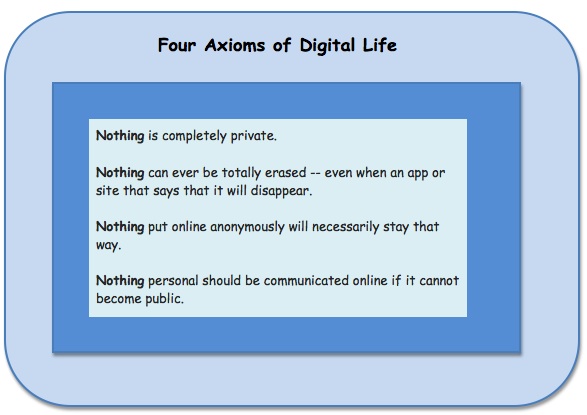
4 Axioms of Digital Life

four axioms

I keep thinking that grown-up politicians and celebrities will stop humiliating themselves when they use digital media.

But then another event occurs, and I am reminded that a good number of adults, just like many kids, have not absorbed four primary fundamentals or axioms of digital life.

  • Nothing is completely private.
  • Nothing can ever be totally erased — even when an app or site that says that it will disappear.
  • Nothing put online anonymously will necessarily stay that way.
  • Nothing personal should be communicated online if it cannot become public.

Continue reading “4 Axioms of Digital Life”

Posted in 21st Century parenting, 21st Century teaching, digital citizenship, digital kids, ethical behavior, teaching digital kids, values in digital life

Beauty Contests? What Will It Take for Us to Really Lead Our Digital Kids?

socialmediakidsIt is a truth universally acknowledged that whenever a new technology feature comes into vogue, children and adolescents come into possession of digital skills in want of copious adult tutelage.

Or at least this should be universally acknowledged.

Just now, in my part of the world, we are in the midst of an Instagram beauty contest phase. Interestingly, however, parents and educators who have spent the past 10 years connected in any way to the teen-tween digital world will recognize that, at a minimum, this is actually beauty contest 3.0.

I recall two other student beauty contest episodes, each occurring on a different digital playground. Initially, they appeared on make-your-own websites, then on MySpace. Now we have Instagram.

As I said the other morning to a concerned mom, behaviors get recycled each time a neat new whiz-bang digital opportunity emerges. Typical kid behavior gets paired with a powerful app, but mostly without the benefit of that adult tutelage referred to above. Also, kids love contests so it’s natural that the idea comes up.

Children are growing up in two worlds. Families and schools now have two childhood environments to supervise —  face-to-face and the digital — and kids are learning and playing in two places, irrevocably intertwined. School and home guidance acclimate children mostly to the face-to-face world, assuming that the lessons automatically carry over to digital endeavors. They don’t.

Continue reading “Beauty Contests? What Will It Take for Us to Really Lead Our Digital Kids?”

Posted in 21st Century Learning, digital citizenship, digital citizenship minute, digital learning, educating digital natives, parents and technology

5 Digital Citizenship Moments: Adult Conversational Digressions for Kids

You have just shared several websites and take a moment to comment to children about digital footprints. Or perhaps you sent an e-mail that you wish you had not sent and you mention that it’s not possible to get something back once it’s sent out electronically. Maybe you open a website of poor quality and point out one or two things that could be improved.

These are moments, each probably less than a minute of conversational digression, that reinforce the digital citizenship habits of children. These comments can be incorporated into any discussion or lesson.

Each time adults comment on digital citizenship issues in the context of daily lessons and classroom life, we model a kind of digital intelligence that students can emulate and embrace, whether they are working or playing.

When educators and parents make time for digital digressions, moments of digital citizenship addressing crucial issues, they informally incorporate  behavioral values that are a part of 21st Century connected learning. More importantly, these moments allow children to observe that just about every digital activity incorporates time-tested values such as careful evaluation, respect, collaboration, and inclusiveness.

Five Digital Citizenship Moments to Incorporate into Any Conversation

1. Pause for a moment whenever you use a web site, and explain one or two things that you like about it (or don’t like). Or explain just how you found the website.

Continue reading “5 Digital Citizenship Moments: Adult Conversational Digressions for Kids”

Posted in 21st Century Learning, digital citizenship, digital kids, digital learning, digital parenting, NAIS Conference Reports, parents and technology, social media, social media friends

Learning Lots More About Topics I Know Lots About: My NAIS 2013 Conference #1

You are in a good workshop when it’s on a topic that you know well, and you end up learning a whole lot more, and when you feel new knowledge pathways opening up, you say “Wow!”  That’s what happened to me on Friday morning at the 2013 National Association of Independent Schools (NAIS) annual conference, this year in Philadelphia.

I attended a workshop, “It’s Just Facebook: Ethical Questions in Social Media Use,” and discovered first-hand how much I can still learn about educating children, their parents, and educators when it comes to 21st Century digital citizenship and media literacy problem-solving. What’s  especially interesting to me since, just the day before, I presented a workshop with three of my NAIS colleagues on a similar topic.

Ethics institute
Check out the Ethics Institute teacher workshops.

In their “Ethical Questions” workshop, Kent Place School presenters Kimberly Coelho and Karen Rezach helped us compare moral with ethical dilemmas sharing case studies that are designed to help students examine and address the life challenges that pop up in their 21st Century learning and digital lives.

The two leaders, part of the Ethics Institute at Kent Place, walked us through the discussion process, emphasizing how they  include a range of different perspectives. Often right and wrong answers are not so clear because the dilemmas usually present competing values, so the problems are not examined or solved easily.

Continue reading “Learning Lots More About Topics I Know Lots About: My NAIS 2013 Conference #1”

Posted in 21st Century Learning, digital citizenship, digital learning, family conversations, parents and technology, privacy, teaching digital kids

Digital Footprints Video – Check it Out!

A well done and interesting presentation about digital footprints found at Harvard’s Berkman Center for Internet and Society website.

Good for middle school as well as older students. Parts of this video can be shared with fifth graders, but the whole video may a bit too scary for that age.

Parents, on the other hand, may consider this as an excellent resource for family conversations about digital life.

You might also enjoying reading my post, Digital Footprints, Changing What We Teach.

Posted in digital citizenship, digital learning, digital parenting, family conversations, kids changing lives, parents and technology

8 Wishes Connected Kids Have For Their Parents

With more than 30 years as a teacher including over 20 in the educational technology field, I’ve heard many kids reflect thoughtfully, and not so thoughtfully, on their parents’ digital skills. Kids often wonder why parents don’t always model the digital citizenship expectations that they want their children to learn and apply.

I wish my parents wouldHere are the eight most common “I Wish” statements that I’ve heard expressed by children over the last 16 or 17 years. Two of them, I can report, my daughter also mentioned to me ages ago.

Kids Wish Their Parents and Other Adults Would

  1. Try to learn a lot more about computers in particular and technology in general.
  2. Stop saying they don’t know much about technology (mom’s especially)
  3. Do not use Blackberries and phones at sports games and school events
  4. Learn to play some of the kids’ online games.
  5. Understand more about helping with searches on the Internet.
  6. Understand how hard it is to learn the technology rules and regulations and not always threaten to take away technology access when there’s a problem.
  7. Stop automatically saying that new things like Wikipedia are questionable.
  8. Don’t act dumb about technology – act like you want to learn new things.
To learn a bit more read 4 Lessons for Parents in a Constantly Connected World over at the Mashable site.

Continue reading “8 Wishes Connected Kids Have For Their Parents”