
Category: Back-to-school digital reading

3 Copyright Resources: Teaching Digital Kids to Respect Ownership
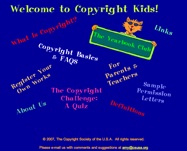
The other day I chatted with a parent about the concept of copyright. Both of us are concerned that digital kids understand very little about intellectual property. The free-for-all digital information climate ensures that children have considerable difficulty comprehending what belongs to whom.
Copyright laws are arcane, and even a bit crazy, but it’s critical to teach kids that protecting the intellectual property of others is important. With your child take the Copyright Challenge quiz at Copyright for Kids to see how much you know. When you finish the quiz check out these frequently asked questions about copyright.
Two Other Resources
Digital Reading: How Much Does Your Child Trust Search Links?
If you enjoy this post, check out my August 2010 post about using online databases, Staying Ahead With Online Resources, about online data.
The next time you watch your child begin a web search for a school project or other academic activity, take a few minutes to observe more closely how he or she selects web resources. In Trust Online: Young Adults’ Evaluation of Web Content (this abstract site leads to a free PDF of the article), professor Eszter Hargittai and colleagues form the Web Use Project at Northwestern University, describe how students tend to place huge amounts of trust in the initial hits retrieved by search engines such as Google and Yahoo.
With first year students in a required writing course at the University of Illinois Chicago (chosen because of its highly diverse student body) researchers conducted a written survey of 1060 students enrolled in the classes. Next researchers selected a stratified random sample of 192 students to observe in person as each student performed 12 specific web-based tasks. Learn more about a stratified random sample.
Interesting Observations
- To complete a web-based task, students usually went to a search engine.
- After search engines presented links, students tended to follow the first few links, apparently assuming that the first links in a search were reliable resources to pursue.
- When they looked at a list of provided links, some had difficulty knowing the difference between regular links and sponsored links.
- As they followed these links, students did not appear concerned about who authored the sites that they found (only 10 percent of the students commented about a site’s authors or the credentials presented).
- To complete tasks students relied on brand names, and corporate brands dominated.
- SparkNotes, an online version of Cliff Notes, dominated.
- For credible sources many students favored .gov and .edu sites as more credible sites.
- Many expressed trust in .org, because they are all not-for-profit sites, although these days just about anyone can get a .org web address.
- To verify information, less than half of the observed students consulted a second website.
Nine Back-to-School Technology Tasks

The beginning of a school year is a good time for families to set limits, explain rules, and in general, clarify expectations about technology use. Getting started in the fall, when everyone is off to a new grade and a fresh beginning, encourages healthy technology habits.
Depending on the age of your children, you may want to accomplish some or even all of the tasks on this list, encouraging everyone to think responsibly and become committed digital citizens.
Nine Back-to-School Technology Tasks
Teens and Hearing Loss
These days it seems like every person under 25 is walking around attached to earbuds. What are they listening to? Music on MP3 players — loud music. Over the years quite a bit of buzz has surfaced about teens and hearing loss. Moreover, pediatricians express ongoing concern and several past research projects (article links below) have identified the extent of hearing loss in adolescents.
 Now just published research (abstract) by a team from Massachusetts General Hospital and Brigham and Women’s Hospital reports that the problem is serious and getting worse. 19.5 percent of teens may have hearing difficulties according to the study which used data up to 2005-06.
According to the Time Magazine article, the researchers studied teens age 12 – 19, and used data “… collected by the government’s National Health and Nutrition Examination Survey (NHANES), conducted over a six-year period in the 1990s and a two-year period more recently.” Read the Wikipedia NHANES explanation.
Good Links to Read on the Current Research and Several Past Studies
Back-to-School Digital Reading Assignment, #3: Teen Cell Phones

For extra insight into the cell phone behavior of your preteen or teenager, take a few minutes to read these 2008 survey results from Harris Interactive, conducted with 2,098 teenagers in the United States. The survey was paid for by CTIA: The Wireless Association, an industry group. The results appear to be as timely today as they were two years ago. The Marketing Charts website depicts the results with emphasis points. Another cell phone and teen research survey, Teens, Cell Phones, and Texting, conducted more recently and published in April 2010 by the Pew Internet and American Life Project, an organization independent of industry interests.
The survey results make it clear to all of us — parents and teachers — that mobile phones and smart phones continue to be influential in the world of pre-adolescents and teens and will probably become even more so in the future. These mini-gadgets are permanently anchored in their social lives — and in ours.
A few data highlights from the Harris survey are below. Check the websites for the bigger picture.
Harris Interactive Survey Highlights Include
Continue reading “Back-to-School Digital Reading Assignment, #3: Teen Cell Phones”
Staying Ahead With Solid Digital Research
 September brings the start of a new school year, and once classes begin, it’s not long before the first research reports and projects are assigned. To get started, your child will head right to his or her computer; however, adult assistance can ensure that a student uses quality sources, thereby developing stronger research skills over the long run.
Just about any time digital children search for information at home, they fire up Google. While their teachers use substantial classroom time and energy introducing students to the best online research resources, children often need assistance applying the research lessons on their home computers. As often as possible adults should remind children that results from Google — as wonderful as Google searching is — provide a huge number of links, many of them of questionable quality.
A better way to search for information is to access library online resources and databases — the crown jewels of student research (Links at the bottom of this post will take readers to a few libraries that describe their virtual databases.) Searching in these databases decreases quantity and dramatically increases quality — which, in turn improves the caliber of a student’s assignment.
Continue reading “Staying Ahead With Solid Digital Research”
 Media! Tech! Parenting!
You must be logged in to post a comment.