Posted in acceptable use, Back-to-school digital reading, copyright, digital devices and gadgets, Evaluating Web Resources

3 Copyright Resources: Teaching Digital Kids to Respect Ownership

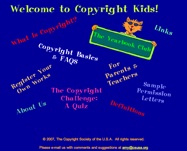
Visit Copyright for Kids!

The other day I chatted with a parent about the concept of copyright. Both of us are concerned that digital kids understand very little about intellectual property. The free-for-all digital information climate ensures that children have considerable difficulty comprehending what belongs to whom.

Copyright laws are arcane, and even a bit crazy, but it’s critical to teach kids that protecting the intellectual property of others is important. With your child take the Copyright Challenge quiz at Copyright for Kids to see how much you know. When you finish the quiz check out these frequently asked questions about copyright.

Two Other Resources

Posted in acceptable use, digital citizenship, digital parenting, leaving comments online, online education, parents and technology

If Every Family Had a Blog…

How would digital literacy and behavior improve if more families saw blogging as a way to communicate, connect with extended family members, and teach their children the basics about global communication? Would they be thrilled that their children had a big head start developing digital citizenship skills? Would they be delighted at all of the writing taking place and take pride as they watched children develop stronger writing skills?

Blogging is safe and easily managed. While we’ve all heard the scary stories, such as people going online and writing mean comments or nasty rumors that go public or even viral — in truth just about all blogging is safe and fun. Blogging teaches people to write, revise, write more, and publish for a community of readers.

Imagine, for a moment, if a family with two children, age five and seven, along with a bunch of relatives, starts a blog.

  • Family members, including grandparents, aunts, uncles, and cousins write, post, and comment. Parents are editors and managers, at least at the beginning, modeling and demonstrating how to use technology (social media) appropriately. Gradually family members share responsibilities.
    Continue reading “If Every Family Had a Blog…”
Posted in acceptable use, American Academy of Pediatrics, digital citizenship, digital parenting, parent education, parents and technology, social media, social networking

Pediatricians, Parents, and Digital Kids, Part I

AAP Media History Form

This morning I was thrilled to read the newest American Academy of Pediatrics (AAP) policy focusing on social media and children. The Impact of Social Media on Children, Adolescents and Families, written by a group of pediatricians and led by Gwenn Schurgin O’Keeffe (also the author of CyberSafe: Protecting and Empowering Digital Kids in the World of Texting, Gaming and Social Media), provides a set of social media guidelines for physicians to use with teen and tween patients as well as with parents. Published in March 28, 2011 edition of the journal Pediatrics, the social media statement describes the benefits and risks of the digital world, avoids judgmental comments, and suggests strategies that can make is safer for children.

Continue reading “Pediatricians, Parents, and Digital Kids, Part I”

Posted in acceptable use, cultural changes, digital parenting, family conversations, parents and technology

5 Ways Parents Can Get a Grip on Social Media

Wringing your hands over social media? Don’t.

Instead, use your energy to learn as much as you can. A parent’s goal is to develop enough knowledge to provide guidance and supervision based on significant family values, even as these media continue to evolve. Continued learning is always required if one aims to help children avoid potential pitfalls.

Thinking that social media will eventually disappear wastes time and energy.

Five Tips to Help You Get Going

Check out more web 2.0 tools!

1. Ask your child on a regular basis — and definitely without belittling yourself — to help you learn a new technology skill. Start with some of the easier web 2.0 interactive sites such as Wordle to make cool word designs or Diigo to save your bookmarks in a place accessible from anywhere. Keep learning.

2. Accept that social networking is not a fad and that life is not the way it used to be when you were young. Any doubt? Watch this video on the social media revolution.

Continue reading “5 Ways Parents Can Get a Grip on Social Media”

Posted in acceptable use, cultural changes, digital parenting, family conversations, parent child conversations, parents and technology, social media, social networking

Grandma/Grandkids Use Facebook: Do You?

Join Facebook?  For three years I avoided the site. I knew that some of my friends from work, church, and other activities were joining, and of course the kids at school were all over it, but I just did not feel like it was a fit. Way too different, I thought. My daughter, then in graduate school, used the social networking site, and she occasionally suggested I get started with Facebook (she spoke these words in bold). Still I refrained.

At some point, however, I became aware that my mother and my twenty-something daughter were communicating with each other more than usual. They knew things about each other that I did not know. Finally my daughter mentioned that her grandmother  — my mother — was on Facebook and that the two of them had “friended’ one another. That’s when I called Mom, at that time age 81. She explained that her fellow workers from the Obama campaign, exceptional young people she called them, had arranged virtual reunions on Facebook. They wanted her to participate and helped her get started.

So, like many of today’s parents, I found that I was in the middle, but basically out of the generational communication loop. By the time I tuned in, my mother had over 100 friends, all people she knew in one way or another (no strangers and privacy settings in place, she reassured me), and quite a few in her age-range. I signed up for Facebook.

Continue reading “Grandma/Grandkids Use Facebook: Do You?”

Posted in acceptable use, cyber-bullying, digital citizenship, digital parenting, family conversations, parents and technology

Trend Micro’s Family Internet Safety and Citizenship Site

Trend Micro, a web security firm, devotes a part of the company’s website to Internet Safety for Families and Kids. The section is well-organized and topical so a visitor can quickly scan a list of subjects to find tips, links to organizations that support digital citizenship, and an internet safety and citizenship resources library that includes a wide range of documents available downloading and sharing. Topics include Safety Tips for Social Networking, three short videos on social networking, and A Safety Guide for Web Threats. These and other documents can be used as handouts for parent organizations and discussion groups, or  just shared during those parent-child conversations that are so necessary in today’s digital world.

Continue reading “Trend Micro’s Family Internet Safety and Citizenship Site”

Posted in acceptable use, digital citizenship, digital photography, parent child conversations, parents and technology, writing for the web

Conversations About Commenting

If you have ever written a comment at the end of an article or blog posting, you have surely read more than a few inappropriate and sometimes distasteful remarks. Sometimes people leave these comments anonymously. Posted by folks who do not understand why websites invite visitors to share thoughts and ideas, many unfiltered remarks are permanently attached to websites — indiscretions waiting for the whole world to discover.

Read a short post and watch a video on newspaper comments, uploaded by the Nieman Journalism Lab at Harvard. Some newspapers sites, such as the Boston Globe, post a short and succinct comment policy.

Helping your child avoid public website blunders is one reason to discuss commenting etiquette. Often children don’t know or forget that their comments leave a digital footprint trail that will last much longer than their per-adolescent and even teenage years.  Often confusion arises because many children first encounter commenting opportunities in places where adult supervision is scarce. As a result an impulsive idea can beat out good common sense even when a child knows better. Bottom line — response and commenting areas are not places to leave nasty, rude, and hateful conversation.

Continue reading “Conversations About Commenting”